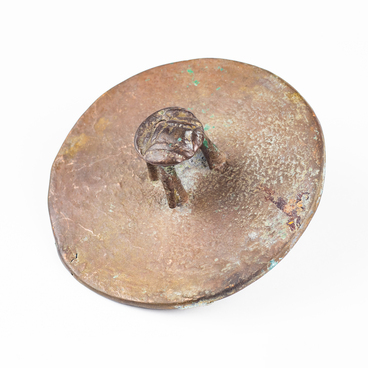
An openwork sewn-on plaque in the form of a deer figure was made of bronze. On its reverse side, the craftsman attached a loop. Scientists have dated the object to the period from the 4th to the 3rd century BCE. The artifact was found in a burial ground near the village of Letnik in the city of Sayanogorsk, on the left bank of the Yenisei.
Rescue archaeological work was carried out by the Beya Archaeological expedition of the Leningrad Branch of the Institute of Archaeology from 1990 to 1991. The head of the group was the Soviet and Russian archaeologist Margarita Nikolaevna Pshenitsyna.
Images of animals were at the heart of complex myths about the origin of humans and the universe. The animal style prevailed in the art of the Scythian era. It was characterized by images of animals in a certain position depicted using special techniques. This style was extremely widespread from Central Europe to Manchuria and China, mainly in steppe and mountainous areas.
Each region of the Scythian world was distinguished by its unique features in the animal style art. There were such objects in the Tagar archaeological culture, which covered the Minusinsk basin in the Krasnoyarsk Territory and the Republic of Khakassia. The Tagar animal style was characterized by images of herbivorous animals. Images of deer have become especially widespread. Of all the regions of the Scythian world, the Tagar culture probably created the largest number of images of these animals in metal.
Bronze deer began to appear there at the end of the Podgornov stage (7th–5th centuries BCE). Deer images were created throughout the Saragashen stage. The Tagars carved deer shapes on numerous petroglyphs, that is, inscriptions and drawings on stones. They also sewed them on clothes and decorated mirrors, knives, daggers and other objects with them.
The Tagars achieved
perfection for their time in bronze processing technology. Their products were
of high quality. Deer plaques were cast in bronze and sometimes covered with gold
foil. This was done for religious reasons. Researchers believe that deer
symbolized the solar deity of the Tagars and were a solar symbol. A bronze
relief plaque from the museum’s collection depicts a deer with an elongated
neck, unrealistically branched horns and legs bent under its belly. This pose
is defined by scholars as a sacrificial connection with the solar cult.