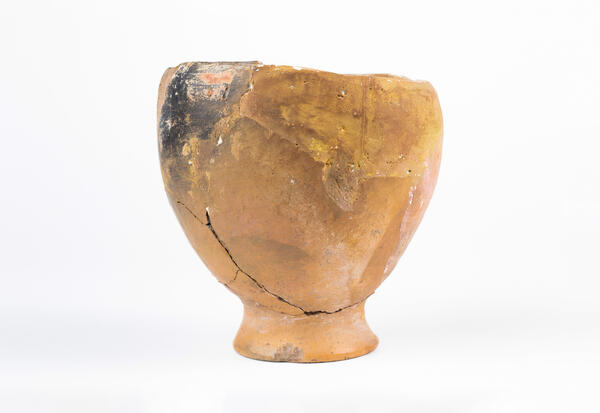
The cup-shaped miniature vessel on a low pallet was made of light clay. Under the foot, the craftsman added six teardrop-shaped impressions. This artifact has been dated to the period from the 4th to the 3rd century BCE. The vessel was included in the burial equipment of Tagar burial mounds, which were examined in 2004–2007. The burial ground was discovered in the construction area of the Sayanogorsk Aluminum Smelter.
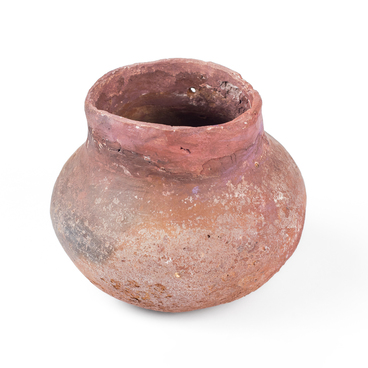
The rescue archaeological work was carried out by the Beya Archaeological Expedition of the Institute of the History of Material Culture of the Russian Academy of Sciences. The work was headed by the Russian archaeologist, Candidate of Historical Sciences Margarita Nikolaevna Pshenitsyna. Scholars have found out that in the Tagar era, there were various forms of vessels. Among them were open cups on foot, rounded flat-bottomed vessels with a narrow low neck, closed rounded vessels with a low neck on low circular foot, jar-type vessels with a narrowing at the bottom, as well as round-bottomed low bowls.
Cups and rounded flat-bottomed vessels, as well as jar ceramics, were usually made in black or gray. Other not jar-like vessels were most often pinkish or reddish in color. Vessels of various shapes and sizes were used for storing and cooking dairy and meat food, and during rituals.
The decorative patterns of the Tagar ceramics of the Minusinsk Basin was rather poor. Earlier Tagar archaeological culture was characterized by the decoration in the form of one or more wide horizontal grooves in the upper part of the vessel. They were made with a finger or a stick. Occasionally, the decor was complemented by grooves located below, as well as groups of teardrop-shaped recesses that formed a triangle. Notches were also created, which made up a horizontal zigzag.
In the areas adjacent to
the forests, other types of decoration prevailed. Archaeologists have
encountered “pearls, ” sometimes separated by round or teardrop-shaped recesses,
and rows of impressions of a comb stamp. A significant part of the ceramics of
the Tagar archaeological culture was devoid of any decorative patterns in
general.