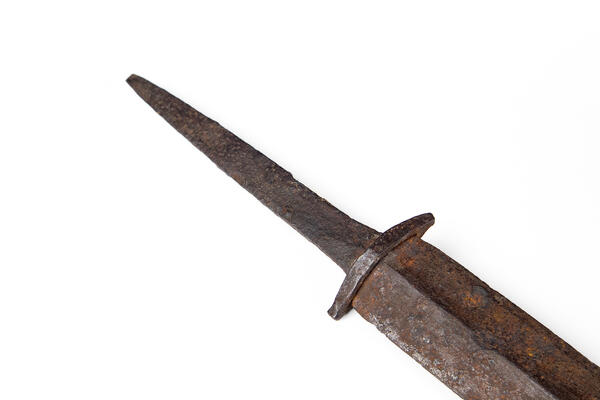
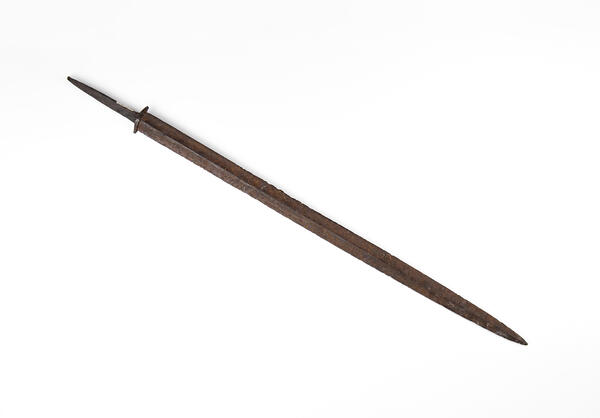
The double-bladed sword is solid-forged with double-sided sharpening along the entire length of the narrow blade. Researchers have managed to date this artifact to the period from the 6th to the 8th century. The sword was discovered in 2001 under accidental circumstances on the slope of a country village in the territory southwest of the city of Sayanogorsk.
Alexander Nikolaevich Baranov, who donated the sword to the museum, said that it was in the ground at a shallow depth. The weight of the sword is 655 grams. Even without the handle, it is well balanced. The length of the sword from the tip of the blade to the end of the shank is 91 centimeters, the blade is 75 centimeters long. The width of the blade at the cross-guard is 3 centimeters. For this sword, the craftsman made a wedge-shaped shank. The blacksmith created a straight cross-guard and placed it on the shoulders of the blade by forge welding.
There are no holes for fixing the handle on the shank, but its end is bent. This suggested that the craftsman used organic material (wood or bone) to create the handle with a through hole. By bending, the handle was rigidly attached to the shank. The end of the handle could have an extension, which provided a reliable palm grip when performing a chopping blow. Such a cross-guard was a poor protection for the hand.
On the territory of the Upper and Middle Yenisei, Soviet and Russian archaeologists have identified more than 30 locations of long-bladed weapons. Notably, all the finds were weapons of the Tyukhtyat and Askiz cultures of the Yenisey Kyrgyz of the 9th–14th centuries. The general morphology of the sword from the vicinity of Sayanogorsk reveals that it dates back to the swords of the Migration Period and the early Middle Ages.
Analogues of these
weapons are presented in the collections of chance finds of the local history
museums of Minusinsk and Abakan. Scholars attributed the Sayanogorsk sword to
the ancient Turkic period in the history of Sayano-Altai. Researcher Oleg Andreevich
Mitko noted that swords of the Sayanogorsk type with a narrow diamond-shaped
blade and a small straight cross-guard could serve as weapons up to the 9th
century.