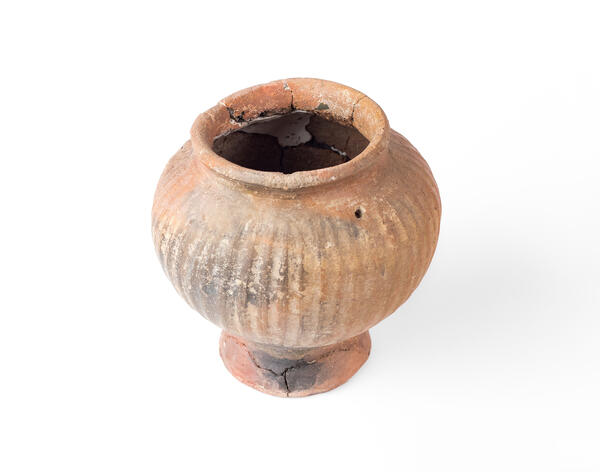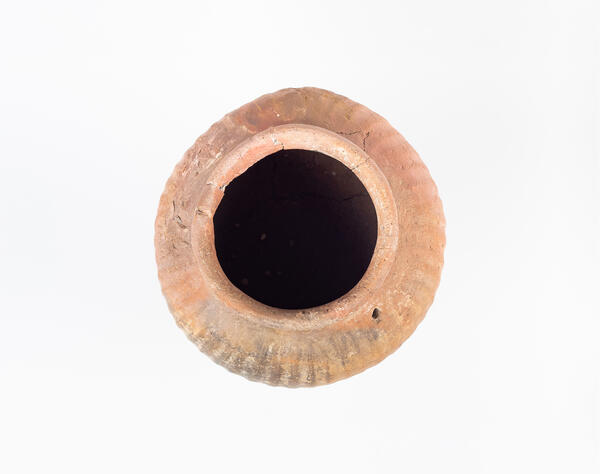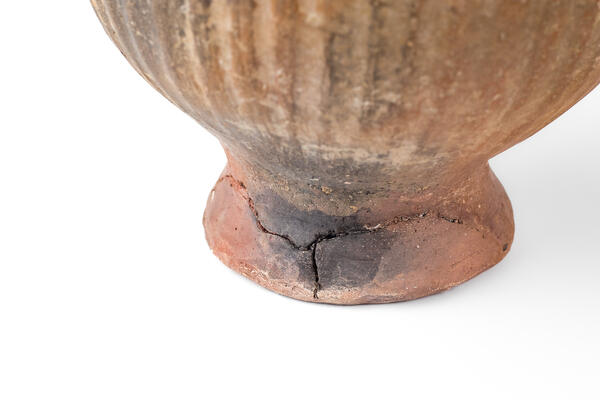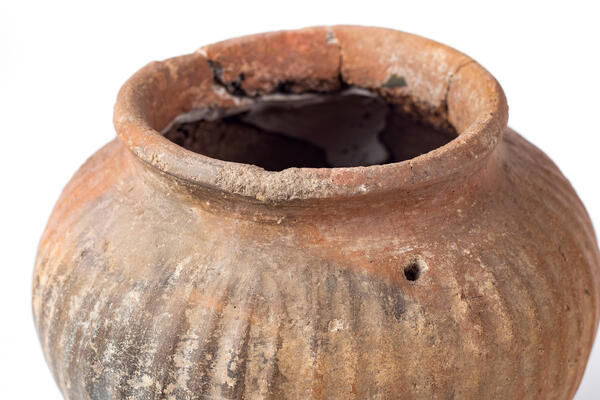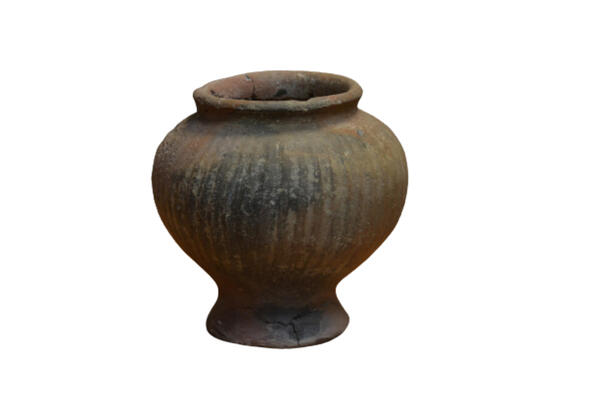
This small vessel was made of light clay of a reddish hue. The vessel has a bent rim and a rounded fluted body. It is decorated with vertical grooves, and also has a foot. The object was discovered in 2007 during the rescue excavations of the burial ground of the Podgornovsky stage of Tagar culture in the village of Beya of the Republic of Khakassia, on the plot of the Paikov family.
The archaeological research was carried out by the Beya expedition of the Institute of the History of Material Culture of the Russian Academy of Sciences. The vessel was a part of the burial equipment of mound 1, grave 2. Most of the earthen mounds in Khakassia, in the southern part of the Krasnoyarsk Territory and in neighboring territories were attributed to the Tagar archaeological culture of the Bronze and Iron Age.
The culture developed in the period from the 8th to the 3rd century BCE. It got its name in honor of Tagar Island on the Yenisei near the city of Minusinsk, Krasnoyarsk Territory. It was there that a large burial mound was excavated, which was identified as the main monument of this culture.
The Bain stage of the Tagar culture (8th–6th centuries BCE), characterized by the prevalence of jar pots with a flattened bottom — the only difference from the previous form of such pottery. This form of pots then prevailed throughout the entire period of the development of Tagar culture. Over time, only the decoration changed, and some peculiar shapes of vessels for various purposes appeared.
The pottery of the Podgornov stage (6th–5th centuries BCE) retained its former shape, however, the rim of the vessels acquired a characteristic thickening along the bevel and a sharp edge below. Besides, the objects began to be decorated with groove patterns. This type of vessel was most widespread in the steppes of the Khakass-Minusinsk Basin, but not throughout.
There were few types of
Tagar ceramic decorative patterns. A group of teardrop-shaped recesses making
up a triangle, as well as notches forming a horizontal zigzag were used as
decoration. There was a decorative pattern of “pearls”. Most of the ceramic
products of the Tagar culture did not bear any decoration.