Font
Color
Graphics
Изображение точки

To see AR mode in action:

1. Install ARTEFACT app for iOS or Android;

2. Find the exhibition «From Century to Century»

3. Push the «Augmented reality» button and point your phone's camera at the exhibit;

Скрыть точки интересаПоказать точки интереса
Показать в высоком качестве

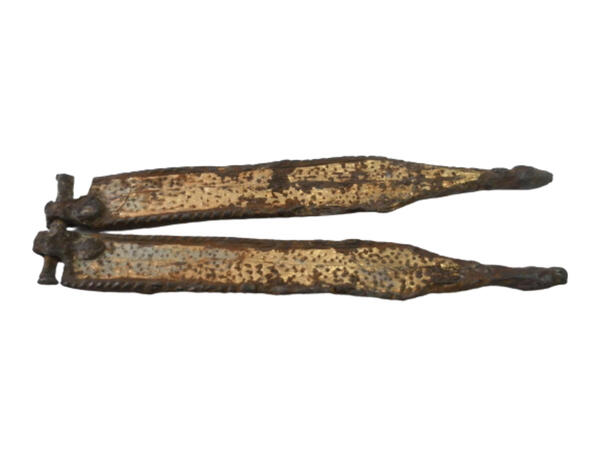
Hinged belt pendant

Creation period
12th–13th century
Place of сreation
the territory of the Middle Yenisei
Dimensions
10,8x1,2 cm
Technique
iron, foil; forging, taushing, applique
5
Open in app
#5

The hinged belt pendant from the museum’s collection is a decoration of a horse harness. A craftsman of the 12th–13th centuries made it from iron. It consists of two rectangular plates with a W-shaped end, as well as ribbed borders along the edges. The tips of the plates were made in a teardrop shape, their upper part is straight.

The craftsman decorated the front side with artistic metalworking. He performed taushing, creating teardrop-shaped notches (burrs) over the entire surface area, and made an appliqué with a thin yellow foil. In addition, the creator of the decorative item made a pin used to attach these plates with a hinge-shaped top. The craftsman attached the hinges to the plates with rivets: one on each.

The state of the Yenisei Kyrgyz — the ancient Khakass state, or, as it is also called, the Kyrgyz Khaganate — arose around the 6th century CE. By the middle of the 9th century, it occupied a huge territory for that time: from the Orkhon River in the east to the Altai in the west; in the north the border ran along the Angara River, in the south it reached the Sayan. It was a state of fortified cities and highly developed culture.

The period from the 6th to the beginning of the 9th century is characterized by scholars as the epoch of the formation of the Yenisei Kyrgyz culture. In the second half of the 1970s, the Soviet archaeologist and orientalist Leonid Romanovich Kyzlasov proposed to distinguish three independent cultures on the basis of the Kyrgyz antiquities, which followed one another: Chaatas in the 5th–9th centuries, Tyukhtyat in the 9th–10th centuries, and Askiz in the 10th–14th centuries.

During the period of the Askiz culture, surface taushing became the main technique. It was an ancient inlay technique based on using different notches which were filled with metal of a different color. A future drawing was applied to the surface of the product and its notch was made. Taushing on objects of the pre-Mongol period was used to cover a small part of the object, while in the Askiz culture — mainly to cover wide surfaces. Background preparation was carried out by a dotted notch on the surface with criss-cross linear grooves, and small areas were covered with teardrop-shaped burrs.

#6
View in the State Catalogue
read morehide
00:00
00:00
1x

Hinged belt pendant

Creation period
12th–13th century
Place of сreation
the territory of the Middle Yenisei
Dimensions
10,8x1,2 cm
Technique
iron, foil; forging, taushing, applique
5
Point your smartphone camera to open in the app
Share
VkontakteOdnoklassnikiTelegram
Share on my website
Copy linkCopied
Copy
Open in app
To see AR mode in action:
  1. Install ARTEFACT app for 
  2. iOS or Android;
  3. Find and download the «Paintings in Details» exhibition
  4. Push the «Augmented reality» button and point your phone's camera at the painting;
  5. Watch what happens on your phone screen whilst you flip through the pictures.
 
We use Cookies
Cookies on the Artefact Website. We use cookies to ensure that we give you the best experience on our website. If you continue without changing your settings, we'll assume that you are happy to receive all cookies on the Artefact website. However, if you would like to, you can change your cookie settings at any time.
Learn more about useHide
Content is available only in Russian

X

Нашли опечатку?...

%title%%type%