

An elbow-shaped knife with an unusual design was found during the excavations of the Chekist settlement on the bank of the Bolshaya Kirgizka River, near the place, where it joins the Tom River. The artifact belongs to the Irmen archaeological culture and dates back to the first centuries of the first millennium BC — the period of the Late Bronze Age.
Bronze elbow-shaped knives were an important part of the Karasuk archaeological culture. They were mainly produced on the territory of the modern Minusinsk basin. The fashion for Karasuk tools and jewelry spread both to the East (up to China) and to the West — to the territory of the Ob region near Tomsk and Novosibirsk.
The researchers classified the artifact found in the settlement as a composite single-edged elbow-shaped knife. In archeology, elbow-shaped knives are products with the blade located at an obtuse angle to the handle.
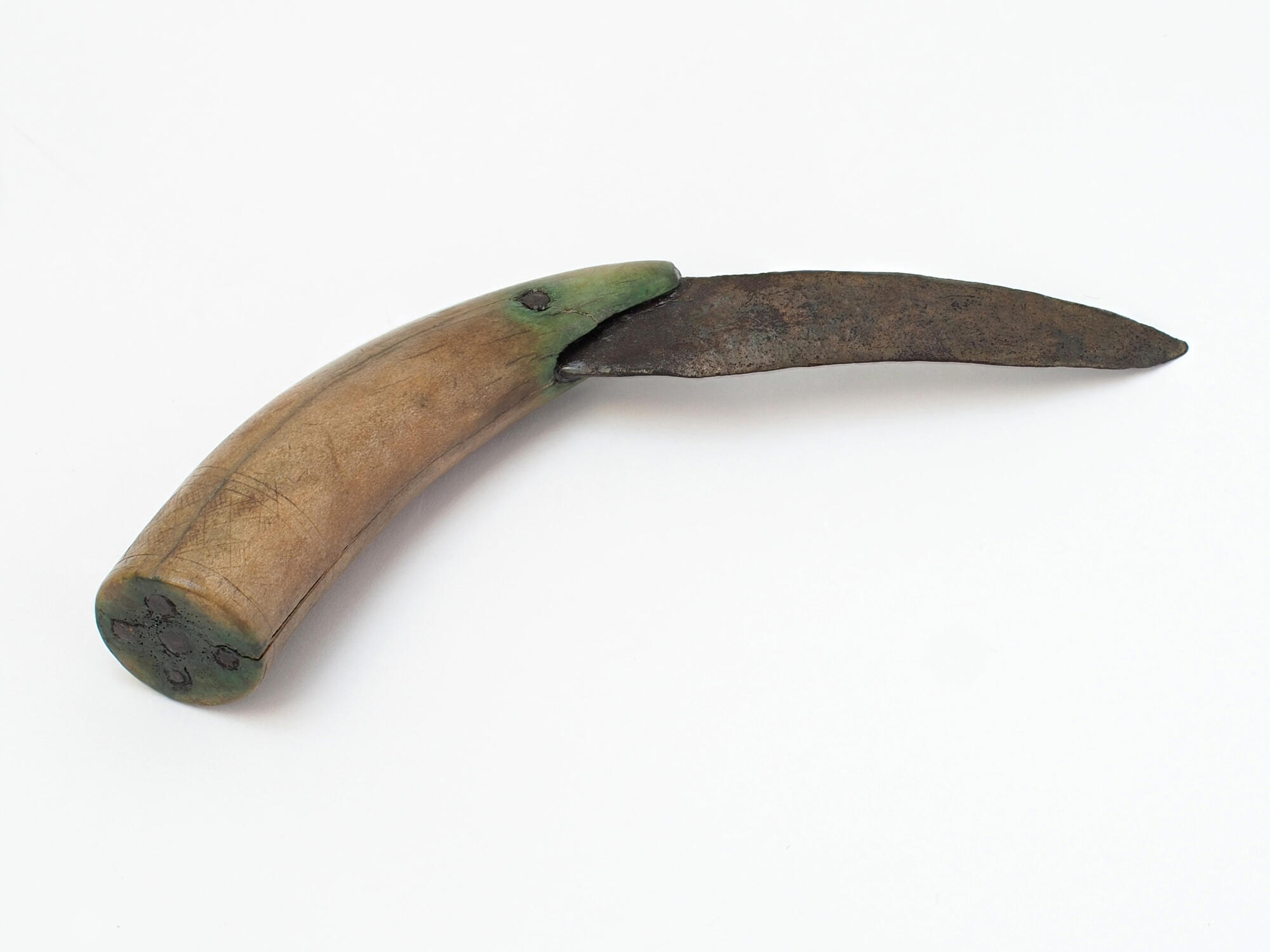
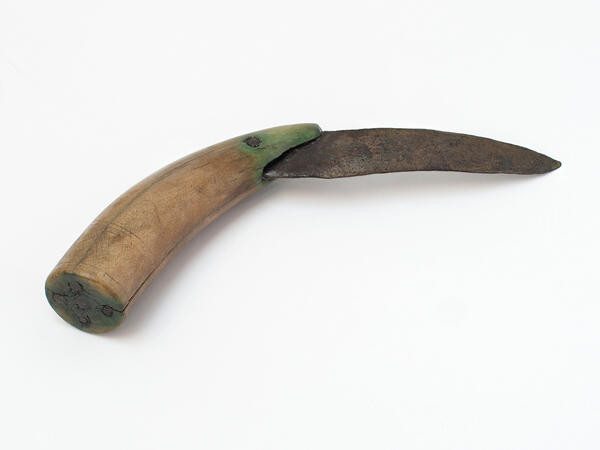
The thin blade is made of bronze and is firmly fixed in a special hole, which the master carefully made in the handle. The slightly curved handle is made of a horn and is carefully polished to a shine. The precisely cut end part (the back of the handle) is decorated with four rivets. They did not have any practical function and only served as an additional decoration: their position resembles the image of a cross. The craftsman decorated the handle surface with engraved lines — they form geometric pattern in the form of a grid of diamonds.
Such knives were considered prestigious and had a high value. Researchers suggested that this knife was brought as a sacrificial gift during a funeral or memorial ceremony.
There are all-metal and composite tools. The latter have a handle made of organic material (for example, bones or horns) and it was necessarily combined with a metal blade. All-metal knives were made entirely of metal.
The cultural layer of the Chekist settlement has a special soil, where organic materials have been preserved intact since ancient times. Thanks to this, the knife from the banks of the Bolshaya Kirgizka River has completely preserved its original appearance. It is considered as a reference copy, so it can be used to study how ancient people created such products.
Bronze elbow-shaped knives were an important part of the Karasuk archaeological culture. They were mainly produced on the territory of the modern Minusinsk basin. The fashion for Karasuk tools and jewelry spread both to the East (up to China) and to the West — to the territory of the Ob region near Tomsk and Novosibirsk.
The researchers classified the artifact found in the settlement as a composite single-edged elbow-shaped knife. In archeology, elbow-shaped knives are products with the blade located at an obtuse angle to the handle.
The thin blade is made of bronze and is firmly fixed in a special hole, which the master carefully made in the handle. The slightly curved handle is made of a horn and is carefully polished to a shine. The precisely cut end part (the back of the handle) is decorated with four rivets. They did not have any practical function and only served as an additional decoration: their position resembles the image of a cross. The craftsman decorated the handle surface with engraved lines — they form geometric pattern in the form of a grid of diamonds.
Such knives were considered prestigious and had a high value. Researchers suggested that this knife was brought as a sacrificial gift during a funeral or memorial ceremony.
There are all-metal and composite tools. The latter have a handle made of organic material (for example, bones or horns) and it was necessarily combined with a metal blade. All-metal knives were made entirely of metal.
The cultural layer of the Chekist settlement has a special soil, where organic materials have been preserved intact since ancient times. Thanks to this, the knife from the banks of the Bolshaya Kirgizka River has completely preserved its original appearance. It is considered as a reference copy, so it can be used to study how ancient people created such products.