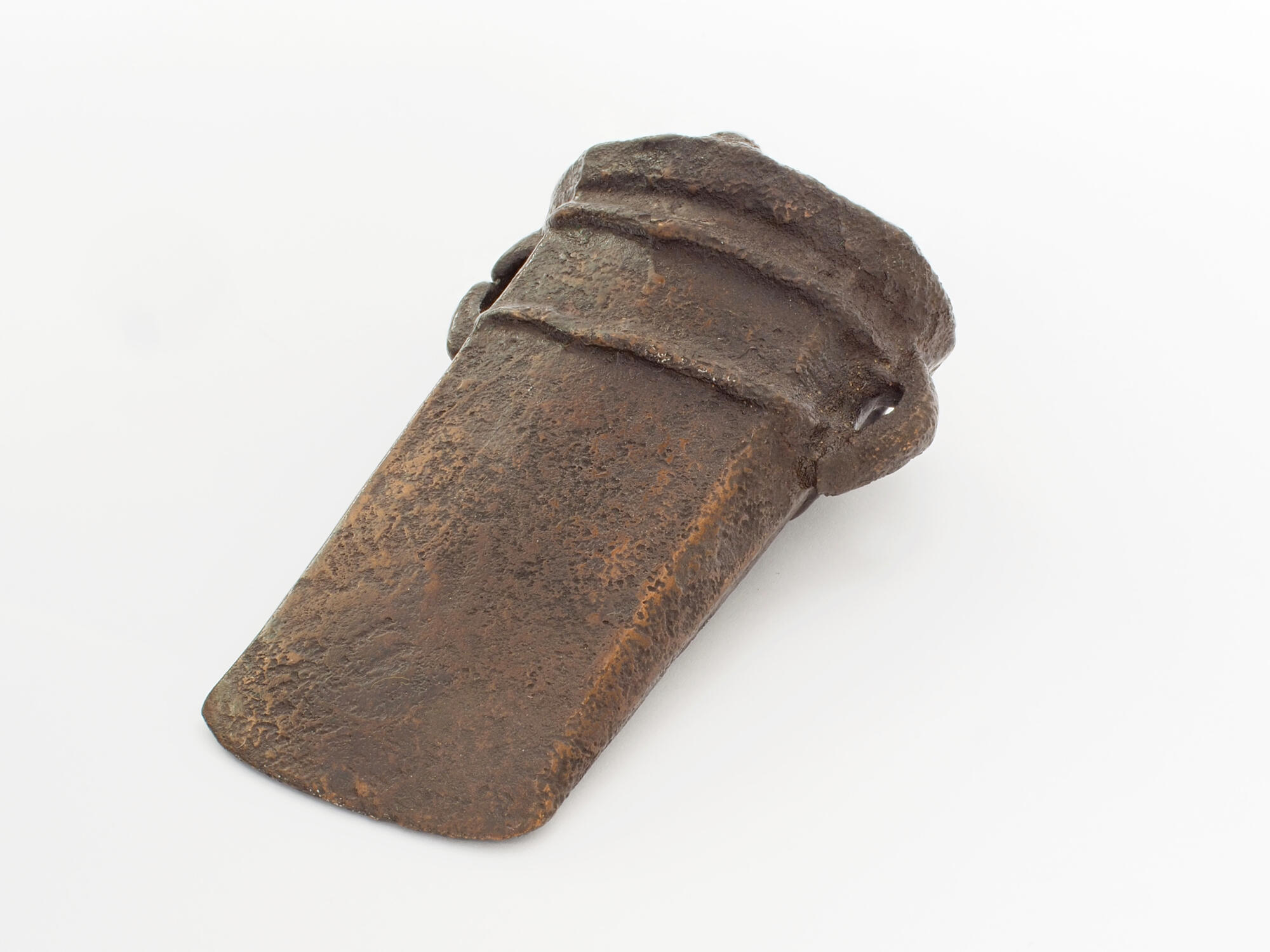


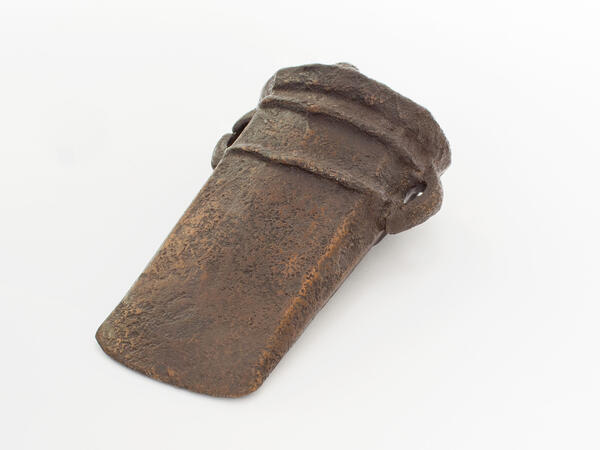
A bronze celt was found during excavations of the Chekist settlement, which was located on the banks of the Bolshaya Kirgizka River, not far from the place of its confluence with the Tom. The Irmen tribe lived on this territory; therefore, the finding is attributed to the Irmen archaeological culture. It dates back to the first centuries of the 1st millennium BC — the late Bronze Age. The expedition was organized by the Seversk Museum and led by the historian and archaeologist Evgeny Vasiliev.
Archaeologists use the term ‘celt’ to describe a chopping tool that has a special hole in the blunt side. It was possible to insert a straight or curved handle into it. If the handle was straight, the celt was used as a shovel, and if it was curved, as an ax. If necessary, it was used not only as a tool, but also as a military weapon.
The body of the celt has a hexagonal shape, which tapers downward. With the help of eyelets and rollers, the ax was attached to a wooden handle. Fragments of a leather strap have been preserved on it since the Bronze Age.
Compared to other similar goods, the celt from the Bolshaya Kirghizka is larger and heavier. Researchers believe that it was made by local craftsmen. They used arsenic bronze, an artificial alloy of copper and arsenic. At that time, it was delivered from afar, presumably from Rudny Altai. Therefore, such weapons were considered valuable and sought after.
The Bronze Age came to Western Siberia rather late: in the 2nd millennium BC. In Anatolia and the Caucasus, the earliest arsenic bronze items appeared at the turn of the 4th–3rd millennia BC.
But one of the most advanced methods of metalworking was born in Siberia (including the Altai foothills) on the eastern outskirts of the Eurasian Metallurgical Province. The Eurasian Metallurgical Province covered vast territories of Europe and Asia, except for the northeastern edge of Asia. According to this technique, thin-walled tools were cast here in stone or ceramic bivalve molds. A special core was used to make the bushing in the tool immediately. This technique helped to save expensive metal and provided more durable fastening of the thing to the shafts and handles.
Archaeologists use the term ‘celt’ to describe a chopping tool that has a special hole in the blunt side. It was possible to insert a straight or curved handle into it. If the handle was straight, the celt was used as a shovel, and if it was curved, as an ax. If necessary, it was used not only as a tool, but also as a military weapon.
The body of the celt has a hexagonal shape, which tapers downward. With the help of eyelets and rollers, the ax was attached to a wooden handle. Fragments of a leather strap have been preserved on it since the Bronze Age.
Compared to other similar goods, the celt from the Bolshaya Kirghizka is larger and heavier. Researchers believe that it was made by local craftsmen. They used arsenic bronze, an artificial alloy of copper and arsenic. At that time, it was delivered from afar, presumably from Rudny Altai. Therefore, such weapons were considered valuable and sought after.
The Bronze Age came to Western Siberia rather late: in the 2nd millennium BC. In Anatolia and the Caucasus, the earliest arsenic bronze items appeared at the turn of the 4th–3rd millennia BC.
But one of the most advanced methods of metalworking was born in Siberia (including the Altai foothills) on the eastern outskirts of the Eurasian Metallurgical Province. The Eurasian Metallurgical Province covered vast territories of Europe and Asia, except for the northeastern edge of Asia. According to this technique, thin-walled tools were cast here in stone or ceramic bivalve molds. A special core was used to make the bushing in the tool immediately. This technique helped to save expensive metal and provided more durable fastening of the thing to the shafts and handles.