Lev Shaboldin, a distinctive painter from Nizhny Novgorod, graduated from the Gorky School of Arts in 1962. He almost immediately became a permanent participant in city, regional and metropolitan exhibitions, and, in 1978, it ensured him the membership in the Union of Artists of the USSR. His paintings are kept in the collections of many Russian museums, and the lyrical still life ‘Lilacs’ belongs to the collection of the Varnavino Museum of History and Art.
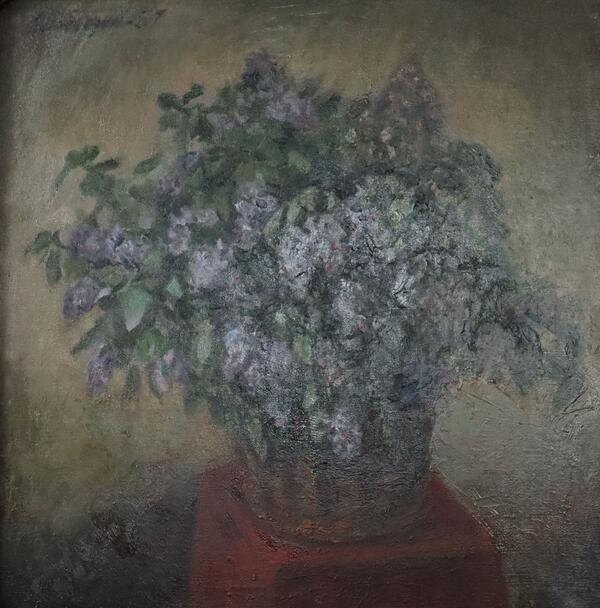
This oil painting made in 1987 depicts a lush bouquet of lilacs standing on a table covered with a red cloth. Thanks to his light-handed use of delicate colorful tones, as well as to a precise choice of pictorial forms, we can almost smell the fresh scent of lilacs. In this painting, the painter captured the eternal reminder of the exciting spring awakening of the nature, a symbol of which became a bouquet of lilacs. He also created a spectacular color contrast between the bouquet, the table and slightly gloomy brownish, faded colors of the background.
In a sense, the Varnavino Museum possesses a highly unusual work of Shaboldin, because in recent years he was primarily associated with the watercolor landscapes of Nizhny Novgorod. Like any painter, he had his favorite plots for paintings, including the secluded places of the old city, and wide panoramic views of the mighty banks of the great Russian River Volga.
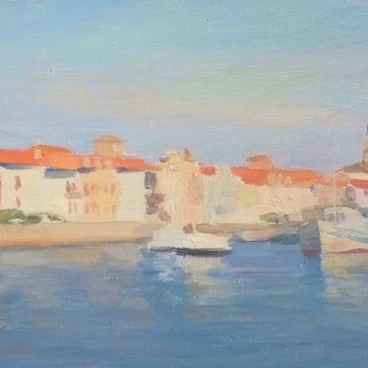
Shaboldin cultivated a special feeling of the rhythms of his native city in his works. From the numerous views of the spit, which is the confluence of the Volga and the Oka, one can literally study the changes in the architectural appearance of one of the main attractions of Nizhny Novgorod. In the lyrical landscapes showing the industrial Chernigovskaya Street, where the painter’s studio was located in the last years of his life, he captured all the seasons and their slightest nuances and shadings.
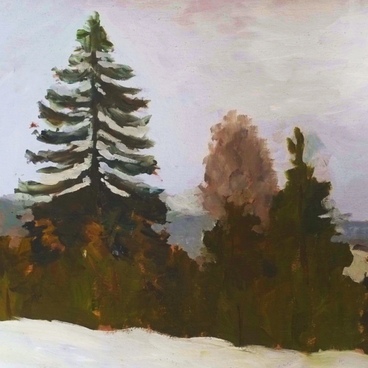
It is interesting that in 1960, while studying at the Gorky School of Arts, Shaboldin worked on interior paintings and portraits. As early as then, though, he already showed interest in the landscape genre: he created several landscapes permeated by complex emotions. However, even then, a clear sense of tone and unusual feeling of space through the use of color spots predicted Shaboldin’s great artistic future.
This oil painting made in 1987 depicts a lush bouquet of lilacs standing on a table covered with a red cloth. Thanks to his light-handed use of delicate colorful tones, as well as to a precise choice of pictorial forms, we can almost smell the fresh scent of lilacs. In this painting, the painter captured the eternal reminder of the exciting spring awakening of the nature, a symbol of which became a bouquet of lilacs. He also created a spectacular color contrast between the bouquet, the table and slightly gloomy brownish, faded colors of the background.
In a sense, the Varnavino Museum possesses a highly unusual work of Shaboldin, because in recent years he was primarily associated with the watercolor landscapes of Nizhny Novgorod. Like any painter, he had his favorite plots for paintings, including the secluded places of the old city, and wide panoramic views of the mighty banks of the great Russian River Volga.
Shaboldin cultivated a special feeling of the rhythms of his native city in his works. From the numerous views of the spit, which is the confluence of the Volga and the Oka, one can literally study the changes in the architectural appearance of one of the main attractions of Nizhny Novgorod. In the lyrical landscapes showing the industrial Chernigovskaya Street, where the painter’s studio was located in the last years of his life, he captured all the seasons and their slightest nuances and shadings.
It is interesting that in 1960, while studying at the Gorky School of Arts, Shaboldin worked on interior paintings and portraits. As early as then, though, he already showed interest in the landscape genre: he created several landscapes permeated by complex emotions. However, even then, a clear sense of tone and unusual feeling of space through the use of color spots predicted Shaboldin’s great artistic future.