Font
Color
Graphics
Изображение точки

To see AR mode in action:

1. Install ARTEFACT app for iOS or Android;

2. Find the exhibition «From Century to Century»

3. Push the «Augmented reality» button and point your phone's camera at the exhibit;

Скрыть точки интересаПоказать точки интереса
Показать в высоком качестве

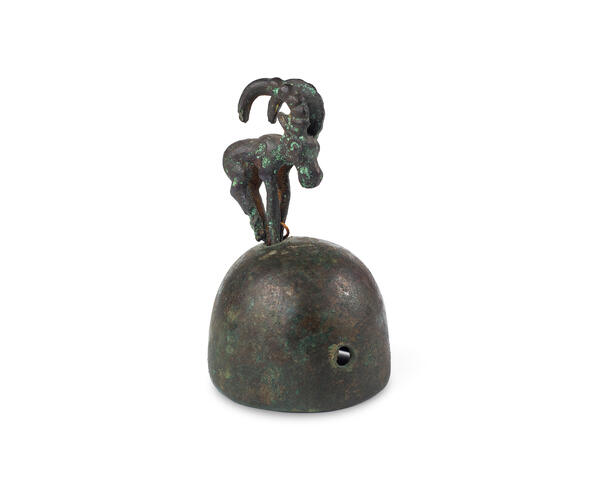
Cast figure of a goat

Creation period
4th–3rd century BCE
Place of сreation
Khakass-Minusinsk Basin
Dimensions
3,2x4,4x1 cm
Technique
bronze, casting
5
Open in app
#5

The cast figure of a mountain goat, placed on a bell-shaped final, was made of bronze. This item of burial equipment was discovered during the excavations of Tagar burial mounds of the 4th–3rd centuries BCE. The figurine was taken from the Ai-Dai III burial ground.

The excavations of the monuments of the Tagar culture were carried out by the Beya archaeological expedition of the Institute of the History of Material Culture of the Russian Academy of Sciences from 1992 to 1994 in Sayanogorsk. The research was led by Margarita Nikolaevna Pshenitsyna, Candidate of Historical Sciences, Soviet and Russian archaeologist.

Images of animals, figurines of sheep and goats on knife handles, deer-shaped plaques, small sculptures of deer were the most expressive examples of the Scythian-Siberian animal style in the monuments of the Tagar archaeological culture. This style was a characteristic manner of performing animal images, widely represented in the cultures of the Late Bronze and Early Iron Age of the Eurasian steppes, including the territory of Southern Siberia.

One of the common animals depicted by the Tagar was a mountain goat. Scientists came to the conclusion that it was an important totem. Archaeologists have found images of this animal on weapons, combat badges and belt buckles, and numerous pictograms (petroglyphs) of the Tagar culture.

Already at an early stage of this archaeological culture, images of a goat were used as decoration for knives. Bronze figurines decorated standards, knives, pendants, plaques, buckles, daggers, mirrors, bell-shaped finials, which were mounted on columns at the corners of the funeral bed. They were also soldered on top of the ritual torch holder.

Perhaps this prestigious item determined the social status of the deceased, confirmed their belonging to the “elite, ” an ancient, almost mythical clan of priests or rulers. It is noteworthy that in the Saragashen period, the stage of the Tagar culture from the 4th to the 3rd century BCE, when the miniaturization of things took place, some negligence appeared in the manufacture of funeral equipment.

#10
Cast figure of a goat
#9
View in the State Catalogue
read morehide
00:00
00:00
1x

Cast figure of a goat

Creation period
4th–3rd century BCE
Place of сreation
Khakass-Minusinsk Basin
Dimensions
3,2x4,4x1 cm
Technique
bronze, casting
5
Point your smartphone camera to open in the app
Share
VkontakteOdnoklassnikiTelegram
Share on my website
Copy linkCopied
Copy
Open in app
To see AR mode in action:
  1. Install ARTEFACT app for 
  2. iOS or Android;
  3. Find and download the «Paintings in Details» exhibition
  4. Push the «Augmented reality» button and point your phone's camera at the painting;
  5. Watch what happens on your phone screen whilst you flip through the pictures.
 
We use Cookies
Cookies on the Artefact Website. We use cookies to ensure that we give you the best experience on our website. If you continue without changing your settings, we'll assume that you are happy to receive all cookies on the Artefact website. However, if you would like to, you can change your cookie settings at any time.
Learn more about useHide
Content is available only in Russian

X

Нашли опечатку?...

%title%%type%