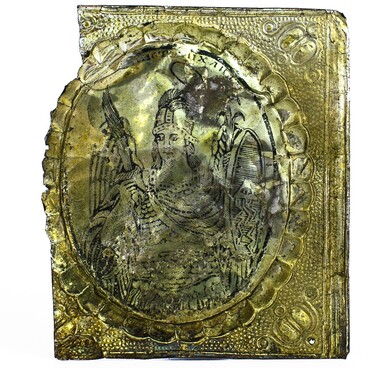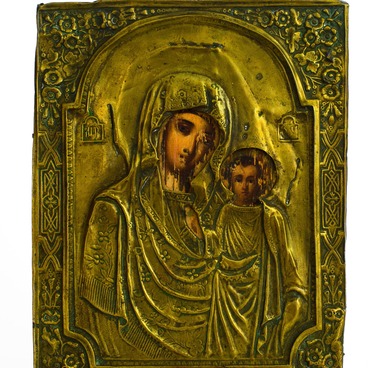


Copper-cast icons were in great demand in Rus and were very widespread. Despite the decree of Peter the Great of 1722 “On the prohibition of using carved and cast icons in church and private buildings”, their production did not stop. The art workshops of the Old Believers in the White Sea coastal areas, as well as the Urals and the region of Guslitsy near Moscow, became the centers of creating copper-cast images. Artistic copper casting developed and flourished there over the following decades. The Old Believers also produced buttons, inkwells, and book clasps. But their main assortment consisted of religious objects: crosses, icons, and folding icons.
Among the copper-cast icons and other relics, folding icons were especially appreciated. They could replace entire iconostases and menologies. Folding icons more often had two or three panels, less often — four or five.
Such folding images could be easily carried, transported and stored. Folding icons were popular with travelers, pilgrims, warriors on campaigns, merchants and other people who were often on the road.
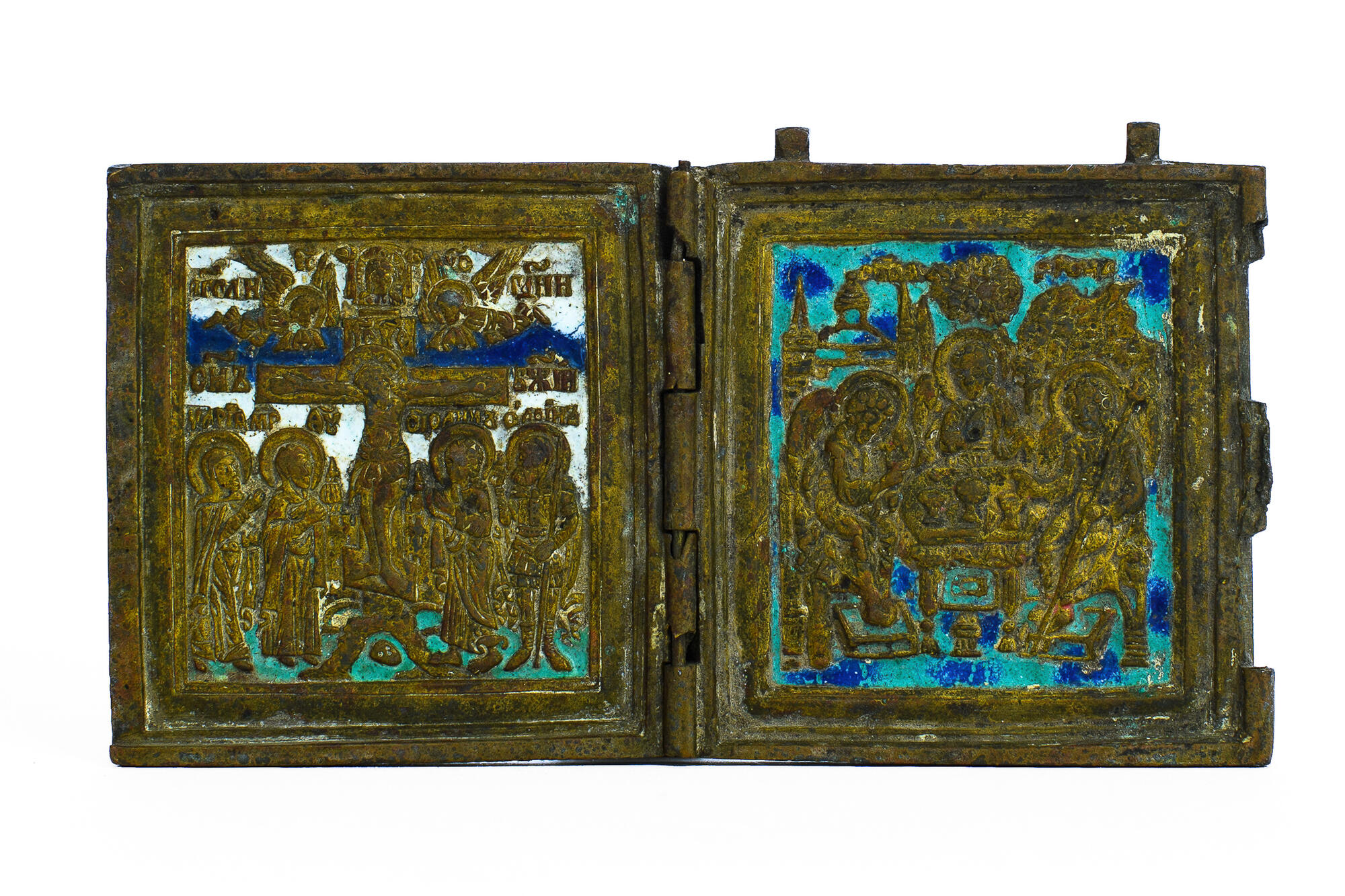
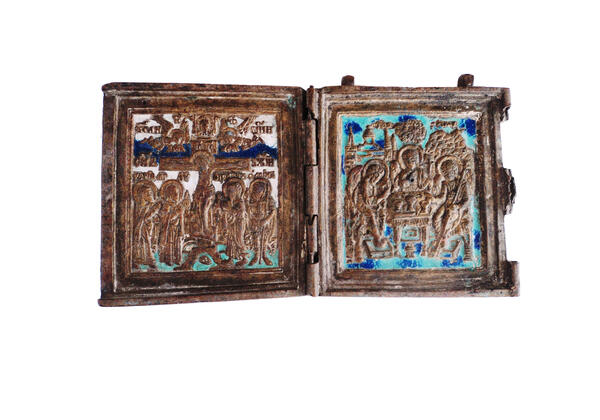
The Museum Complex of Kuybyshev houses a fragment of a three-leaf folding icon. It depicts the Crucifixion of Christ and the Old Testament Trinity. Only two panels are left, the right one was lost by the owner.
Each panel is a square-shaped cast metal plate. On the left, in the frame-like recess is a relief image of the icon “Crucifixion of Christ”. Jesus is on the cross, angels hover in the sky above Him, mourning Him and symbolizing the eternal life and the Divine nature of Christ. In the center between the angels is God the Father. To the sides of the cross are the Virgin Mary, Magdalene, and John the Apostle, who after the execution of Jesus cared for the Mother of God as for his own mother. Next to him is Centurion Longinus, a Roman soldier who pierced the crucified Jesus with a spear. The Church honors him as a martyr. Below the cross is Adam’s skull.
On the central panel, in the frame-like recess, is an icon of the “Old Testament Trinity”. It depicts God the Father, the Holy Spirit and God the Son. Behind them are the Oak of Mamre as an emblem of eternal life, the Christian church and the mountain as a symbol of the trials that Christ has to go through to save people from sins. The saints sit at a table, opposite each is a cup.
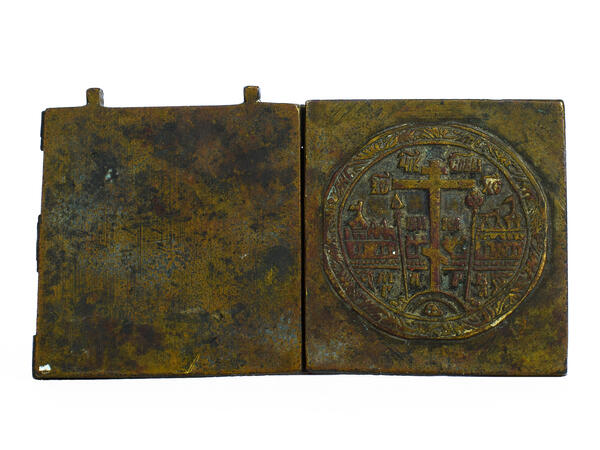
The image “Our Lady of the Sign” was depicted on the right panel. The recesses of the panels are filled with dark blue, turquoise and white enamel. Traces of attachments are visible at the top of the icon.
Among the copper-cast icons and other relics, folding icons were especially appreciated. They could replace entire iconostases and menologies. Folding icons more often had two or three panels, less often — four or five.
Such folding images could be easily carried, transported and stored. Folding icons were popular with travelers, pilgrims, warriors on campaigns, merchants and other people who were often on the road.
The Museum Complex of Kuybyshev houses a fragment of a three-leaf folding icon. It depicts the Crucifixion of Christ and the Old Testament Trinity. Only two panels are left, the right one was lost by the owner.
Each panel is a square-shaped cast metal plate. On the left, in the frame-like recess is a relief image of the icon “Crucifixion of Christ”. Jesus is on the cross, angels hover in the sky above Him, mourning Him and symbolizing the eternal life and the Divine nature of Christ. In the center between the angels is God the Father. To the sides of the cross are the Virgin Mary, Magdalene, and John the Apostle, who after the execution of Jesus cared for the Mother of God as for his own mother. Next to him is Centurion Longinus, a Roman soldier who pierced the crucified Jesus with a spear. The Church honors him as a martyr. Below the cross is Adam’s skull.
On the central panel, in the frame-like recess, is an icon of the “Old Testament Trinity”. It depicts God the Father, the Holy Spirit and God the Son. Behind them are the Oak of Mamre as an emblem of eternal life, the Christian church and the mountain as a symbol of the trials that Christ has to go through to save people from sins. The saints sit at a table, opposite each is a cup.
The image “Our Lady of the Sign” was depicted on the right panel. The recesses of the panels are filled with dark blue, turquoise and white enamel. Traces of attachments are visible at the top of the icon.