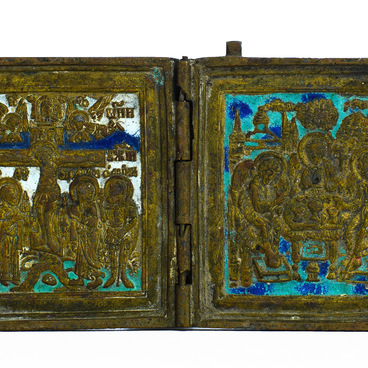
The printed icons that became widespread at the end of the 19th century were inexpensive and publicly available. Along with the images on which, for financial reasons, only the faces and hands of saints were painted and the rest of the details were depicted on a tin revetment covering the wooden board, the printed icons were distinguished by high production speed and affordability. They were inferior in quality to the images created at professional icon painting workshops of monasteries, but this was compensated by the low price.
By the beginning of the following century, manufacturers of such icons found a way to make their products even cheaper: tin revetments were replaced by foil onlays. Such icons began to be called “under-foil” ones; additional images were printed on foil revetments — icons depicting holidays or saints, who were known as prompt helpers.
The common people considered the most prompt helpers to be the holy “demon fighters” that protect people from the influence of evil forces; their images were the most revered. One of the holy “demon fighters” is Michael the Archangel.
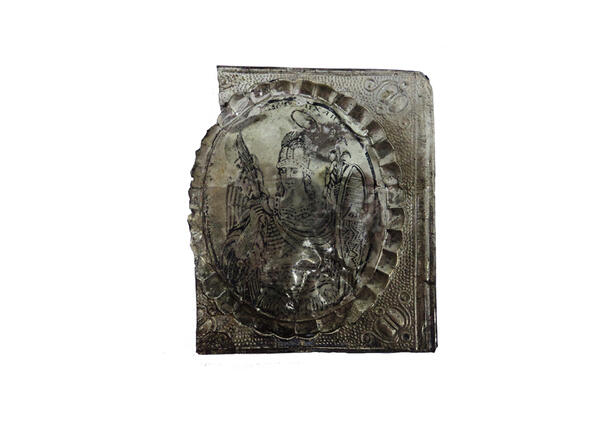
The Museum Complex of Kuybyshev houses a fragment of an icon’s revetment, depicting the scene (“kleimo” — literally “mark, branding”) “Michael the Archangel”. This fragment is a plate of metal foil with a flat oval in the middle. Inside the relief patterned frame is the image of the archangel in black ink made using printing plates.
Michael the Archangel, who in Orthodox Christianity is also called the Archistrategos (which means “supreme commander”), is a military leader, commander of the angels loyal to God, and victorious enemy of Satan, who triumphs over evil. Since ancient times, he has been considered the patron saint of warriors fighting for a just cause.
The artifact is a half-length image of Michael the Archangel in military armor with a helmet on his head. He slightly turns to the right. His angelic nature is represented by the wide-open wings behind his back. In his right hand, the archangel holds a flaming cloak, in his left hand — a shield with the image of the Eye of Providence and three thunderbolts.
There is a halo above the saint’s head. The name of the icon is printed in the upper central part of the oval.
By the beginning of the following century, manufacturers of such icons found a way to make their products even cheaper: tin revetments were replaced by foil onlays. Such icons began to be called “under-foil” ones; additional images were printed on foil revetments — icons depicting holidays or saints, who were known as prompt helpers.
The common people considered the most prompt helpers to be the holy “demon fighters” that protect people from the influence of evil forces; their images were the most revered. One of the holy “demon fighters” is Michael the Archangel.
The Museum Complex of Kuybyshev houses a fragment of an icon’s revetment, depicting the scene (“kleimo” — literally “mark, branding”) “Michael the Archangel”. This fragment is a plate of metal foil with a flat oval in the middle. Inside the relief patterned frame is the image of the archangel in black ink made using printing plates.
Michael the Archangel, who in Orthodox Christianity is also called the Archistrategos (which means “supreme commander”), is a military leader, commander of the angels loyal to God, and victorious enemy of Satan, who triumphs over evil. Since ancient times, he has been considered the patron saint of warriors fighting for a just cause.
The artifact is a half-length image of Michael the Archangel in military armor with a helmet on his head. He slightly turns to the right. His angelic nature is represented by the wide-open wings behind his back. In his right hand, the archangel holds a flaming cloak, in his left hand — a shield with the image of the Eye of Providence and three thunderbolts.
There is a halo above the saint’s head. The name of the icon is printed in the upper central part of the oval.