The Kazan Mother of God occupies a special place among all Christian images. The appearance of this icon occurred in 1579 after the annexation of the Khanate of Kazan to Russia. The Most Holy Theotokos came in a dream to Matrona Onuchina, a nine-year-old girl, and told her that the icon could be found on the site of the burned-down house of the Onuchins.
The Virgin appeared to the girl three times. The bishops and voivodes did not believe Matrona, so she and her mother found the icon in the place indicated by the Mother of God. The icon shone with a wonderful light and looked like it had just been painted. A monastery was built on the site where it was found. Matrona Onuchina and her mother became its first abbesses.
From the time of its acquisition until the early 20th century, the miraculous icon was kept in this monastery — the Kazan Convent of the Theotokos. In 1904, Varfolomei Chaikin, a peasant, and his accomplices stole the image at night. The precious revetment of the Kazan Mother of God was sold, and the investigation established that the icon itself had been burned. However, according to another hypothesis, the abbess replaced the icon with a copy for that night. In this case, the relic was not destroyed, but its location is unknown.
There are many well-known and revered copies of Our Lady of Kazan, including the Moscow, St. Petersburg and Vatican ones, and others.
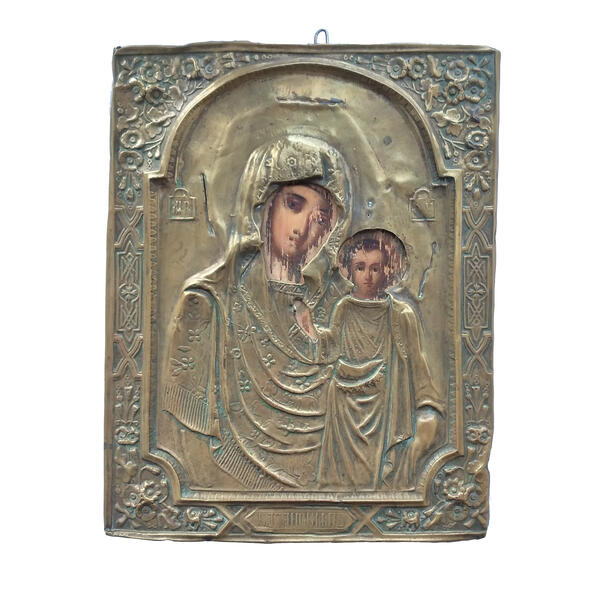
The icon of the Most Holy Theotokos of Kazan from the collection of the Museum Complex of Kuybyshev was painted in the early 20th century. It consists of two parts — the wooden board with the painted image and the revetment made of tin. Icons with tin revetments were produced and released very quickly, they were cheap and in great demand.
The face and right hand of the Christ Child and the face of the Mother of God are painted on a rectangular-shaped board. It was first covered with a thin layer of gesso — levkas. The image of the Mother of God is half-length. Her head is covered with a maphorion as a sign that the Mother of God is the Queen of Heaven. She is slightly inclined towards the Baby Jesus, whose right hand is raised in a blessing gesture, and the left one is hidden by a himation.
All elements, except for the faces, are painted conditionally, in red-brown color. The faces are executed in a realistic manner with meticulously worked out details. The revetment is made of a copper alloy. The srednik (the middle part) has a rounded finish and its edges are also rounded. It is bordered by a relief frame with an ornament. In the margins at the corners of the frame is a floral ornament, a geometric pattern is in the center on the left and right. The bottom in the center of the frame features the name of the copy.
The Virgin appeared to the girl three times. The bishops and voivodes did not believe Matrona, so she and her mother found the icon in the place indicated by the Mother of God. The icon shone with a wonderful light and looked like it had just been painted. A monastery was built on the site where it was found. Matrona Onuchina and her mother became its first abbesses.
From the time of its acquisition until the early 20th century, the miraculous icon was kept in this monastery — the Kazan Convent of the Theotokos. In 1904, Varfolomei Chaikin, a peasant, and his accomplices stole the image at night. The precious revetment of the Kazan Mother of God was sold, and the investigation established that the icon itself had been burned. However, according to another hypothesis, the abbess replaced the icon with a copy for that night. In this case, the relic was not destroyed, but its location is unknown.
There are many well-known and revered copies of Our Lady of Kazan, including the Moscow, St. Petersburg and Vatican ones, and others.
The icon of the Most Holy Theotokos of Kazan from the collection of the Museum Complex of Kuybyshev was painted in the early 20th century. It consists of two parts — the wooden board with the painted image and the revetment made of tin. Icons with tin revetments were produced and released very quickly, they were cheap and in great demand.
The face and right hand of the Christ Child and the face of the Mother of God are painted on a rectangular-shaped board. It was first covered with a thin layer of gesso — levkas. The image of the Mother of God is half-length. Her head is covered with a maphorion as a sign that the Mother of God is the Queen of Heaven. She is slightly inclined towards the Baby Jesus, whose right hand is raised in a blessing gesture, and the left one is hidden by a himation.
All elements, except for the faces, are painted conditionally, in red-brown color. The faces are executed in a realistic manner with meticulously worked out details. The revetment is made of a copper alloy. The srednik (the middle part) has a rounded finish and its edges are also rounded. It is bordered by a relief frame with an ornament. In the margins at the corners of the frame is a floral ornament, a geometric pattern is in the center on the left and right. The bottom in the center of the frame features the name of the copy.