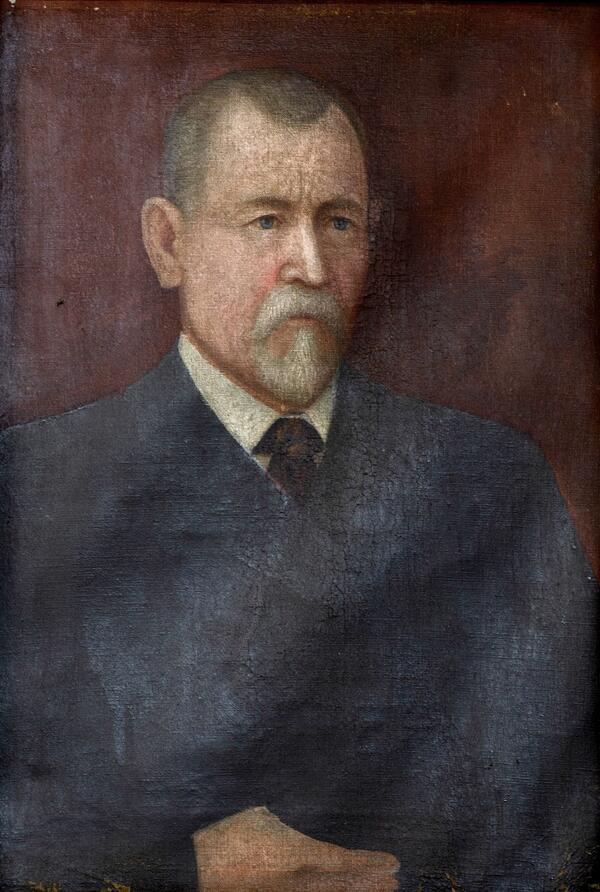
A self-portrait by Ivan SItnikov, an artist who worked for the plant theatre, is on display at the exhibition. It was painted in the early 20th century. Ivan Sitnikov came to the Izhevsk plant in 1889 whereupon he served as a counter in the stock workshop. He received his first medal—a minor silver medal on the St. Stanislaus ribbon—in 1901.
In 1908, for his service at Izhevsk Ironworks and Weapons Arsenal, he was awarded a silver medal “For Diligence” to be worn on the St. Anna ribbon on the chest. Sitnikov worked as a clerk in 1900–1913.
In 1896, Ivan Sitnikov, an activist of the Izhevsk Society for Sobriety, started painting for the first time — decorations for a vaudeville “Soldier Yashka, Red Shirt, Blue Gussets” were his first work. He went on with painting decorations for the “Under the Tower” plant theater, even though he did not have a formal education in art.
The “Under the Tower” theater was founded by engineer Ivan VasIlyev in 1907. Workers and other employees of the Izhevsk plant were its first actors. Productions of the theatre were quite popular with all societal classes of the local population: theatre’s repertoire included both comedies and tragedies. Over time, touring professional troupes from other cities of Russia began to perform here. Contemporary press often praised the performances of that theater.
Theatre of the workers was a signature touch of the Izhevsk plant that made it stand out among other plants in Russia at the time. Theatrical art presupposes the development of some other arts: fiction, fine arts, music, dramatic art. In 1907, Ivan Sitnikov was entrusted with an honorable mission in honor of the 100th anniversary of the Izhevsk Arms Plant: he was to make a bust of the founder of the Izhevsk Arms Plant, mining engineer Andrei Deryabin. The primary source for the sculptor was the 1870s lithograph depicting Deryabin in profile, made by the engraver Pyotr Borel. A monument to the engineer was erected on the embankment, across the main building of the Arsenal.
In 1918–1919, Sitnikov participated in the creation of revolutionary paintings: ‘Red Gate’ on the triumphal arch on Sovetskaya Street, and ‘Proletarskiy Shtandart’ on the tower of the Izhevsk Arsenal.
In 1908, for his service at Izhevsk Ironworks and Weapons Arsenal, he was awarded a silver medal “For Diligence” to be worn on the St. Anna ribbon on the chest. Sitnikov worked as a clerk in 1900–1913.
In 1896, Ivan Sitnikov, an activist of the Izhevsk Society for Sobriety, started painting for the first time — decorations for a vaudeville “Soldier Yashka, Red Shirt, Blue Gussets” were his first work. He went on with painting decorations for the “Under the Tower” plant theater, even though he did not have a formal education in art.
The “Under the Tower” theater was founded by engineer Ivan VasIlyev in 1907. Workers and other employees of the Izhevsk plant were its first actors. Productions of the theatre were quite popular with all societal classes of the local population: theatre’s repertoire included both comedies and tragedies. Over time, touring professional troupes from other cities of Russia began to perform here. Contemporary press often praised the performances of that theater.
Theatre of the workers was a signature touch of the Izhevsk plant that made it stand out among other plants in Russia at the time. Theatrical art presupposes the development of some other arts: fiction, fine arts, music, dramatic art. In 1907, Ivan Sitnikov was entrusted with an honorable mission in honor of the 100th anniversary of the Izhevsk Arms Plant: he was to make a bust of the founder of the Izhevsk Arms Plant, mining engineer Andrei Deryabin. The primary source for the sculptor was the 1870s lithograph depicting Deryabin in profile, made by the engraver Pyotr Borel. A monument to the engineer was erected on the embankment, across the main building of the Arsenal.
In 1918–1919, Sitnikov participated in the creation of revolutionary paintings: ‘Red Gate’ on the triumphal arch on Sovetskaya Street, and ‘Proletarskiy Shtandart’ on the tower of the Izhevsk Arsenal.