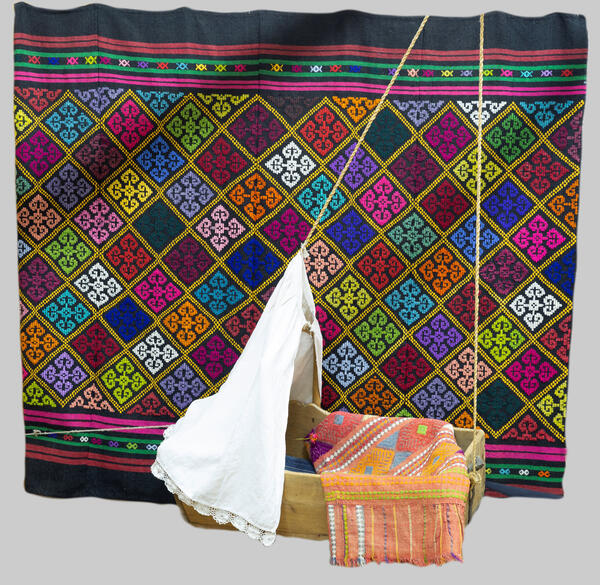
Zoya MazItova made this carpet in 1972. She was born in the Karamas-Pelga village in 1920. At present, it is the Kiyasovsky District of the Umdurt Republic.
The carpet consists of four cloths with linen and woolen threads. The Udmurts decorated walls of their houses with carpets. Carpets, like fabrics, were woven on a manual low-warp loom. They were usually sewn of two cloths. The width of a homespun cloth varied from 31 to 45 centimeters. Calculating threads was quite simple: one centimeter of a fabric contained about ten threads. So 310 warp threads were required to weave a 31-centimeter-wide cloth. Before warping, preparing threads for winding on a loom, women already knew how many shirts, or other products could be made from woven homespun cloth. Uneducated weavers, who worked on a loom, could perform complex calculations of threads and weaves in almost all weaving techniques.
Weaving appeared in the Kama-Vyatka region in the Neolithic Age, around the 5th–3d millennium BC. It is proven by the discovered clay and stone spindle whorls in monuments of that period. A long period of simple manual fabric weaving is supposed to have preceded the art of weaving.
The first fabrics may have been woven of coarse fibers made of nettle, or hemp. In the following historic periods, craftsmen improved technologies, complicated textures and color schemes.
Relics discovered by ethnographers-travelers of the 18th century prove the wide use of weaving in everyday life of the Udmurts. In the 19th century, the Udmurts manufactured various fabrics: selected, for shirts, lining, and others. A large amount of manufactured fabrics was used at home. However, weavers also sold their goods in markets. Goods of craftswomen were often demonstrated at held exhibitions. For example, products manufactured by weavers of the Glazovsky Uyezd (administrative territorial unit) were shown as ‘samples of the Votsk fabrics’ at the Kazan Science and Industry Exhibition.
The ethnographer G.D. Fedorov visited the Udmurt region in 1915. He wrote that flax and hemp processing and weaving fabrics were the most common crafts among the Udmurts of the Vyatka Governorate. He noted that every woman ‘spinned, wove, chose carpets and towels, or wove various belts.’
Goods of craftswomen were unique by the technique, colors, and patterns. The weaving process was taken seriously. Women chose the best calendar days, weeks and daytime for weaving. They thought that it was wrong to start something on Fridays. It was forbidden to distract weavers from weaving the warp thread because it could lead to tangled threads of fate. Before starting work, one should not talk so that their thoughts did not get confused. A weaver was to focus on her work.
Flax, hemp, and wool of domestic sheep were used for pattern weaving. In the late 19th century, people started using purchased cotton yarn and fine wool, called bay yarn, manufactured and dyed at factories.
The carpet consists of four cloths with linen and woolen threads. The Udmurts decorated walls of their houses with carpets. Carpets, like fabrics, were woven on a manual low-warp loom. They were usually sewn of two cloths. The width of a homespun cloth varied from 31 to 45 centimeters. Calculating threads was quite simple: one centimeter of a fabric contained about ten threads. So 310 warp threads were required to weave a 31-centimeter-wide cloth. Before warping, preparing threads for winding on a loom, women already knew how many shirts, or other products could be made from woven homespun cloth. Uneducated weavers, who worked on a loom, could perform complex calculations of threads and weaves in almost all weaving techniques.
Weaving appeared in the Kama-Vyatka region in the Neolithic Age, around the 5th–3d millennium BC. It is proven by the discovered clay and stone spindle whorls in monuments of that period. A long period of simple manual fabric weaving is supposed to have preceded the art of weaving.
The first fabrics may have been woven of coarse fibers made of nettle, or hemp. In the following historic periods, craftsmen improved technologies, complicated textures and color schemes.
Relics discovered by ethnographers-travelers of the 18th century prove the wide use of weaving in everyday life of the Udmurts. In the 19th century, the Udmurts manufactured various fabrics: selected, for shirts, lining, and others. A large amount of manufactured fabrics was used at home. However, weavers also sold their goods in markets. Goods of craftswomen were often demonstrated at held exhibitions. For example, products manufactured by weavers of the Glazovsky Uyezd (administrative territorial unit) were shown as ‘samples of the Votsk fabrics’ at the Kazan Science and Industry Exhibition.
The ethnographer G.D. Fedorov visited the Udmurt region in 1915. He wrote that flax and hemp processing and weaving fabrics were the most common crafts among the Udmurts of the Vyatka Governorate. He noted that every woman ‘spinned, wove, chose carpets and towels, or wove various belts.’
Goods of craftswomen were unique by the technique, colors, and patterns. The weaving process was taken seriously. Women chose the best calendar days, weeks and daytime for weaving. They thought that it was wrong to start something on Fridays. It was forbidden to distract weavers from weaving the warp thread because it could lead to tangled threads of fate. Before starting work, one should not talk so that their thoughts did not get confused. A weaver was to focus on her work.
Flax, hemp, and wool of domestic sheep were used for pattern weaving. In the late 19th century, people started using purchased cotton yarn and fine wool, called bay yarn, manufactured and dyed at factories.