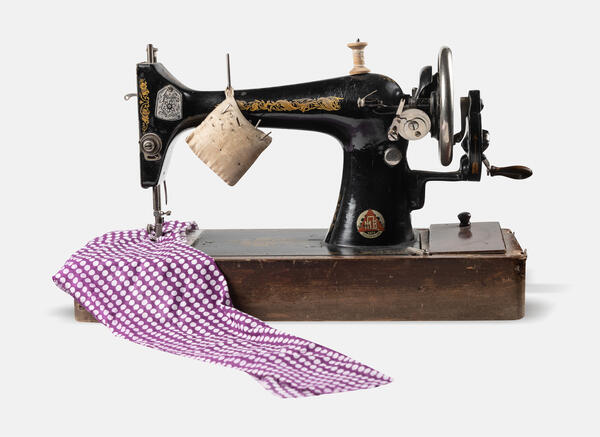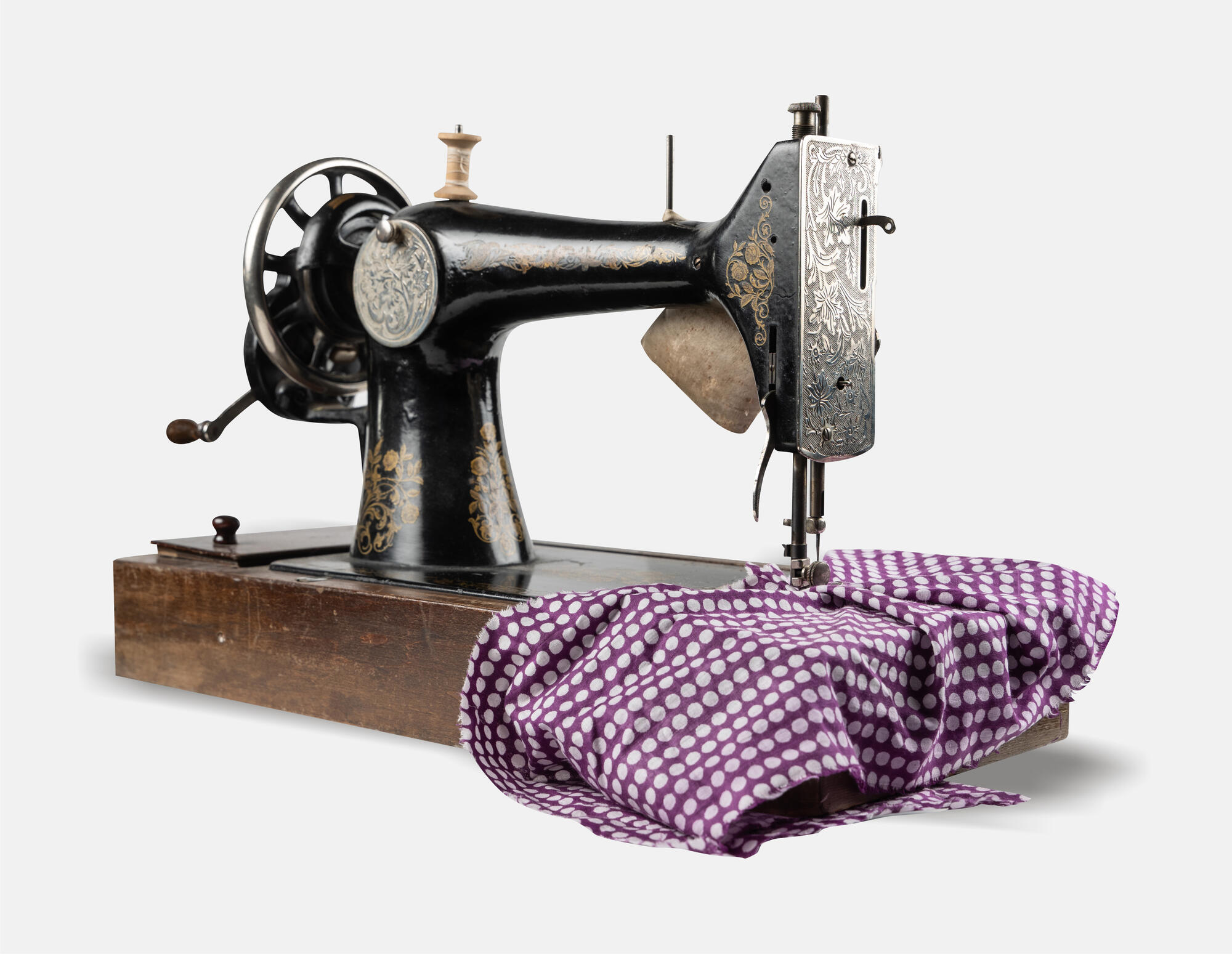


The sewing machine made by the Podolsk Mechanical Plant was donated to the museum by Maria Petrovna Kuznetsova, one of the first Soviet residents of Zelenogradsk. Maria Kuznetsova herself told the story of her family heirloom.
When the Great Patriotic War began, Maria was living in Leningrad and working at the Admiralty. It was there that she met her future husband Dmitry Kuznetsov who was soon sent to the front line. Before the Siege of Leningrad began, the Admiralty was evacuated, and Maria stayed in Leningrad with a sewing machine. The Siege lasted almost 900 days, and during that hard period of hunger, the sewing machine was of great help to its owner. Maria used to mend sailors’ uniforms and transform their trousers into bell-bottoms, and in return they shared their food rations with her, saving her from starvation. When the Soviet troops ruptured the German encirclement, Maria was reunited with Dmitry. He fought bravely on the outskirts of the city, striving to hasten their meeting.
Maria and Dmitry got married and soon had a daughter. The Kuznetsovs heard the news of the victory when they were in East Prussia. The young family moved to the former German town of Cranz where Dmitry Kuznetsov was assigned to his new duty station. It was there that the couple had their second daughter. The sewing machine came in handy again: Maria sewed baby sleepers, undershirts, and dresses for her girls. The daughters grew up, grandchildren and great-grandchildren were born, and the sewing machine was used rarely. Together, the family decided to donate the machine to the museum.
The Podolsk Sewing Machine Factory was founded as a
branch of the famous Singer company, which in 1851 patented an affordable
mechanical sewing machine with a body resembling an old bottle. Sewing machines
of this shape began to be produced in the Russian Empire. In 1900, a factory
was built in Podolsk. The first sewing machines were manufactured there in
1902. The enterprise quickly expanded its production facilities. At its peak,
in 1913, the company produced 600,000 sewing machines a year. However, because
of the revolution and the First World War, the factory’s operations were shut
down. The Soviet authorities resumed the production of sewing machines in 1924.
Later, the factory improved its models and began to design its own machines.
The Kalinin Podolsk Mechanical Plant became a prosperous enterprise.