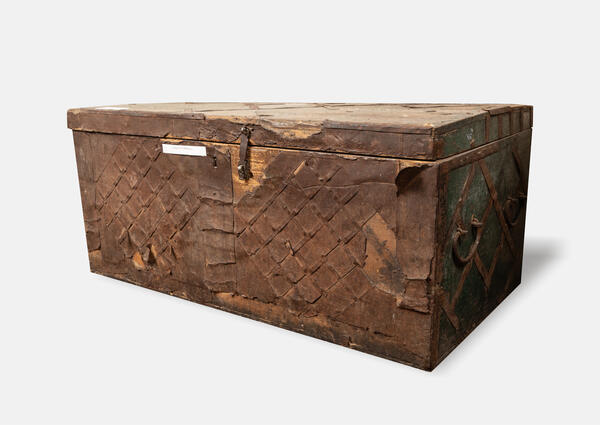
The wooden chest reinforced with wrought iron was brought to the Kaliningrad Region by settlers from the Don region.
Chests have been known since olden times. They were used in Ancient Egypt, Greece, and Rome. As a piece of furniture, they came to Rus from the East. The Russian word “sunduk” meaning “chest” came from the Turkic “sandyk” and was used among earlier Russian words such as “lar”, “korob”, and “skrynya”, all referring to storage units. People have always needed to store their belongings, and before the advent of cabinets, safe deposits, and suitcases, that function was performed by chests. They varied in size, material, manufacturing techniques, and purposes. The design and function of chests depended on their country of origin. They could be tiny or huge and have the shape of a rounded travel bag or a small headrest. Chests could be decorated with painted patterns and carvings, covered with fabric or leather. Chests were used to store household goods, tools, weapons, documents, and jewelry. They were locked or barred.
In the Don region, chests were an essential element of everyday life and an important piece of interior décor. A Cossack woman could sit on a small chest while doing her handiwork. Between the ages of 9 and 12, a girl could get a storage chest for her birthday. She was supposed to collect her dowry in the chest so that she would already have some possessions when she got married. In the Don region, it was customary to sleep not only on a bed but also on a large storage chest. A feather bed and a pile of pillows were placed on the chest for that purpose. The inside of the lid could be decorated with postcards and used to keep various records.
The process of making a chest is also of great interest. It is quite complicated and requires the contribution of several craftsmen, including a carpenter, a blacksmith, a painter, and a locksmith. The design of chests has changed throughout their history and resulted in the appearance of new furniture items. For example, in the 17th century, the chest was fitted with legs and drawers. This was the prototype of the modern dresser. In the 18th and 19th centuries, Don Cossacks often used chests when they went on a journey and needed to transport a lot of things. Usually, chests were placed in a wide sled. In the mid-20th century, when some Don Cossacks moved to the Kaliningrad Region, they brought along their possessions in the large-sized storage chests of their grandmothers.