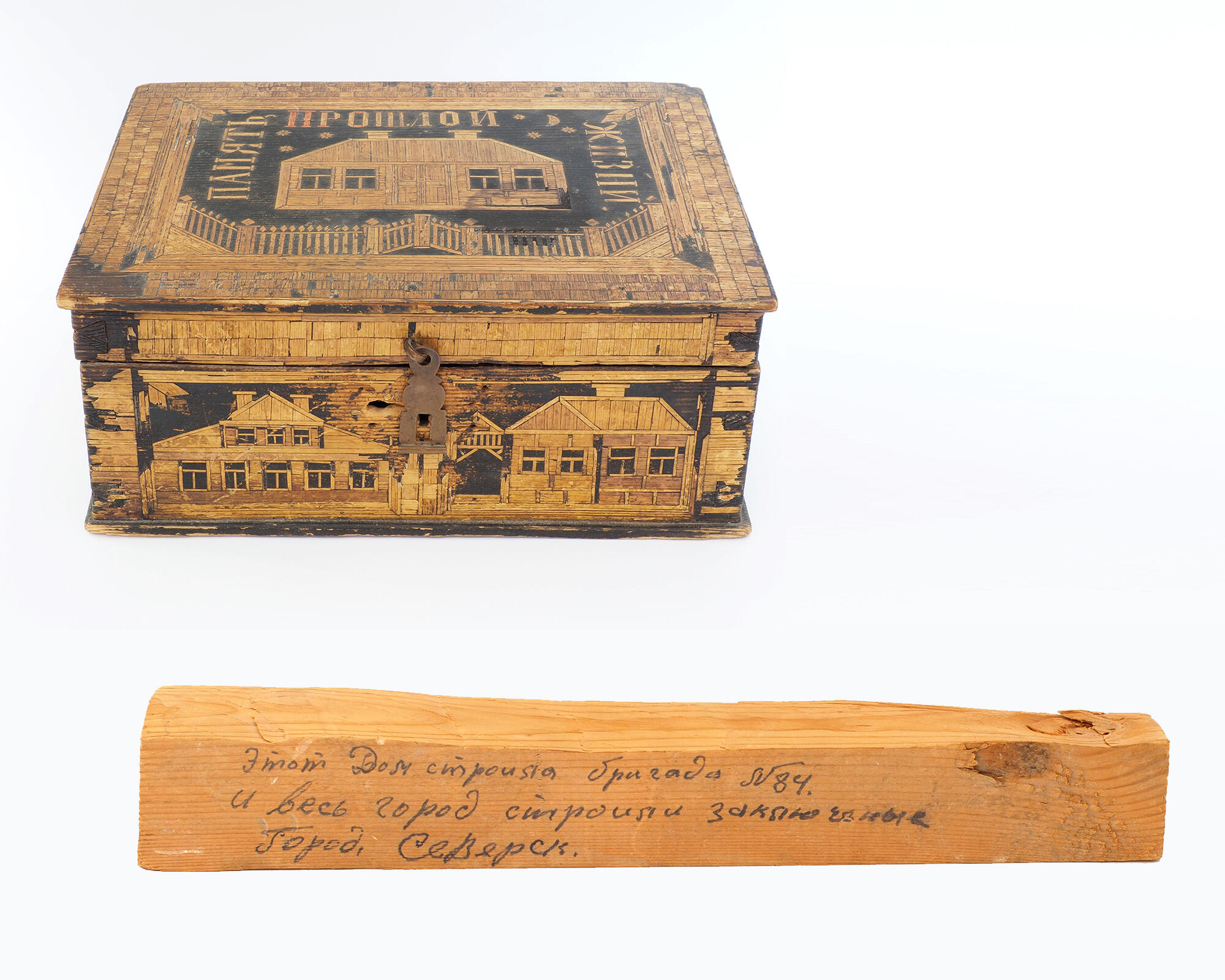


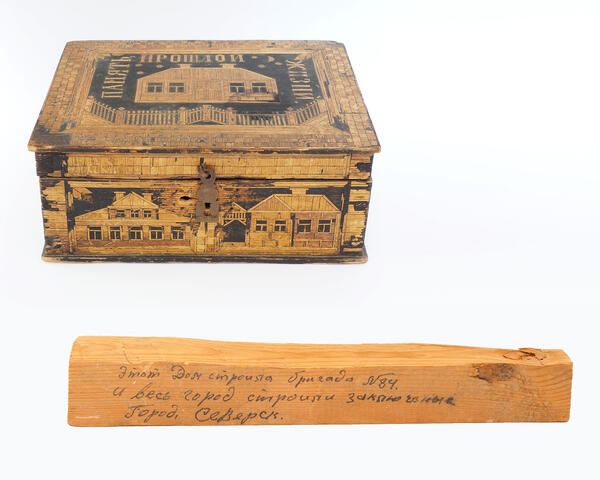
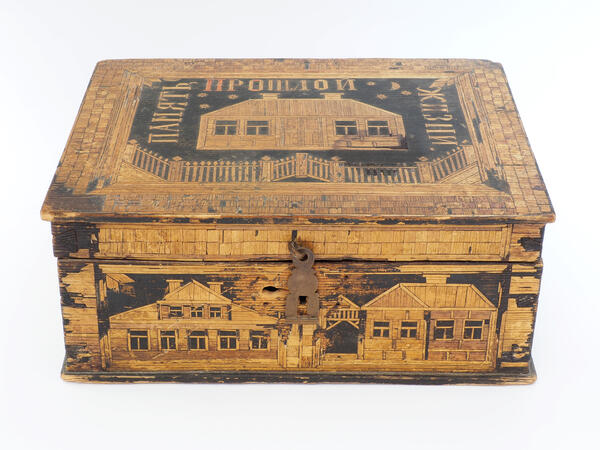
The box with a hinged lid, which is on display in the museum, is made of wood and decorated with straw inlay. The prisoners of the forced labor camp ‘GKh-5’ made it in the middle of the 20th century.
The bottom and the lid of the box are made of plywood. There is a shaped metal hinge fastened to the front side of the lid. The inner surface is glued with embossed purple paper that has a ‘grid’ pattern. There are architectural scenes featured on the sides and the upper part of the box. On the lid of the box, there is an inscription ‘The Memory of Past Life’ and the borders are decorated with a checkered pattern.
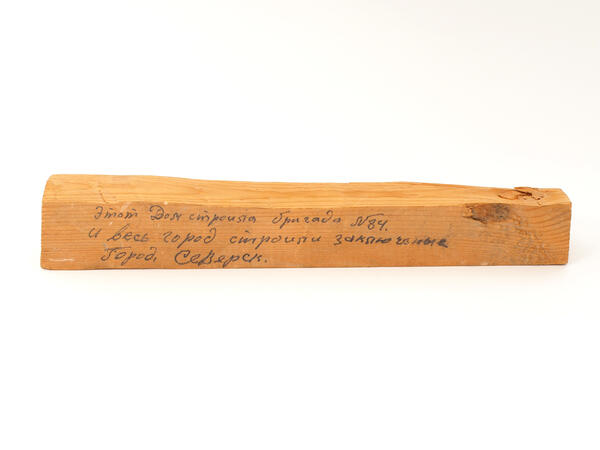
In Seversk, one frequently finds objects that were made by prisoners. The town was built according to the post-war type of construction: first, a major enterprise was designed and built, and then residential and municipal buildings and infrastructure appeared around it. During the first years of the construction of the ‘Zauralsky Machine-Building Plant’ — one of the secret names of the future Siberian Chemical Combine — the largest category of workers was convicts.
Prisoners that were convicted for political crime were not sent to the high-security facilities. They were transferred to the Irkutsk Region. Instead, new prisoners were sent, those who were serving time for criminal offenses. In July 1949, the first prisoners arrived in the new labor camps — more than four thousand people.
The project site was unfolding. It was necessary to provide the site not only with construction workers but also with the employees working in the design and planning departments. The number of ‘free’ professional employees was not enough. So, in accordance with the next order, these employees were also recruited from the prisoners. The order prescribed that only those who were fit for work should be sent to the camp, and that as many construction workers as possible should be included in their number.
By the end of 1949, there were already more than 11 thousand convicts and in 1952 there were 36 thousand people. The prisoners built practically the entire old part of the city including the most beautiful buildings: the House of Culture named after Nikolai Ostrovsky, the cinemas ‘Mir’, ‘Rossiya’ and others.
The bottom and the lid of the box are made of plywood. There is a shaped metal hinge fastened to the front side of the lid. The inner surface is glued with embossed purple paper that has a ‘grid’ pattern. There are architectural scenes featured on the sides and the upper part of the box. On the lid of the box, there is an inscription ‘The Memory of Past Life’ and the borders are decorated with a checkered pattern.
In Seversk, one frequently finds objects that were made by prisoners. The town was built according to the post-war type of construction: first, a major enterprise was designed and built, and then residential and municipal buildings and infrastructure appeared around it. During the first years of the construction of the ‘Zauralsky Machine-Building Plant’ — one of the secret names of the future Siberian Chemical Combine — the largest category of workers was convicts.
Prisoners that were convicted for political crime were not sent to the high-security facilities. They were transferred to the Irkutsk Region. Instead, new prisoners were sent, those who were serving time for criminal offenses. In July 1949, the first prisoners arrived in the new labor camps — more than four thousand people.
The project site was unfolding. It was necessary to provide the site not only with construction workers but also with the employees working in the design and planning departments. The number of ‘free’ professional employees was not enough. So, in accordance with the next order, these employees were also recruited from the prisoners. The order prescribed that only those who were fit for work should be sent to the camp, and that as many construction workers as possible should be included in their number.
By the end of 1949, there were already more than 11 thousand convicts and in 1952 there were 36 thousand people. The prisoners built practically the entire old part of the city including the most beautiful buildings: the House of Culture named after Nikolai Ostrovsky, the cinemas ‘Mir’, ‘Rossiya’ and others.