The construction of Seversk expanded, various structural divisions of the plant developed, the city’s population grew rapidly. To provide people with favorable living and working conditions, Construction Department No. 601 and the plant created their own departments and services. It became necessary to coordinate their actions with each other.
On March 23, 1951, the director of the plant and the head of Construction No. 601 jointly created the first village civil authority, which was named the Administrative Council. The joint authority stated that its goal would be ‘to maintain internal order on the territory and coordinate the management of the factory village.’
The Administrative Council helped to carry out all the activities for which the local authorities were responsible, supervised the work of social and cultural institutions, was responsible for the sanitary and fire safety of houses and apartments in the village.
On March 17, 1954, the village of plant No. 816 was transformed into a city of regional significance. From that moment, the village was directly subordinate to the Tomsk region administration alongside the districts. It received a new name — Seversk, but it was secretly called Tomsk-7 in the correspondence.
The representative authority in Seversk, as in other cities of the RSFSR, was supposed to be the city council of workers' deputies, and executive and administrative functions were entrusted to the executive committee, an elected collegial authority.
On May 13, 1954, the first elections were held for 157 deputies of the Seversk City Council. Compared to the other cities, Seversk council members were young — the oldest among the deputies, Mikhail Tsarevsky, was 56 years old. Nikolai Lazarev was elected as the chairman of the city executive committee. He used to work as the deputy director for social and domestic issues of the plant and voluntarily headed the administrative council of the village.
Lazarev was the chairman of the city executive committee until retiring in 1963. During this time, he managed to establish cooperation between all services of the city.
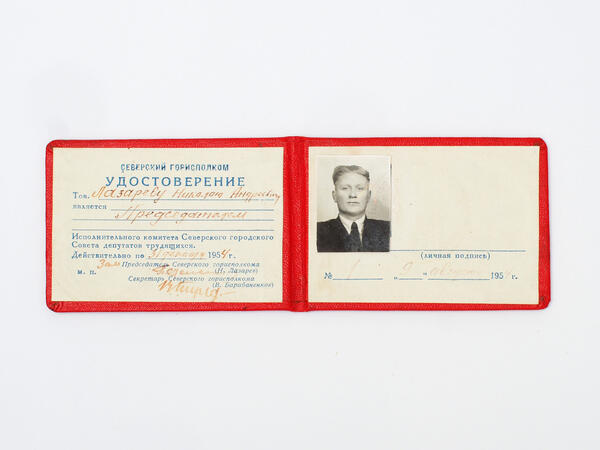
The Seversk Museum houses identification document No. 1 of Nikolai Lazarev, chairman of the executive committee of the Seversk city council of workers' deputies. Liubov Beliakova donated it to the museum from her archive.
The identification document looks like a little red book. It was issued on August 9, 1954, and was valid until December 31, 1954. The document was signed by the secretary of the city executive committee and the chairman himself. There are faded stamps on both sides of the spread, including the photograph.
On March 23, 1951, the director of the plant and the head of Construction No. 601 jointly created the first village civil authority, which was named the Administrative Council. The joint authority stated that its goal would be ‘to maintain internal order on the territory and coordinate the management of the factory village.’
The Administrative Council helped to carry out all the activities for which the local authorities were responsible, supervised the work of social and cultural institutions, was responsible for the sanitary and fire safety of houses and apartments in the village.
On March 17, 1954, the village of plant No. 816 was transformed into a city of regional significance. From that moment, the village was directly subordinate to the Tomsk region administration alongside the districts. It received a new name — Seversk, but it was secretly called Tomsk-7 in the correspondence.
The representative authority in Seversk, as in other cities of the RSFSR, was supposed to be the city council of workers' deputies, and executive and administrative functions were entrusted to the executive committee, an elected collegial authority.
On May 13, 1954, the first elections were held for 157 deputies of the Seversk City Council. Compared to the other cities, Seversk council members were young — the oldest among the deputies, Mikhail Tsarevsky, was 56 years old. Nikolai Lazarev was elected as the chairman of the city executive committee. He used to work as the deputy director for social and domestic issues of the plant and voluntarily headed the administrative council of the village.
Lazarev was the chairman of the city executive committee until retiring in 1963. During this time, he managed to establish cooperation between all services of the city.
The Seversk Museum houses identification document No. 1 of Nikolai Lazarev, chairman of the executive committee of the Seversk city council of workers' deputies. Liubov Beliakova donated it to the museum from her archive.
The identification document looks like a little red book. It was issued on August 9, 1954, and was valid until December 31, 1954. The document was signed by the secretary of the city executive committee and the chairman himself. There are faded stamps on both sides of the spread, including the photograph.