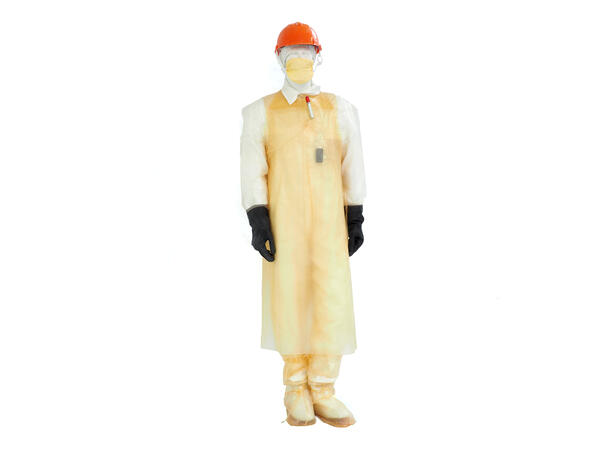
The museum houses a protective suit of a Siberian Chemical Combine employee. It consists of dacron сoveralls and a cap. The set also includes a special jacket and trousers, an apron, oversleeves, plastic boot covers, rubber gloves, an orange plastic helmet, and a gauze FFP mask. Such clothes protected workers from radioactive rays. The Combine worker had to wear an individual dosimeter, which was attached to the chest under the jacket.
The workwear did not have to be disposable. Depending on the fiber type, the fabric structure, and dyes, it could be decontaminated — radioactive and chemical substances could be removed. Such workwear could be reused.
As a rule, dyed fabrics are less likely to be cleared of radioactive substances. Therefore, white workwear made of bleached moleskine, a thick and durable nappy cotton fabric with fleece, is believed to be more suitable for working in radioactive environments.
Until recently, workers most often wore clothing made of dacron — polyester fiber. It was highly durable and chemically resistant, decontaminated well, and shrank very little. However, fabrics made of synthetic fibers, including dacron, are more vulnerable to radioactive aerosols than cotton.
The sole of the white shoes worn by Combine workers was made of polyurethane. This material withstood the effects of oils and gasoline, acid and alkali solutions. The upper part of the shoes was made of a special dacron fabric ‘Atom, ’ resistant to aggressive agents. The sole was attached to it by casting.
A thermoplastic toe box was placed inside the safety shoes for additional protection. It supported the toes from bumps and friction. An insole was made of foamed polyurethane. Workers usually wore rubber overshoes, for example, boot covers, oil-and-frost resistant rubbers, or plastic shoes: footlets, covers, and stockings.
For a long time, the Siberian Chemical Combine worked for a defense industry complex. Here, enriched uranium-235 and plutonium-239 were obtained, and fuel spent at a nuclear power plant was reprocessed. This process is called regeneration. The Combine manufactured components for new nuclear charges, as well as dismantled and recycled into fuel charge components removed from service.
The enterprises of the State Corporation ‘Rosatom’ (Joint-Stock Company ‘Siberian Chemical Combine’ is now part of the TVEL Fuel Company) ensured that the workers' clothing corresponded to the professional specifics of work. For this purpose, they developed sets that would protect their employees from dust, moisture, high temperature, acids, and alkalis.
The workwear did not have to be disposable. Depending on the fiber type, the fabric structure, and dyes, it could be decontaminated — radioactive and chemical substances could be removed. Such workwear could be reused.
As a rule, dyed fabrics are less likely to be cleared of radioactive substances. Therefore, white workwear made of bleached moleskine, a thick and durable nappy cotton fabric with fleece, is believed to be more suitable for working in radioactive environments.
Until recently, workers most often wore clothing made of dacron — polyester fiber. It was highly durable and chemically resistant, decontaminated well, and shrank very little. However, fabrics made of synthetic fibers, including dacron, are more vulnerable to radioactive aerosols than cotton.
The sole of the white shoes worn by Combine workers was made of polyurethane. This material withstood the effects of oils and gasoline, acid and alkali solutions. The upper part of the shoes was made of a special dacron fabric ‘Atom, ’ resistant to aggressive agents. The sole was attached to it by casting.
A thermoplastic toe box was placed inside the safety shoes for additional protection. It supported the toes from bumps and friction. An insole was made of foamed polyurethane. Workers usually wore rubber overshoes, for example, boot covers, oil-and-frost resistant rubbers, or plastic shoes: footlets, covers, and stockings.
For a long time, the Siberian Chemical Combine worked for a defense industry complex. Here, enriched uranium-235 and plutonium-239 were obtained, and fuel spent at a nuclear power plant was reprocessed. This process is called regeneration. The Combine manufactured components for new nuclear charges, as well as dismantled and recycled into fuel charge components removed from service.
The enterprises of the State Corporation ‘Rosatom’ (Joint-Stock Company ‘Siberian Chemical Combine’ is now part of the TVEL Fuel Company) ensured that the workers' clothing corresponded to the professional specifics of work. For this purpose, they developed sets that would protect their employees from dust, moisture, high temperature, acids, and alkalis.