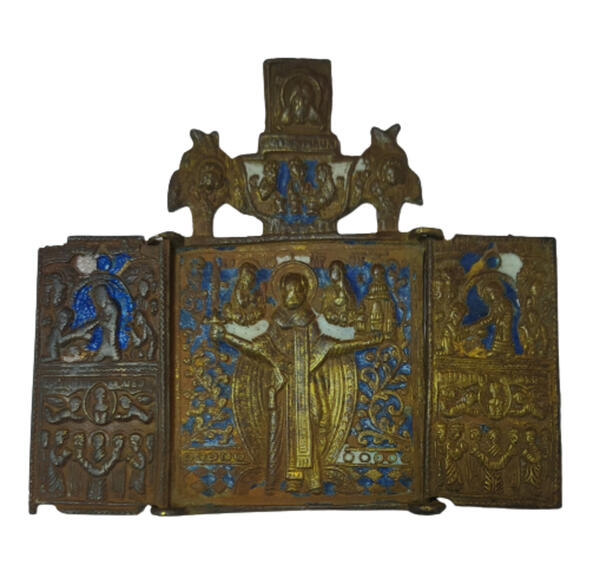
The copper folding iconostasis “St. Nicholas the Wonderworker of Mozhaysk” was made in the 18th or 19th century. This religious object was created with two rectangular leaves closing on the centerpiece — a central rectangular icon with a final. The leaves were made half the width of the centerpiece. Parts of the triptych were attached with loop-shaped fasteners.
The images of the copper three-leaved hinged icon are convex, bas-relief, created in the engraving technique. On the centerpiece, the artist placed the image of St. Nicholas the Wonderworker of Mozhaysk with a sword in his right hand and a church in his left. On both sides of the saint’s head, the creator of the object executed images of Jesus Christ and the Mother of God.
The space of the folding icon was decorated with floral ornaments in the form of flower shoots. On the right and left leaves, one can distinguish images of the Gospel stories “Descent into Hades” and “Ascension;” on the top there are two cherubims surrounding the central image of the Old Testament Trinity, above which there is the Savior Not Made by Hands.
The blue and white enamel was partially preserved on the folding icon, while the metal itself darkened and irregularities and patina appeared on the reverse side. The white color of the enamel symbolized the purity, holiness and innocence of the soul; it is the color of the transfigured Christ, the color of angelic clothes. With the blue color of the enamel, the masters emphasized the desire to perform penance and observe chastity.
On the left leaf, pins were cut in all four corners, the upper left of them was broken off, which indicates a likely restoration of the folding icon or the fact that the craftsman failed while performing the work and thus corrected the error.
Small cast copper plastic arts have been known in Russia since the 9th century and were widespread throughout the Middle Ages. At the end of the 17th — beginning of the 18th century, this technique became widely developed, replacing carved plastic made of stone, bone, and wood. Such plastic did not go out of use until the beginning of the 20th century.
Cast icons of Nicholas
the Wonderworker, the most revered saint in Russia, are the ones researchers
most often came across. The iconography of St. Nicholas the Wonderworker
features images with the Gospel, which is depicted both closed and open, as
well as full length images with a church and a sword in his hands, as in this
object.