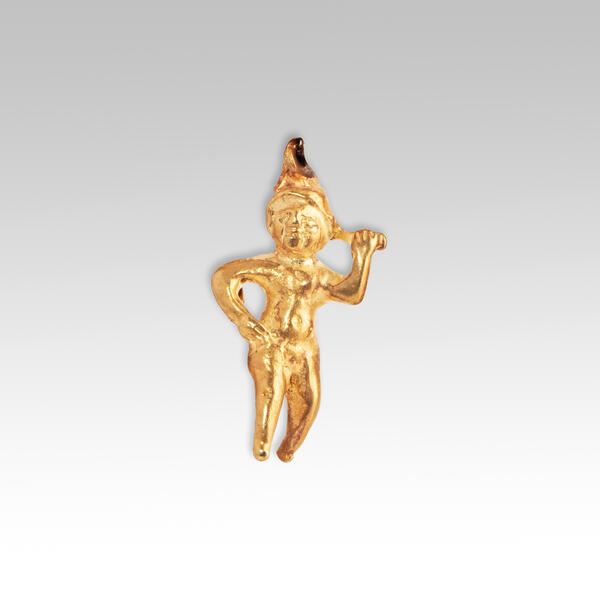
The earrings from the museum’s collection feature a complex decorative design with a cast figurine of the Phrygian deity Attis in the center.
Both earrings have a closure — an ear wire. It is a hook made of wire that is round in cross section. Several decorative elements are affixed to it in the form of two curls that mirror each other along the vertical axis, as well as a setting with an insert made of glass. The outer surface of the setting is adorned with granulation — granules that are arranged in a circular pattern in a single line.
The granulation technique can be applied in a variety of ways. Granules can be dispersed throughout the ornamentation, border parts of the item in several lines, appear as independent decorative elements of rhombuses and triangles, as well as form relief pyramids and groups.
The process of creating and attaching the granules required great skill, accuracy, and patience on the part of the craftsman. In order to produce a large number of identical granules, it was necessary to measure and cut wire to an equal length. These wires were then placed in even rows into the recesses using tongs, before being heated to melting point. The molten metal flowed into the recesses and solidified into granules.
A significant decorative element of these earrings is an anthropomorphic golden figurine depicting Attis.
Attis, a Phrygian god, was a deity associated with Asia Minor. He was a god of nature, vegetation, and fertility, and was mythologically linked to the mother goddess Cybele, who was the mother of all things. Attis was a shepherd and Cybele, the mother of all gods, fell in love with him. After suffering a fatal wound during a hunting trip, he transformed into a pine tree.
In Asia Minor and then in Rome, where the cult of Attis was adopted by the local population, his death and resurrection were commemorated annually. Attis is considered a chthonic deity, as he represented rebirth. His images were placed on sarcophagi and his clay figurines were produced for burials. The magical power embedded in the image of the deity was thought to enhance the efficacy of objects with sacred significance, including jewelry.
Close analogs of these earrings have been found in the Ust-Alma burial site in the Bakhchysarai region of Crimea, in a burial from the middle of the 1st century CE.