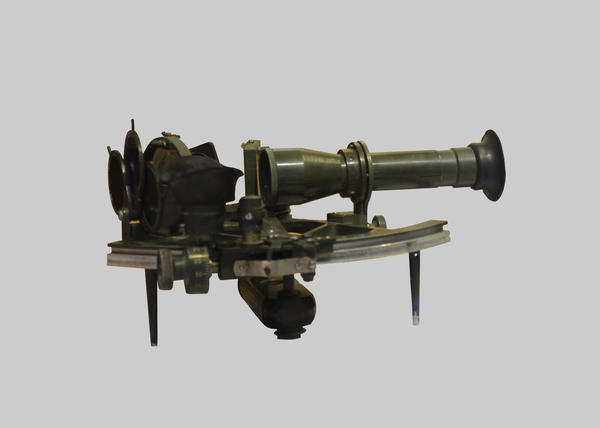
Sextant is an angular reflection-type instrument, one of the symbols of navigational service. Altitudes of celestial bodies above the horizon are sighted from moving vessel by dint of sextant, as well as angles in any plane are measured. This makes it possible to fix actual geographic coordinates of the vessel. The skill of working with marine sextant is the hallmark of a true navigator.
The word ‘sextant’ comes from Latin ‘sextantis’, one-sixth part of anything. The instrument was called so after its arc length equal 60° or 1/6 of the circuit. Disputes are still on how the word should be pronounced in Russian: ‘sextant’ or ‘sextan’ because in English there is letter ‘t’ at the end of the word.
Many reputable Russian seafarers used the word ‘sextant’ in their records made in Russian, but today such a spelling is considered to be unprofessional among Russian seamen.
The principle of matching two objects by way of two successive reflection of one of them is implemented in the sextant. We have to be grateful to Sir Isaac Newton for this idea, though he never made his invention public. Laurels of inventors were received by Englishman John Hedley and American Thomas Godfrey who worked independently of each other. Astrolabe ceased to be the main marine instrument when sextan was invented.
The principle elements of sextant design are two mirrors: fixed small round (horizon mirror) and movable large square (index mirror). For example, in the process of sighting the altitude of Sun above the horizon, the observer brings the reflection of the Sun lower edge in coincidence with the line of horizon by moving the index bar.
To decrease brightness and protect eyes, shades of various densities are used. The data obtained are interpreted by way of simple mathematical manipulations. Sextant can measure angles with the accuracy up to.1/10 of arc minute.
If the frame of this very delicate optomechanical instrument becomes deformed that can happen as a result of a drop, its settings will get busted. It is therefore necessary to keep sextant dry, avoid temperature shocks and not to drop it. Additionally, the instrument needs periodic adjustment.
In the process of observation the navigator holds the instrument at the handle. Sextant is placed on horizontal surface when not used, resting on special legs. It is stored in a case with clamp.
An ancient astronomic instrument was also called sextant. Johannes Hevelius gave name to a new equatorial constellation in honor of his favorite sextant burnt together with his observatory in 1679. It was no coincidence that he placed ‘Sky Sextant’ (Latin: Sextans) between Leo and Hydra (the constellations of fiery nature, in view of the astronomers of that time). By his own account, the scientist decided that ‘Vulcan won over Urania’, i.e. the Roman god of fire wiped out the muse of astronomy).
The word ‘sextant’ comes from Latin ‘sextantis’, one-sixth part of anything. The instrument was called so after its arc length equal 60° or 1/6 of the circuit. Disputes are still on how the word should be pronounced in Russian: ‘sextant’ or ‘sextan’ because in English there is letter ‘t’ at the end of the word.
Many reputable Russian seafarers used the word ‘sextant’ in their records made in Russian, but today such a spelling is considered to be unprofessional among Russian seamen.
The principle of matching two objects by way of two successive reflection of one of them is implemented in the sextant. We have to be grateful to Sir Isaac Newton for this idea, though he never made his invention public. Laurels of inventors were received by Englishman John Hedley and American Thomas Godfrey who worked independently of each other. Astrolabe ceased to be the main marine instrument when sextan was invented.
The principle elements of sextant design are two mirrors: fixed small round (horizon mirror) and movable large square (index mirror). For example, in the process of sighting the altitude of Sun above the horizon, the observer brings the reflection of the Sun lower edge in coincidence with the line of horizon by moving the index bar.
To decrease brightness and protect eyes, shades of various densities are used. The data obtained are interpreted by way of simple mathematical manipulations. Sextant can measure angles with the accuracy up to.1/10 of arc minute.
If the frame of this very delicate optomechanical instrument becomes deformed that can happen as a result of a drop, its settings will get busted. It is therefore necessary to keep sextant dry, avoid temperature shocks and not to drop it. Additionally, the instrument needs periodic adjustment.
In the process of observation the navigator holds the instrument at the handle. Sextant is placed on horizontal surface when not used, resting on special legs. It is stored in a case with clamp.
An ancient astronomic instrument was also called sextant. Johannes Hevelius gave name to a new equatorial constellation in honor of his favorite sextant burnt together with his observatory in 1679. It was no coincidence that he placed ‘Sky Sextant’ (Latin: Sextans) between Leo and Hydra (the constellations of fiery nature, in view of the astronomers of that time). By his own account, the scientist decided that ‘Vulcan won over Urania’, i.e. the Roman god of fire wiped out the muse of astronomy).