Font
Color
Graphics
Изображение точки

To see AR mode in action:

1. Install ARTEFACT app for iOS or Android;

2. Find the exhibition «The Indigenous People: Lifeways and Trades»

3. Push the «Augmented reality» button and point your phone's camera at the exhibit;

Скрыть точки интересаПоказать точки интереса
Показать в высоком качестве
#1

Saddle

#3

The Shors and nomadic herders viewed the horse in a completely different way. Leonid Pavlovich Potapov described this difference in his “Essays”:“Catching a horse, saddling was such a nuisance. It was better to walk a kilometer or two, unlike a southern Altaian, who, if he had a horse, would ride a horse even for half a kilometer, considering it indecent to walk.”

This affected both the degree of development of horse breeding in general and the production of horse equipment, including saddles. The “Essays” specify that the horse saddles of the Shors were“simple pieces of wood, often without a soft cushion and with one girth made of rope, saddled almost on the bare back of the horse.”

A high quality balanced saddle distributes the rider’s weight evenly on the horse’s back and makes it easier for the horse to move, otherwise the animal could be physically harmed.

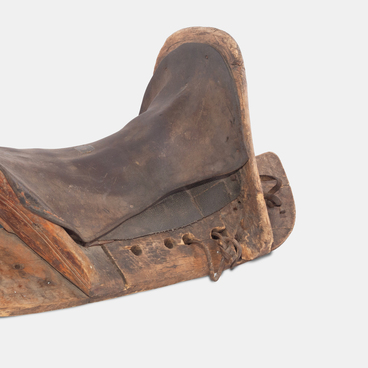
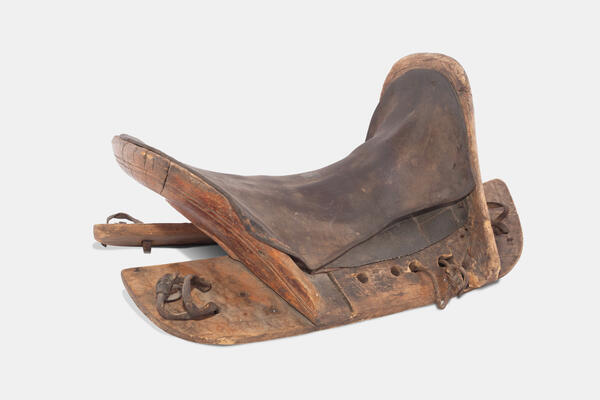
As a rule, the saddle was assembled on an “archak” tree. It was made entirely of wood, the low curved front and rear parts of the saddle followed the shape of the horse’s back. In composite wooden saddles, the front and rear parts of the saddle were attached to the saddle tree with leather straps. The upper part of the saddle could be made more comfortable by padding it with a layer of felt and covering it with leather on top. A felt padding was also placed under the saddle, which was pulled up to the horse’s croup using a girth made of kendyr threads. The shock-absorbing saddle pad, which modern riders place under their saddle cloth to protect the horse’s back from mechanical damage, was not used.

The saddle presented in the exhibition resembles a cavalry one. This sophisticated item was created in a later period and belongs to a group of saddles that riders used in training and works. The rider was to remain on horseback for a long time while grazing livestock or during multi-day trips in unpredictable weather and road conditions. The wooden tree was commissioned to fit the individual measurements of both the horse and the person. For the covering, pigskin was most likely used, previously treated with steam to fit the base. The low pommel is located above the horse’s withers providing protection. The cantle is slightly higher and provides a comfortable riding position.
#4
Name: Saddle
Date of creation: the 20th century
Place of creation: Russia
Technique: leather, metal, wood
Dimensions: 49×34×28 cm
#2
Horse collar
#6

According to the characteristic features of horse equipment, the development of Shor horse-riding transport was influenced by the culture of Central Asian nomads. As for horse-drawn transport, it was influenced by Russian settlers. In the mountain taiga region of Siberia, the main means of transport were wooden sleds with two runners, to which the horse was harnessed using a Russian shaft bow and a “koop” horse collar.

Thanks to this part of the harness, the load was evenly distributed on the horse’s neck and shoulder girdle, and the efforts to move the cart or plow were directed in the desired direction.

Before the horse collar, a soft yoke was placed around the animal’s neck. The heavier the load required to be pulled, the more pressure was placed on the chest, which made it difficult for the horse to breathe and led to rapid exhaustion. This approach significantly limited the use of horse traction.

An improved rigid model of a “collar” appeared in the 7thcentury in the East; in the second half of the 10th–11thcenturies, Europeans became acquainted with it, and then it appeared in Rus.

Unlike the yoke, the horse collar has an advantage — it does not compress the animal’s trachea and allows it to push the weight with the back of the body and legs, rather than pull it on the shoulders.

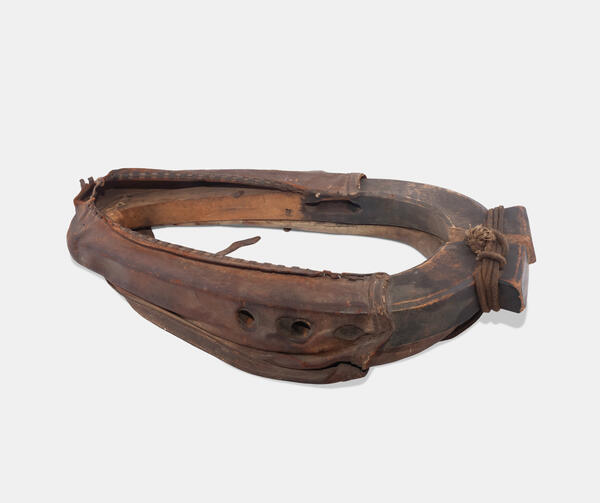
This device consists of a lining (“khomutina”) and a pair of curved wooden parts to which traces are attached — rope or leather loops that are necessary to hitch the horse to the shaft. To allow the animal’s head to pass freely through the horse collar, they are slightly moved apart. After the horse collar is put on the horse, the lower ends are tightened with a narrow and durable belt made of rawhide. This provides a closer and more comfortable fit to the animal’s body.

The oval shape of the clamp also contributes to a tight fit. In places where the collar touches the skin, the rigidity of the structure is softened by an elastic soft lining. It looks like a roller and is made of leather or fabric and stuffed with sponge, hair, straw, or other shock-absorbing filler, sometimes even wool or felt is used. When the harness is adjusted correctly, a small gap no bigger than the width of a palm remains between the horse’s throat and the collar. Two fingers should fit freely between the top of the collar and the animal’s neck.

#7
Name: Horse collar
Date of creation: the mid-20th century
Place of creation: Gornaya Shoria, the USSR
Technique: wood, leather

№: 25458805

#5
read morehide

Saddle, Horse collar

0
Point your smartphone camera to open in the app
Share
VkontakteOdnoklassnikiTelegram
Share on my website
Copy linkCopied
Copy
Open in app
To see AR mode in action:
  1. Install ARTEFACT app for 
  2. iOS or Android;
  3. Find and download the «Paintings in Details» exhibition
  4. Push the «Augmented reality» button and point your phone's camera at the painting;
  5. Watch what happens on your phone screen whilst you flip through the pictures.
 
We use Cookies
Cookies on the Artefact Website. We use cookies to ensure that we give you the best experience on our website. If you continue without changing your settings, we'll assume that you are happy to receive all cookies on the Artefact website. However, if you would like to, you can change your cookie settings at any time.
Learn more about useHide
Content is available only in Russian

X

Нашли опечатку?...

%title%%type%