The Mordvins are a Finno-Ugric people, which is divided into two sub-ethnic groups — the Moksha and Erzya. They live mainly in the Russian Federation. About a third of them live in Mordovia, as well as in neighboring regions: Nizhny Novgorod, Penza, Tambov, Ryazan, Samara, and Moscow.
In the past, Mordvinian clothing was one of the notable ethnic determinants that distinguished this people from others. The outfits of the Moksha and Erzya had specific features characteristic of each of these groups. The Erzya and Moksha types of the Mordovian costume included at least a dozen and a half varieties.
A special role in traditional womenswear was given to the headdress. Headdresses strictly corresponded to the wearer’s age and marital status, and complemented the dress. Like other peoples, the Mordvins had different headdresses for girls and young women.
For girls, the most common type of headdress was a headband in the form of a hoop made of bast or cardboard, covered with fabric and decorated with embroidery, beads, and braid (ashkorks, purdavks — for the Moksha, and patsya konya or prya syuks — for the Erzya). The headband could also be soft.
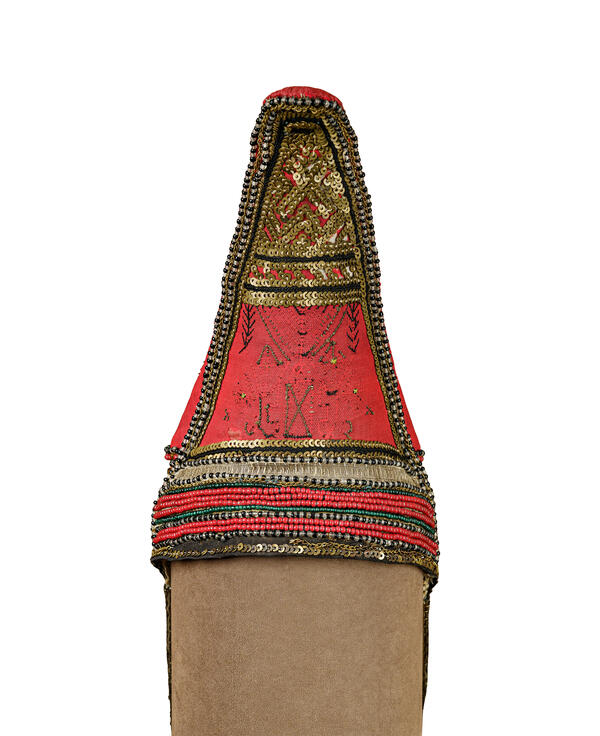
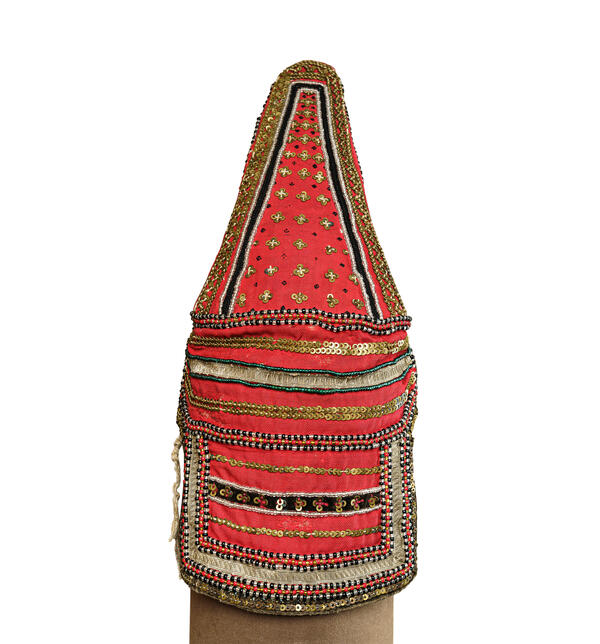
Erzya headdresses for adult women (pango soroka, sorka, shlygan) were tall, made with a solid base and came in the shape of a cylinder, a half-cylinder, and a cone. The base of the headdress was made of bast or birch bark. The front part was often decorated with archaic embroidery, reminiscent of ancient pictographs.
A tall headdress on a solid base of conical or rectangular shape called pango was common mainly among the Erzya. The birch bark or bast base was covered with red cloth and decorated. A small embroidered piece of fabric descended to the back of the neck.
The hairstyle also depended on the headdress: for example, in Erzya villages, women made one braid on the top of the head and twisted it into a tight knot — a “kokol” — above the forehead. A tall pango headdress could be securely worn with this hairstyle.
The Moksha wore trapezoidal caps. Head towels or
shawls were also used. Traditionally, women abundantly embellished their
headdresses to distinguish them from others.