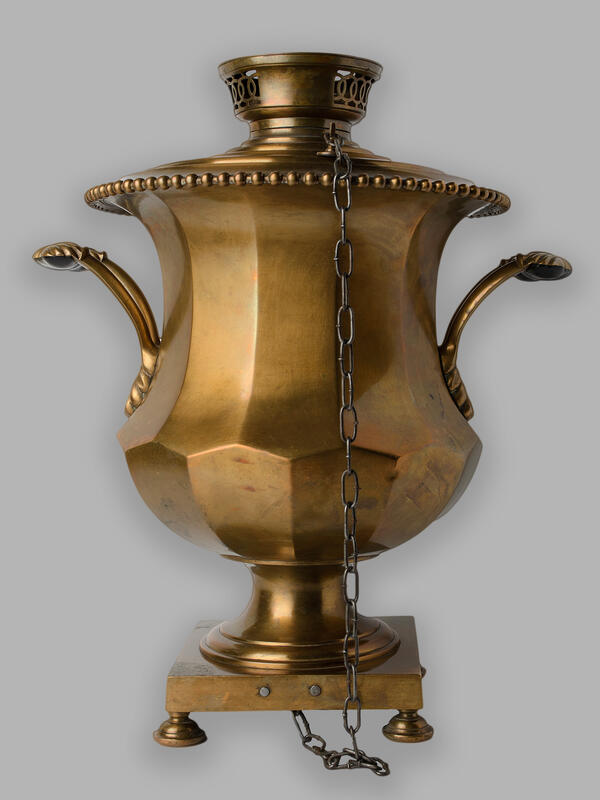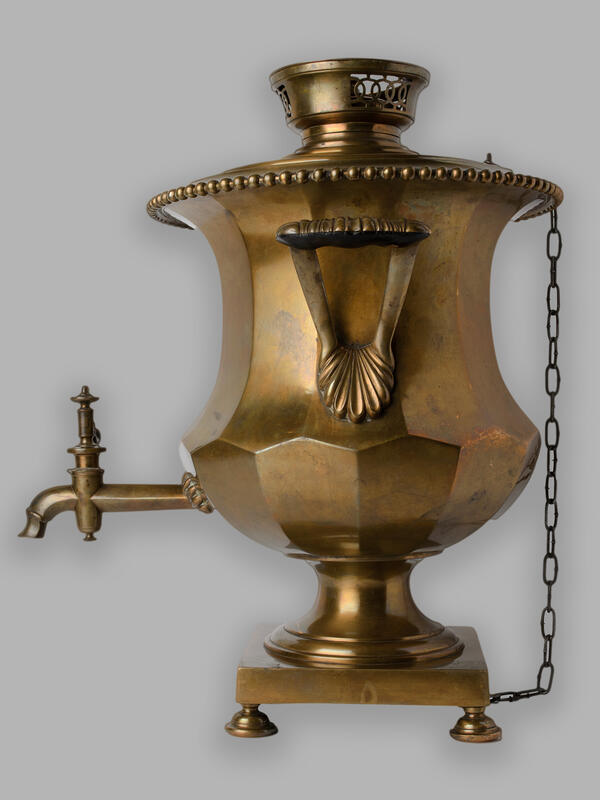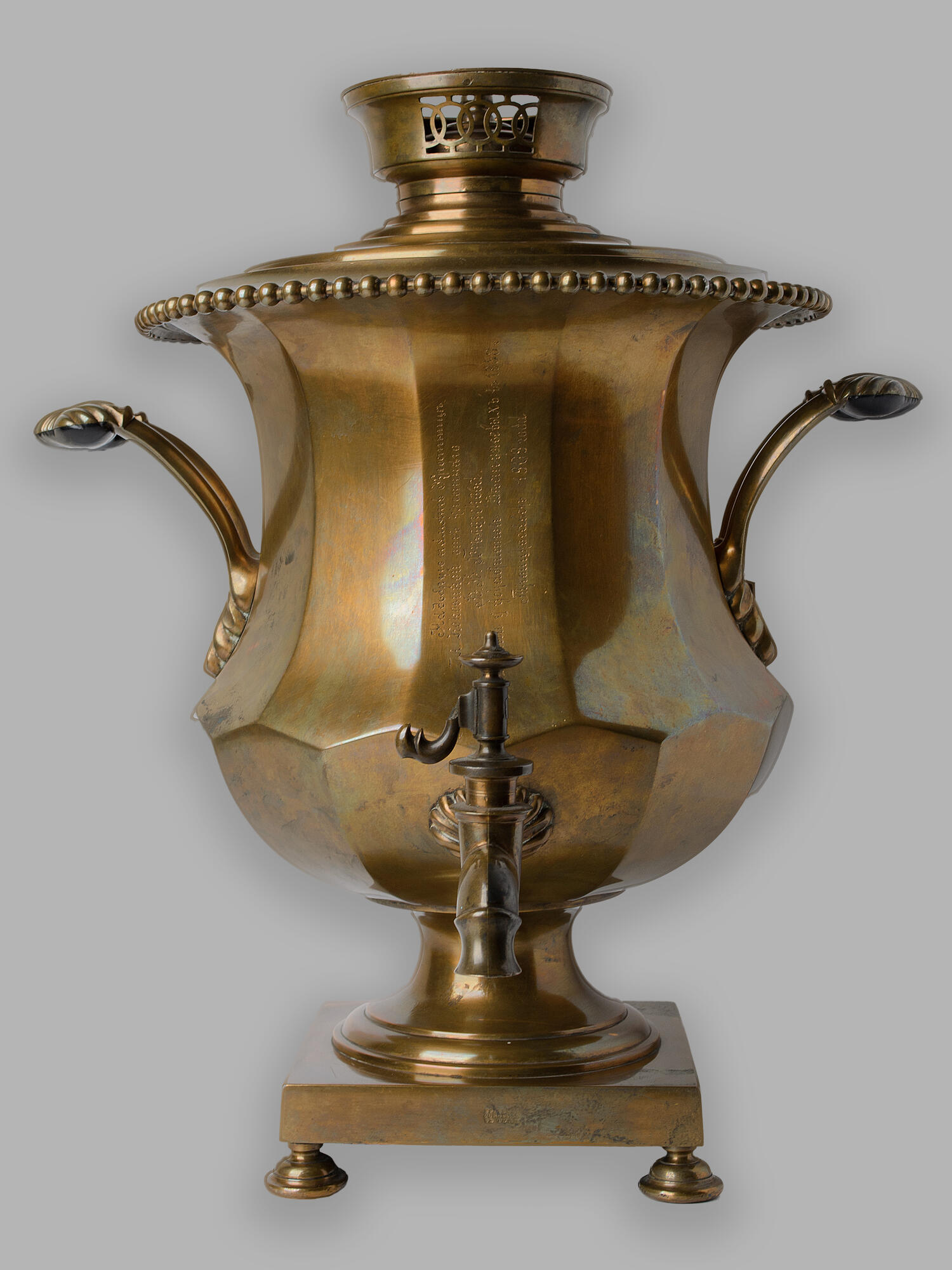


The samovar from the collection of the Kyakhta Museum of Local Lore is made in the shape of a long-neck vase. It has faceted walls, a stepped lid, and handles made of paired plates.
The lower part of the base is a flat wooden plate. The handles are attached to the body using a leaf-shaped relief overlay. The escutcheon plate around the faucet is round and embossed.
The valve handle is a curved, s-shaped relief plate. In this samovar, it is stylized as a plant stem. The neck, or the part at the bottom of the body, is short. The tray is square and flat. The legs are shaped like rounded rods on a flat base.
The vase samovar is a memento. It features an engraving that provides information on its origin, “For goddaughter G.A. Kokovina to remember her godfather B.V. Belozyorov. Purchased from the Decembrists Bestuzhevs in Troitskosavsk in 1858. 1909.”
The inscription means that the samovar was purchased by the Kyakhta merchant Boris Belozyorov from the Decembrist Mikhail Bestuzhev, brother of Nikolay Bestuzhev. The vase samovar was manufactured at the factory of the Somov brothers.
The factory is believed to have been founded by Praskovya Somova in 1841. However, its potential was only unlocked in the 1850s–1860s when the management was overtaken by the founder’s sons, both named Ivan Somov. The factory’s products were distinguished by their own style and a variety of forms and details. The product range included samovars shaped like faceted vases, jugs, and kraters with segments and facets.
In his story
“Shlisselburg Station”, Nikolay Bestuzhev reflected upon tea drinking,