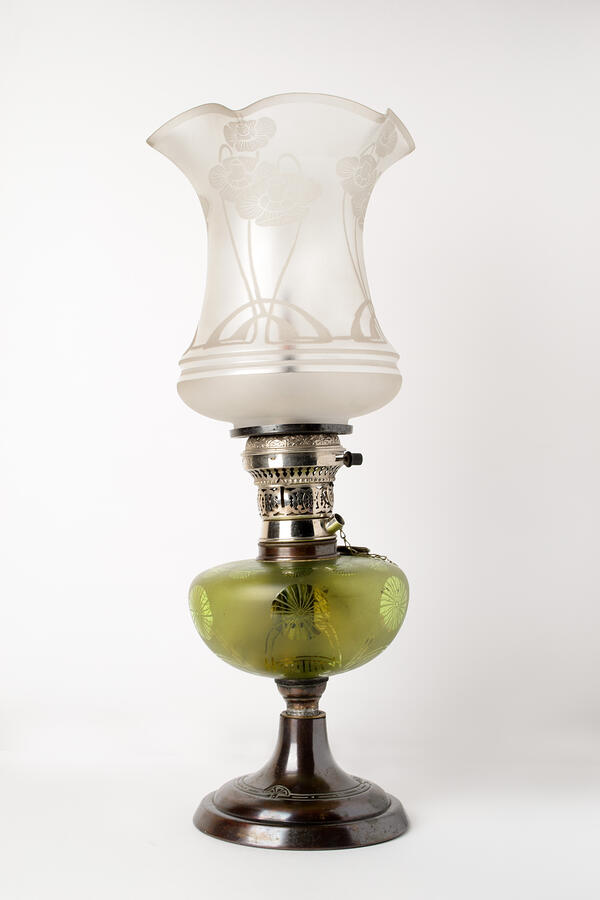
In the early 20th century, kerosene lamps were still widely used in the Russian Empire. They shone a little brighter than candles. Despite their popularity, kerosene lamps became obsolete after the widespread introduction of electric lighting. However, they remained popular in areas without electricity and continued to be used by tourists.
Traditionally, the size of wicks and glass tubes for kerosene lamps was indicated in lines, an old unit of length. For example, the diameter of the glass tube at the bottom could be equal to 20 lines or 50.8 millimeters.
A lamp that had a wick with a width of 7 lines or 18 mm became known as a seven-line lamp. Kerosene lamps differed from each other in burning time and brightness. Depending on the design, a lamp could burn from 4 to 20 hours and produce light equivalent to 5 to 400 watts.
The principle of operation of a kerosene lamp is simple: kerosene was poured into a fuel tank, from where it was supplied for combustion in the correct amount. The burner could be equipped with means for supplying air and removing combustion byproducts, as well as protecting the flame. The lamp had a frame for carrying and hanging the lamp. Reflectors could be used to concentrate the light into a beam.
At present, there are several designs of kerosene lamps. Most popular are the traditional lamps with a flat or circular wick where kerosene is drawn up from the tank through a wick by capillary action.
Kerosene lamps require the wick to be frequently adjusted and are equipped with a special mechanism. By adjusting the wick length, a user can control the lamp’s brightness. A long and uneven wick should be trimmed from time to time using scissors to avoid the production of soot. The wick is usually made of cotton.
In the past, there were numerous types of kerosene
lamps: some were equipped with a system for pre-heating the air for better
combustion, while others protected the fuel from spilling if a lamp was knocked
over. There were also wind-resistant lamps for outdoor use, explosion-proof
mine lamps, and lamps with reflectors.