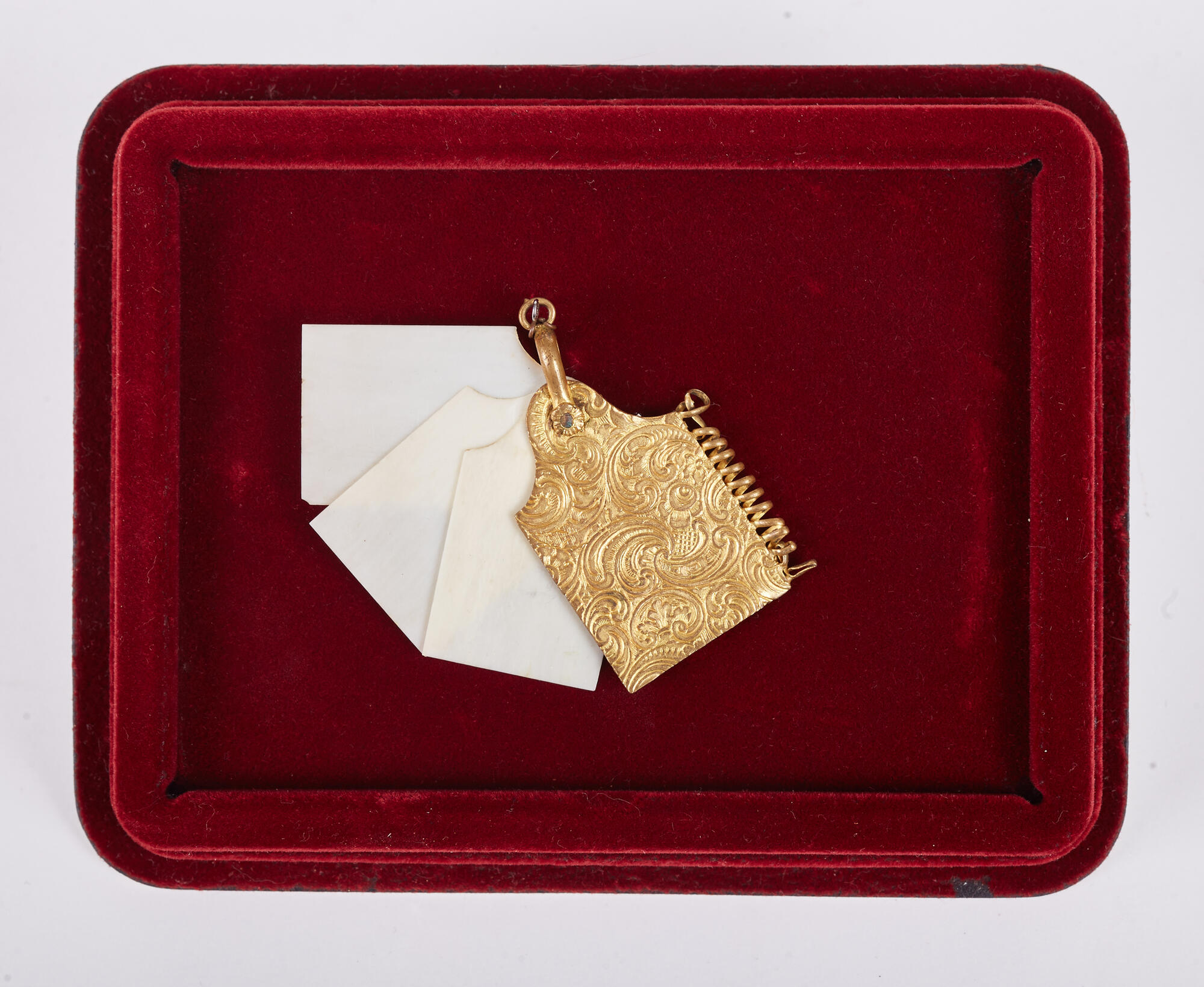


The exhibition of the Zheleznodorozhny Local Lore Museum presents a dance card — a booklet with a pencil or a box with leaves, where a lady wrote down the gentlemen whom she intended to dance with.
Dance cards first appeared in the 18th century and continued to be used until the end of the 19th century. At first, dance cards became very popular in Vienna, and then became widespread in Europe, Russia and the USA.
Even though balls lasted for many hours, it was considered improper for a lady to forget that she had already promised a dance to someone and accept an invitation from someone else instead. Another unforgivable mistake at a ball was to agree to dance with two gentlemen at the same time. Not only was this considered bad manners, but it could also lead to a duel. A miniature notebook helped to remember the order of the dance partners — agenda (from English agendum), carte de bal (French) — “dance card”, or carnet (French) — “notebook, notepad”. Such booklets came with a small pencil and were attached to the lady’s waist with a special clip. Over time, dance cards became highly decorative. Thus, Prince Grigory Potemkin gave Catherine II a gold carnet, covered with transparent blue enamel and decorated with half pearls, opals, emeralds and the inscription meaning “Token of Gratitude” laid in diamonds.
In her book on etiquette, Kleopatra Svetozarskaya emphasized that the role dance cards played was “very modest — simply to prevent the memory from making mistakes, and not at all to be material evidence of brilliant social achievements.” And yet, dance cards were often used by vain belles to do just that — boast about their success in society.
The
dance card presented at the exhibition is a miniature album with a
golden-colored rectangle metal cover and bone leaves. The cover is decorated
with relief floral patterns. Metal loops, presumably made for a small pencil,
are attached along the side edge. The sheets are fastened with a bigger loop,
and there is also a round loop for attaching the card to the dress.