The museum houses a unique musical instrument — a royalino. It is a baby grand piano, shaped like a triangle with beveled corners. It was invented by the Moscow piano maker Alexander Magnus Meybom.
Alexander Meybom opened his own piano workshop in Moscow in the early 1840s. According to the 1848 reference book, it was located in the House of Voyeikova on Myasnitskaya Street.
The address book of the same year mentioned Mr. Meybom as the inventor and manufacturer of an instrument called royalino, which was noted for “tuning stability, pleasant tone, and convenience.” The craftsman had been granted a privilege, essentially a patent, for the royalino three years earlier, on June 16, 1845.
Alexander Meybom was last mentioned in Moscow address books in 1855. According to the publication, Meybom was a 3rd-guild merchant and lived on Varvarskiye Vorota Square in the House of Makarov. In 1858, the craftsman moved to Reval together with his family.
The royalino was intended for playing music and giving small concerts at home. Legend has it that Meybom initially wanted to name his invention the “royalet”, by analogy with the spinet — a small keyboard instrument, a type of harpsichord. However, eventually, he decided to give it a name that he and his friends found more elegant.
This instrument is notable for its balanced proportions. The pedalboard attracts attention with its unique shape. It is made of wood and stylized as a lyre with metal strings.
The three faceted legs of the instrument, tapering towards the bottom, stand on metal wheels, making it extremely convenient to move the instrument around the house. The pedals are made of yellow metal. The surface of the royalino is finished with precious wood veneers.
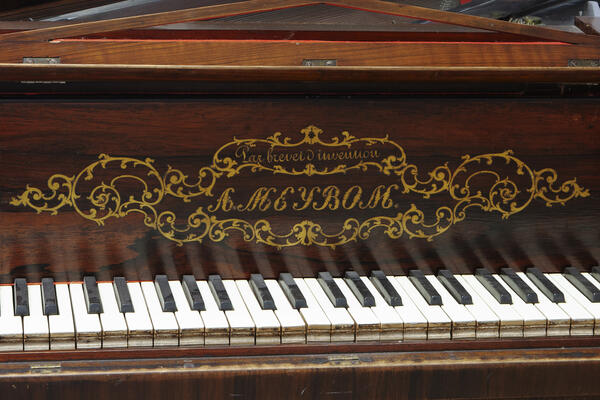
On the inside of the lid, framed by numerous floral scrolls, there are inlaid inscriptions in French “Par brevet d’invention” and below “A. Meybom”. The inscriptions mean that this is an authentic instrument created by the craftsman who holds a patent for this invention.
Alexander Meybom opened his own piano workshop in Moscow in the early 1840s. According to the 1848 reference book, it was located in the House of Voyeikova on Myasnitskaya Street.
The address book of the same year mentioned Mr. Meybom as the inventor and manufacturer of an instrument called royalino, which was noted for “tuning stability, pleasant tone, and convenience.” The craftsman had been granted a privilege, essentially a patent, for the royalino three years earlier, on June 16, 1845.
Alexander Meybom was last mentioned in Moscow address books in 1855. According to the publication, Meybom was a 3rd-guild merchant and lived on Varvarskiye Vorota Square in the House of Makarov. In 1858, the craftsman moved to Reval together with his family.
The royalino was intended for playing music and giving small concerts at home. Legend has it that Meybom initially wanted to name his invention the “royalet”, by analogy with the spinet — a small keyboard instrument, a type of harpsichord. However, eventually, he decided to give it a name that he and his friends found more elegant.
This instrument is notable for its balanced proportions. The pedalboard attracts attention with its unique shape. It is made of wood and stylized as a lyre with metal strings.
The three faceted legs of the instrument, tapering towards the bottom, stand on metal wheels, making it extremely convenient to move the instrument around the house. The pedals are made of yellow metal. The surface of the royalino is finished with precious wood veneers.
On the inside of the lid, framed by numerous floral scrolls, there are inlaid inscriptions in French “Par brevet d’invention” and below “A. Meybom”. The inscriptions mean that this is an authentic instrument created by the craftsman who holds a patent for this invention.