Back in the middle of the 19th century, the ethnographer Vasily Vasilyevich Radlov described Shor houses as “almost empty inside, since [Shors] do not have the habit of possessing anything other than the clothes they wear on their bodies.” The main types of “home” production were the processing of birch bark and wood.
At the same time, the Shors considered birch to be a sacred tree, a tree of happiness. This
special attitude was associated with religious beliefs: birch wood was used to create objects for religious purposes. According to the Shors, in the distant past, each clan had its own type of tree from which it traced its origin. Representatives of the clan treated their tree with great respect. They never cut it down, and if such a need arose, they invited a person from another family. Arriving at the hunting site, the Shors first chose a mighty (sacred) cedar or fir.
Russian settlers in Siberia brought many crafts that had been unknown to the indigenous population, including those related to wood processing, carpentry and making sleighs, wheels, and carts. The Siberians, including the Shors, mastered new work technologies necessary for the manufacture of spindles, distaffs, and other household items.
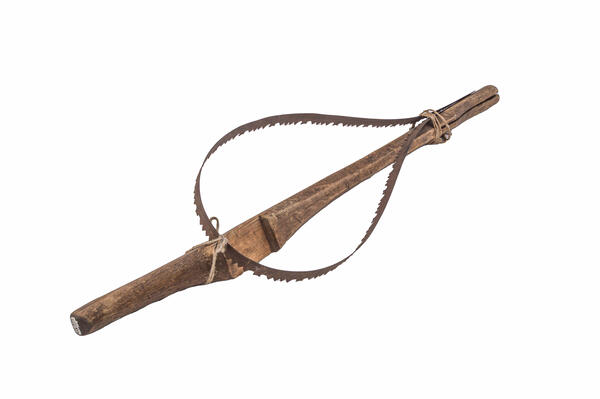
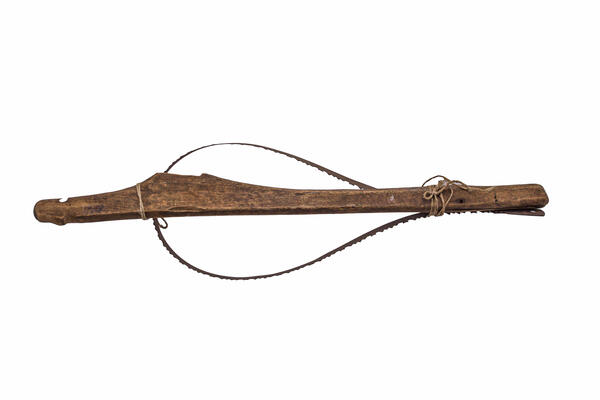
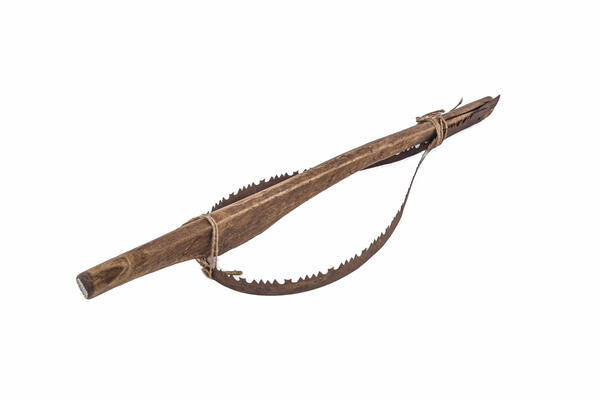
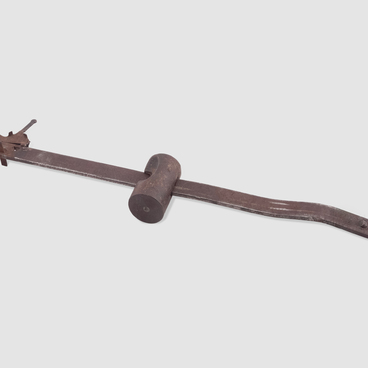
The tools that were new for the Shors included a two-handed bow saw charbek (cherbek) for sawing wood along the grain.
The “bow” instrument received its name for its similarity with the weapon of the same name: the same principle of elasticity and the presence of a bowstring made of flax or hemp rope.
A bow saw can be used to make cuts in both dry and wet wood. The tool consists of three solid racks (a horizontal center and two vertical side ones), which are not only carefully processed, but often varnished. Racks are made from hardwood, such as oak, ash or hornbeam. In the lower part of the vertical posts, identical symmetrical through holes are made for attaching both handles.
Between the middle post and the bowstring there is an auxiliary bar — a latch, the rotation of which ensures the tension of the bowstring and, consequently, the iron part between the handles.
The remarkable thing about a bow saw is that its
blade never jams at the cut site, although sawing can be hard in difficult
areas.