Before irons came into use, homespun, linen and hemp towels, tablecloths and other household items were treated after washing with a rubel. Without this, the fabric became rough and creased.
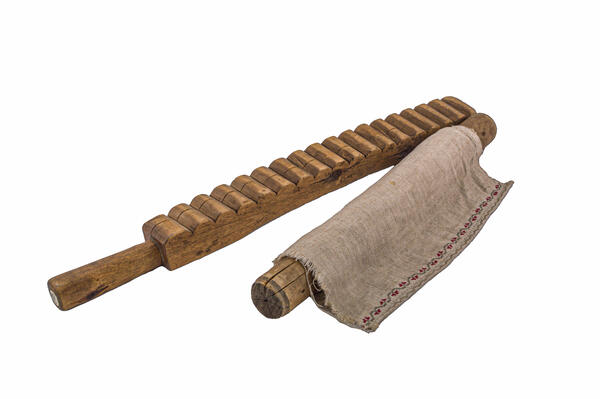
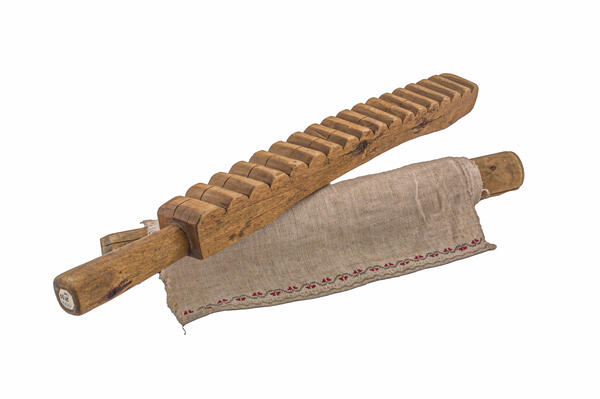
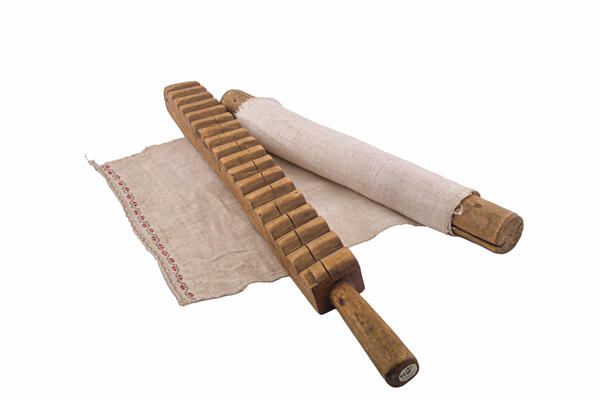
A rubel is a long wooden board with cut-out transverse grooves. The wooden blank was processed manually: the ends of the rubel were smoothed, the sharp corners on the edges were rounded using a file. The handle was carved from the same blank. Rounded notches were cut across on one side of the board, the other was left smooth, and sometimes decorated with intricate carvings. A rubel was used along with a roller — a smooth wooden cylinder with a diameter of 4–6 centimeters and a length of about 80 centimeters. Sometimes an ordinary kitchen rolling pin was used instead.
After washing and rinsing, the Shors wrung out the linen and wound onto a roller, trying to fit its size. Then the rubel was rolled with force along the resulting roll several times with the jagged side. With this mechanical method of ironing, not only was the water squeezed out of the washed item, but at the same time the small remaining pieces of dirt were expelled.
The rubel is also known as a musical instrument. In the old days, artisans left a hollow space in its handle and put dried peas inside: in the Russian North there was a belief that the rumble during operation drives evil spirits away. Over time, the sound of the rubel began to be used outside of the ritual space.
The musical rubel, unlike the household rubel, is made somewhat shorter, completely hollow, and the notches have sharper edges. A non-through resonator cavity is drilled into one of the end sides, which produces a loud sound. The handle, as before, can be made hollow and filled with peas or other small objects.
The performer holds the handle with one hand, and
with the other runs a wooden spoon or stick along the ribbed surface with a
characteristic “crackling” sound. Nowadays, musical rubels are found in folk
instrument orchestras or folk groups.