

Porcelain was invented in China around the 7th century. For a very long time, the Chinese kept the secret of porcelain from foreigners. Porcelain trade represented a significant share of the nation’s income. Only several centuries later did other countries master the production of the valuable “white gold”.
Japan organized its own porcelain production in the 17th century when Korean potters were brought to the country as slaves after Japan had invaded Korea. In 1867, the International Exposition was held in Paris, where Japanese porcelain was exhibited for the first time.
The exposition sparked a fascination with Japanese culture in Europe. The demand for Japanese decorative and applied arts surged. When Japanese potters produced tableware for export, they tried to give their products the shapes that were more familiar and understandable to Europeans. Still, certain details, including the painted images, always revealed their Japanese origin.
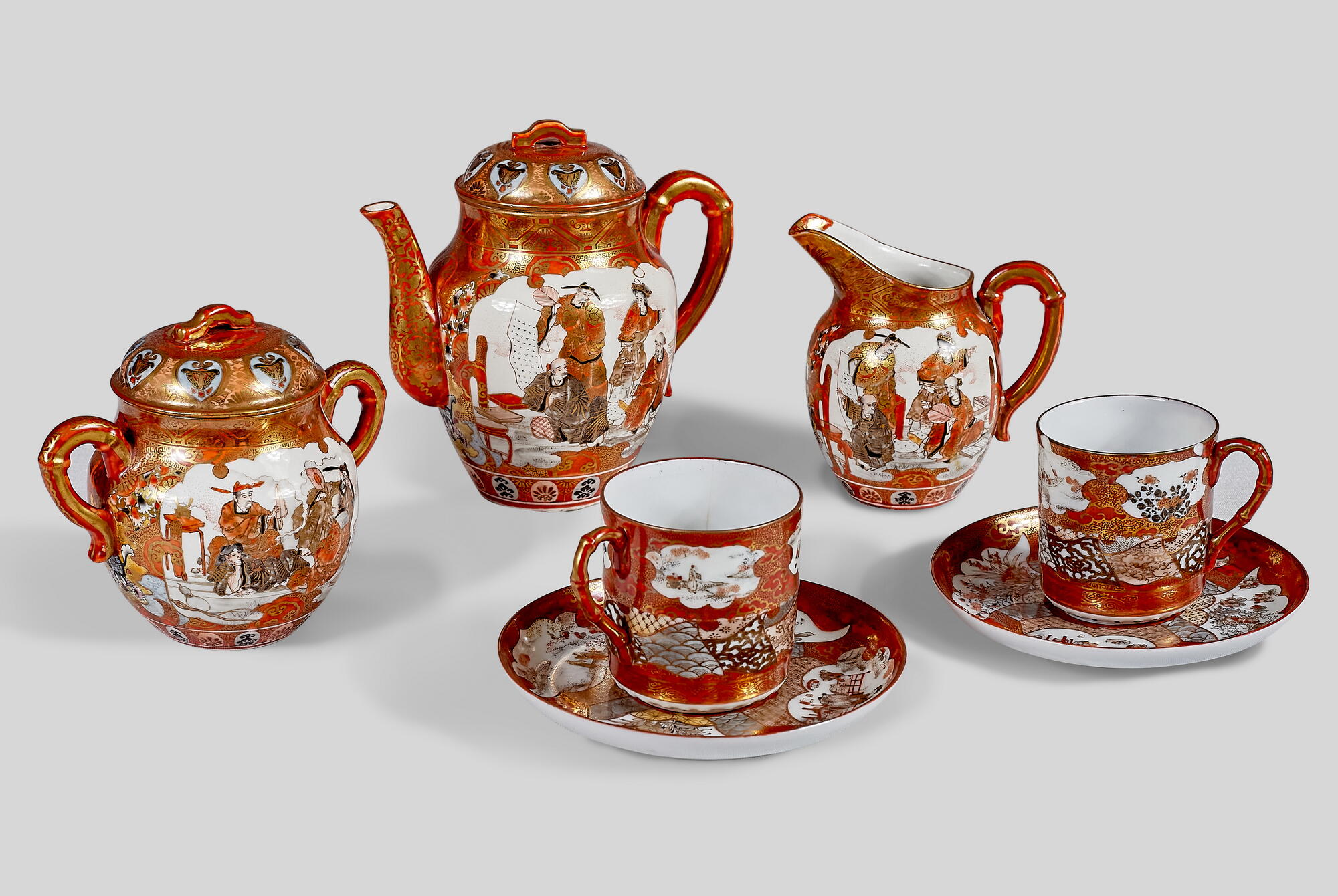
The tea set from the museum’s collection was produced at the turn of the 20th century in the style of Kutani ware. This style was named after its place of origin — the village of Kutani on Honshu Island.
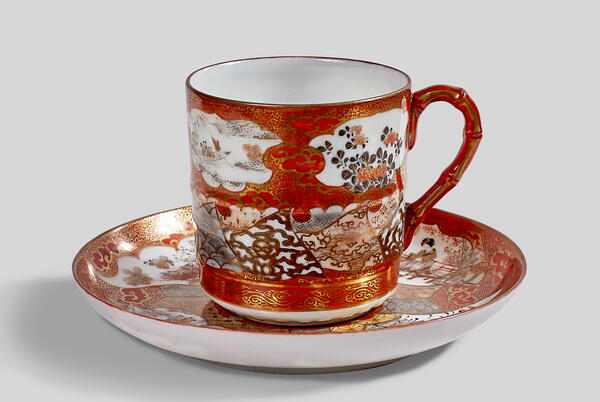
Kutani ware is so diverse that the style is divided into several subtypes, although the differences are not always obvious to foreigners. Such items as the tea set from the museum’s collection, with their exquisite genre scenes and rich gilding against a red background, were unmistakably recognized by Europeans as the “Japanese Kutani”.
All the set’s components are shaped according to European custom. However, such details as the bamboo-shaped handles, and the finials of the high, hemispherical teapot and sugar bowl lids, reveal their Eastern origin.
The white areas reserved for painting stand out against the red background. In these areas, the artist painted genre scenes in a delicate and exquisite manner. All the depicted people wear traditional Japanese clothing.
For these images, the artist used the same red and gold color palette as for the patterns around them. By doing so, the artist achieved a cohesive look despite the richness and variety of the ornamental motifs painted against the red background.
Japan organized its own porcelain production in the 17th century when Korean potters were brought to the country as slaves after Japan had invaded Korea. In 1867, the International Exposition was held in Paris, where Japanese porcelain was exhibited for the first time.
The exposition sparked a fascination with Japanese culture in Europe. The demand for Japanese decorative and applied arts surged. When Japanese potters produced tableware for export, they tried to give their products the shapes that were more familiar and understandable to Europeans. Still, certain details, including the painted images, always revealed their Japanese origin.
The tea set from the museum’s collection was produced at the turn of the 20th century in the style of Kutani ware. This style was named after its place of origin — the village of Kutani on Honshu Island.
Kutani ware is so diverse that the style is divided into several subtypes, although the differences are not always obvious to foreigners. Such items as the tea set from the museum’s collection, with their exquisite genre scenes and rich gilding against a red background, were unmistakably recognized by Europeans as the “Japanese Kutani”.
All the set’s components are shaped according to European custom. However, such details as the bamboo-shaped handles, and the finials of the high, hemispherical teapot and sugar bowl lids, reveal their Eastern origin.
The white areas reserved for painting stand out against the red background. In these areas, the artist painted genre scenes in a delicate and exquisite manner. All the depicted people wear traditional Japanese clothing.
For these images, the artist used the same red and gold color palette as for the patterns around them. By doing so, the artist achieved a cohesive look despite the richness and variety of the ornamental motifs painted against the red background.