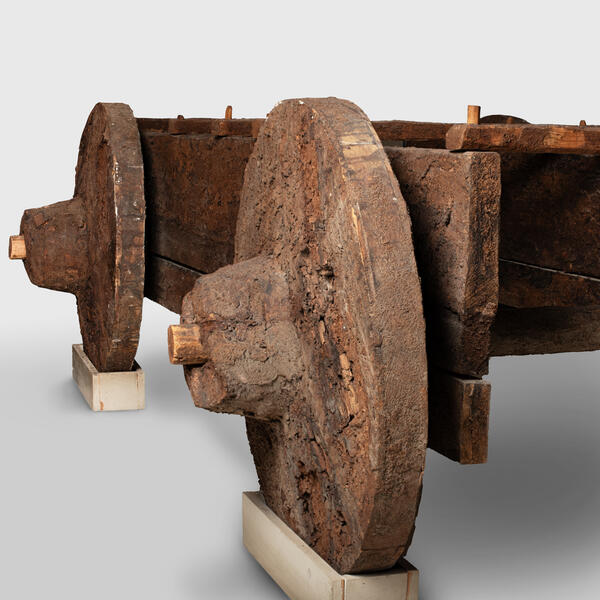
Fragments of a wheeled cart were discovered in 1962 during excavations at burial No. 6 in kurgan No. 2, near the farm Kudinov in the Bagayevsky district. The finds were dated to the second millennium BCE, the Bronze Age period. The burial was a catacomb-like structure, containing the skeletal remains of an adult individual.
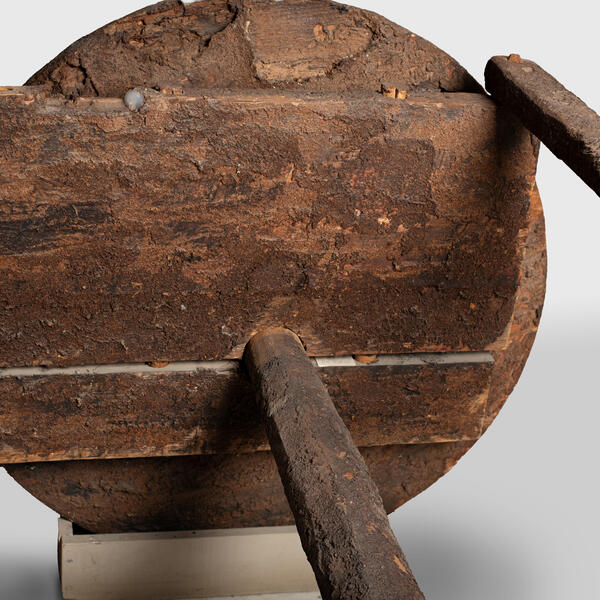
The wooden, four-wheeled cart was in a poor condition. The wood partially decayed. However, the wheels and remnants of the covering mat were clearly visible. This discovery was the first ancient cart that had been preserved to such an extent, where it was possible to scrutinize the details of its design. Yevgeny Arsenyevich Rumyantsev, a restorer from the State Hermitage Museum, carefully examined it and measured the various components. Subsequently, he reconstructed the appearance of the vehicle using modern materials and incorporating fragments of ancient wood that had been preserved as decorations.
Researchers determined that the axles of these wagons were fixed. The wheels were made of three thick wooden boards, which were joined together with wooden pegs. In the center, there was a large protruding hub unit. The body of the wagon was supported by a rectangular frame, made from heavy longitudinal beams and lighter crosspieces. The cart may have had a kibitka-style design, consisting of a lightweight wooden frame covered in felt. A kibitka (or a yurt) is a portable, round tent covered and insulated with skins or felt.
The set of artifacts from burial No. 6 of kurgan No. 2 near the farm Kudinov indicates the high social status of the individual buried there. These items include bronze objects, a knife, and two bronze awls. One of the awls was likely used as a goad — a small pin attached to a stick used to drive oxen pulling the cart. The animals would be “goaded” to move forward. Additionally, a large vessel in the shape of a turnip and an ornately decorated clay incense burner on a cruciform stand were also found in the grave.
The deceased’s noble status and wealth were evident by the cart itself, which was an item of incredible value during the owner’s lifetime. It served as a home for the steppe dweller, and up to three people could reside in it.
More commonly, only a single wagon wheel or smaller replicas were placed in burials. The cart also played a role in a religious ritual. It was used as a dwelling during the individual’s lifetime, and was intended to become their home in the afterlife.