The torc on display was found in a burial chamber, along with other items. Based on the composition of the grave goods, it can be assumed that a female was buried there. Most likely, she was a member of the upper social class in the city of Tanais of the late Roman period. This group of people was closely associated with the Black Sea region of the period of late antiquity.
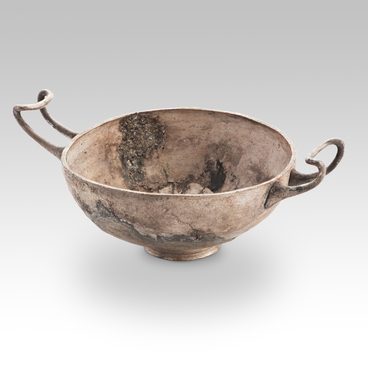
The grave goods included metal utensils, such as a bronze jug and a silver kantharos (a drinking vessel), as well as silver toiletries (vial, spoon, mirror, ear scoop, needlecase), and gold jewelry (torc, earring, pendant, necklace composed of various beads).
The oval torc is made from a twisted rod that is rounded in cross-section. It is thicker in the center of the item. One end of the torc has a flattened, rounded shape with a diameter of nine millimeters and a thickness of three millimeters. A round hole with a diameter of six millimeters is cut out in the center to allow for fastening. At the other end, a pyramidoid and triangular in cross-section lock cap with a flat, round base is soldered onto the rod.
Some researchers believe that the torcs and bracelets from the Scythian and Sarmatian periods are genetically related to the neck and wrist jewelry associated with Iranian peoples, as similar types of jewelry were commonly used in those regions.
Torcs were not simply pieces of jewelry for everyday wear, but rather had a special significance and were considered particularly prestigious items.
The decorations themselves varied: there were belts, necklaces, torcs, anklets, and shoulder and wrist bracelets. They were either in the form of a spiral or a closed or open circle. These types of jewelry were based on the idea of a protective ring, a universal concept in ancient worldview.
For centuries, Tanais served as the sole and primary trading center in the region. The city enjoyed the greatest prosperity in the period from the 1st century to the first half of the 3rd century CE, until it was defeated by the Goths.
According to the ancient Greek historian and geographer Strabo, luxury goods and household items “typical of a civilized lifestyle” spread from Tanais throughout Asian and European Sarmatia. The city was a vital economic, cultural, and political center that facilitated communication between the cities of the Bosporan Kingdom and the northern Black Sea region with the tribes inhabiting the steppes surrounding the city.