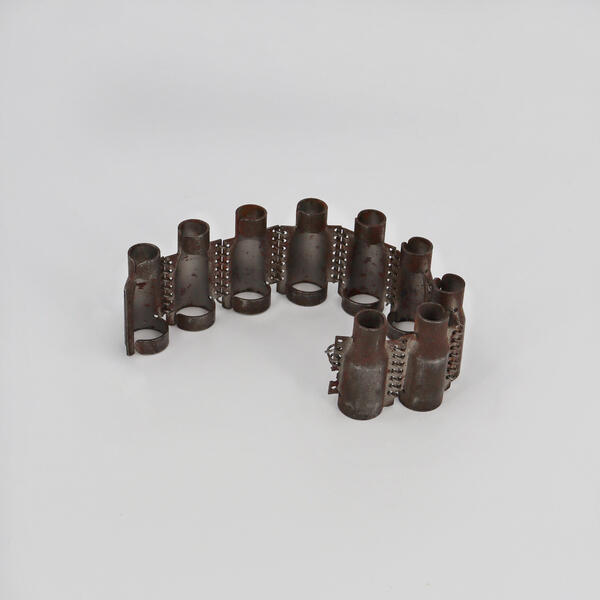
The machine-gun belt equipped with cartridges to feed small arms in combat became widespread along with the mounted machine gun, the famous invention of Hiram Stevens Maxim, that appeared in the 1880s. The belt consisted of two tarpaulin or canvas strips initially sewn together with cross seams at a spacing. The structure formed “nests” the cartridges were inserted into.
Soon, the original seams were replaced with metal strips tied with rivets. Such belts were used in machine-guns of the early 20th century. However, though enjoying a low cost of production, the fabric-based belts were of poor durability and too prone to damage due to moisture. If moistened or over-dried after being wet, the cartridge would be often stuck inside the gun, which led to frequent delays in firing. Nevertheless, the belts remained in service with the Red Army through the middle of the Great Patriotic War.
The first 24-round metal belts appeared in France. They looked like a steel plate about half a millimeter thick with longitudinal grooves and bent legs holding the cartridges. Later, metal belts were invented that had cartridges chained with hinged links.
Serial production of a flexible belt was launched by the Germans in 1917. Its peculiarity was that after use it crumbled into fragments. This drew the attention of aircraft machine gun manufacturers, since it was in the air that it was most difficult to dispose of spent cartridges and freed sections. The collapsible belt was commonly used in the Soviet air machine guns PV-1 and ShKAS.
During the Great Patriotic War, a fixed-length closed-link belt, previously used for Goryunov machine-guns and the latest modification of the domestically produced Maxim version, found its application in the Maxim machine-gun. Surprisingly, German machine-gun belts turned out to be fit for use with it, though with a tweak: the gunner had to load the cartridges backwards.
Even though they were known for good reliability and high feeding speed, metal belts also had their downsides, namely, high cost and susceptibility to corrosion. The Germans tried to eliminate the latter shortcoming by making some of the belts for air- and sea-borne machine guns of stainless steel.
Since the 1980s, attempts have been made to create ammunition belts of plastic, but no suitable material has been found that could successfully operate in such a wide temperature range.
Soon, the original seams were replaced with metal strips tied with rivets. Such belts were used in machine-guns of the early 20th century. However, though enjoying a low cost of production, the fabric-based belts were of poor durability and too prone to damage due to moisture. If moistened or over-dried after being wet, the cartridge would be often stuck inside the gun, which led to frequent delays in firing. Nevertheless, the belts remained in service with the Red Army through the middle of the Great Patriotic War.
The first 24-round metal belts appeared in France. They looked like a steel plate about half a millimeter thick with longitudinal grooves and bent legs holding the cartridges. Later, metal belts were invented that had cartridges chained with hinged links.
Serial production of a flexible belt was launched by the Germans in 1917. Its peculiarity was that after use it crumbled into fragments. This drew the attention of aircraft machine gun manufacturers, since it was in the air that it was most difficult to dispose of spent cartridges and freed sections. The collapsible belt was commonly used in the Soviet air machine guns PV-1 and ShKAS.
During the Great Patriotic War, a fixed-length closed-link belt, previously used for Goryunov machine-guns and the latest modification of the domestically produced Maxim version, found its application in the Maxim machine-gun. Surprisingly, German machine-gun belts turned out to be fit for use with it, though with a tweak: the gunner had to load the cartridges backwards.
Even though they were known for good reliability and high feeding speed, metal belts also had their downsides, namely, high cost and susceptibility to corrosion. The Germans tried to eliminate the latter shortcoming by making some of the belts for air- and sea-borne machine guns of stainless steel.
Since the 1980s, attempts have been made to create ammunition belts of plastic, but no suitable material has been found that could successfully operate in such a wide temperature range.