The first folding knives date back to the middle of the Iron Age, around 600–500 BC. The oldest pocket blade with a bone handle was found during excavations in Hallstatt, Austria. Similar tools created by Iberian artisans have also been found in Spain.
In the heyday of the Roman Empire, almost every citizen had a folding knife. The tool was used during meals, moreover, it was considered good manners for guests to bring their own knives to a feast in Rome. While carrying cold weapons around the city was outlawed, a folding knife did not fall into that category and could still be used to protect its owner.
The very same reason, that is, the tightening of the legislation that forbade commoners to carry cold weapons, led to folding knives becoming extremely popular in 16th-century Spain. They were called the navaja and had a spring pin, which significantly expanded the number of functions.
A century later, folding knives became widespread among peasants in Western Europe. This popularity brought about the so-called penny knives, also known as farmer knives, that were known for their low price and the corresponding quality. Expensive and high-quality knives were first created in France. A few decades later, the leading position in the production of folding knives was won by cutlers’ guilds from Sheffield, England and Solingen, Germany.
In the late 1880s, the Swiss army adopted a new folding pocket knife, which was intended for helping the soldiers to open canned food and operate the Schmidt-Rubin M1889 rifle, which was disassembled with a screwdriver. The production of the Swiss army knife was launched in 1891 by Karl Elsener’s knife manufacturing company, which would later become known as Victorinox.
In Russia, the industrial production of folding knives is believed to have started in 1780 with the opening of a knife manufactory in the town of Vorsma, Nizhny Novgorod region. It was founded by Nikolay Shmakov, the former serf of the Sheremetev family. By the early 19th century, the knife production level at this enterprise had reached 50,000 units per year. Up to 90% of all Soviet knives were also manufactured in Vorsma.
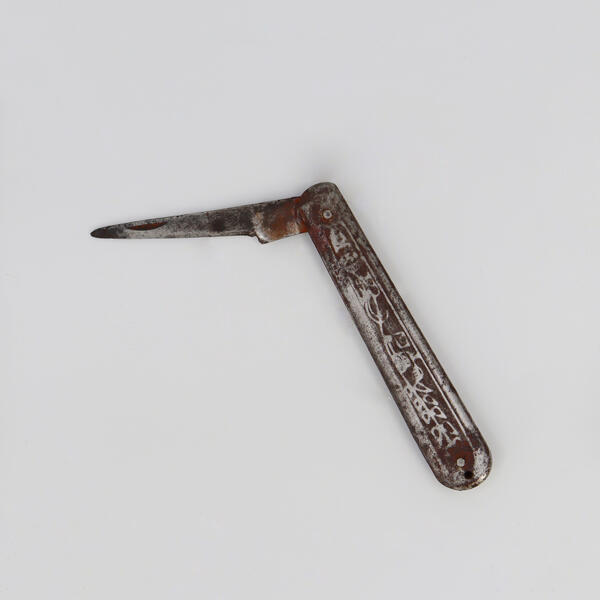
The USSR army adopted folding knives for its Navy and Airborne Troops, as well as sappers and orderlies. During the Great Patriotic War, the Red Army soldiers made active use of civilian folding knives for various everyday tasks.
In the heyday of the Roman Empire, almost every citizen had a folding knife. The tool was used during meals, moreover, it was considered good manners for guests to bring their own knives to a feast in Rome. While carrying cold weapons around the city was outlawed, a folding knife did not fall into that category and could still be used to protect its owner.
The very same reason, that is, the tightening of the legislation that forbade commoners to carry cold weapons, led to folding knives becoming extremely popular in 16th-century Spain. They were called the navaja and had a spring pin, which significantly expanded the number of functions.
A century later, folding knives became widespread among peasants in Western Europe. This popularity brought about the so-called penny knives, also known as farmer knives, that were known for their low price and the corresponding quality. Expensive and high-quality knives were first created in France. A few decades later, the leading position in the production of folding knives was won by cutlers’ guilds from Sheffield, England and Solingen, Germany.
In the late 1880s, the Swiss army adopted a new folding pocket knife, which was intended for helping the soldiers to open canned food and operate the Schmidt-Rubin M1889 rifle, which was disassembled with a screwdriver. The production of the Swiss army knife was launched in 1891 by Karl Elsener’s knife manufacturing company, which would later become known as Victorinox.
In Russia, the industrial production of folding knives is believed to have started in 1780 with the opening of a knife manufactory in the town of Vorsma, Nizhny Novgorod region. It was founded by Nikolay Shmakov, the former serf of the Sheremetev family. By the early 19th century, the knife production level at this enterprise had reached 50,000 units per year. Up to 90% of all Soviet knives were also manufactured in Vorsma.
The USSR army adopted folding knives for its Navy and Airborne Troops, as well as sappers and orderlies. During the Great Patriotic War, the Red Army soldiers made active use of civilian folding knives for various everyday tasks.