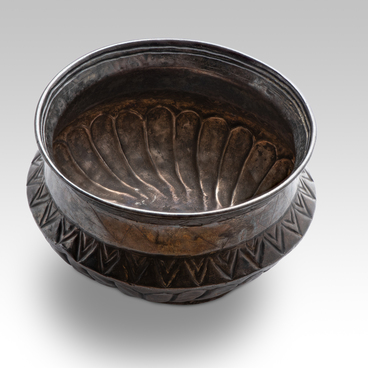
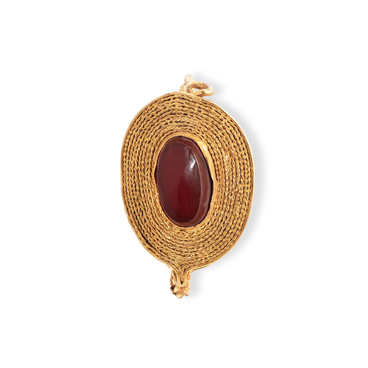
The buckle on display was discovered in a burial complex dated to the period between the second half of the 3rd century and the first half of the 4th century. The accompanying items included metal utensils, such as a bronze jug and a silver kantharos (a drinking vessel), as well as silver toiletries, (vial, spoon, mirror, ear scoop, needlecase), and gold jewelry (torc, pendant, necklace composed of various beads).
Based on the composition of the grave goods, including the buckle, it can be assumed that a female was buried in this chamber. Most likely, she was a member of the upper social class in the city of Tanais of the late Roman period of the Black Sea region.
The buckle features a round shield, a П-shaped fixed frame, and a tongue with a vertical pin. The pin is topped by a teardrop-shaped gold socket, with a red gemstone fixed in the middle.
In the center of the shield, there are opaque light-green glass inserts that form a cross-like shape. Underneath the inserts, there are thin linings made of gold foil. The back of the buckle consists of a solid gold plate with four small loops for attaching to the base that are located opposite each other.
The buckle was meticulously crafted using sophisticated jewelry techniques, such as the enameling technique called cloisonné. It is a unique artifact that has no analogs.
Enameling was a laborious process. First, a metal base was prepared and sanded. Gold and silver wire or thin sheets were then soldered onto the base. The resulting recesses (called cloisons) were filled with special vitreous enamel paste of a certain color. Finally, the item was fired. Once it had cooled, it was polished to give it a shine.
Additionally, the granulation technique was employed in the manufacturing of this buckle. This technique involves creating the tiniest silver or gold granules, which are then affixed to the base of the item. The process of creating and attaching the granules required great skill, accuracy, and patience on the part of the craftsman. In order to produce a large number of identical granules, it was necessary to measure and cut wire to an equal length. These wires were then placed in even rows into the recesses using tongs, before being heated to melting point. The molten metal flowed into the recesses and solidified into granules.