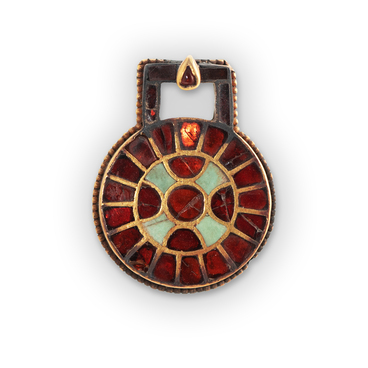
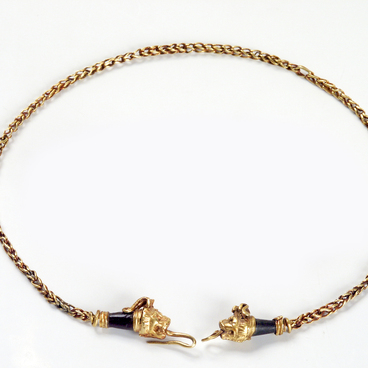
The earring on display was found in a burial chamber, along with other items. Based on the composition of the grave goods, it can be assumed that a female was buried there. Most likely, she was a member of the upper social class in the city of Tanais of the late Roman period. This individual likely lived during the Late Antiquity period of the Black Sea region.
The grave goods included metallic objects (bronze jug and silver kantharos), silver personal toiletries (vial, spoon, mirror, ear scoop, and needlecase), and gold jewelry (torc, pendant, and necklace composed of various beads).
This large earring with an oval shield was also discovered among these items. The shield is crafted from a solid gold plate and is adorned with a filigree braid that forms five concentric rings. In the center of the shield, a stone with an oval shape and a flat top is secured to a high setting made of a thin gold plate. An oval bow is formed from four thin wires that are woven into a voluminous braid. The earring’s closure is made in the form of a hook on the bow and a loop on the shield.
The master who made this piece of jewelry utilized the sophisticated filigree technique several times. Filigree, known as scan in Russian, is a technique that involves creating openwork patterns or soldered designs using wire.
Most often, filigree work was done in silver, although the patterns could also be made from gold and other metals. Both silver and gold are soft metals that can be easily drawn into very fine wires. The wires for the decorative patterns could be smooth or twisted into ropes or spirals. This technique was well-known and was used by craftsmen in Crete, Egypt, and Troy even back in the 6th–4th centuries BCE.
Luxury items have often been found in the graves of Tanais. For many centuries, this city was the sole center for trade in the region. It enjoyed the greatest prosperity in the period from the 1st century to the first half of the 3rd century CE, until it was defeated by the Goths.
According to the ancient Greek historian and geographer Strabo, luxury goods and household items “typical of a civilized lifestyle” spread from Tanais throughout Asian and European Sarmatia. The city was a vital economic, cultural, and political center that facilitated communication between the cities of the Bosporan Kingdom and the northern Black Sea region with the tribes inhabiting the steppes surrounding the city.