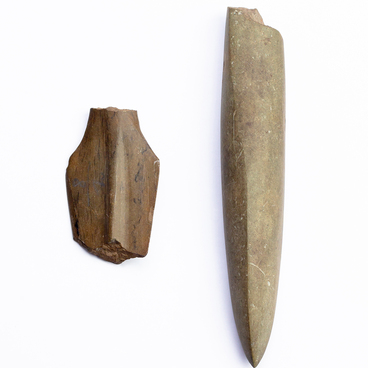
A spindle whorl is a weight in the shape of a disk or cylinder with a through hole along the longitudinal axis. It was used to weigh a hand spindle and to secure yarn to it.
Spindle whorls were made of stone, clay, or bone.
Some spindle whorls were turned from shards of broken pots. This practice was not accidental: pottery was highly valued. Additionally, by giving an object new life, ancient people demonstrated respect for labor, viewing it as a sacred process of material transformation.
Due to their small size and durability, spindle whorls have been well preserved and thus are often found during archaeological excavations. According to one theory, in China, spindle whorls served as prototypes for the first coins with square holes.
The spindle and whorl were considered by all peoples to be among the most powerful amulets that accompanied human life on earth and in the afterlife. Symbolically, threads were considered the thread of life, and the spindle, which rotated clockwise, was associated with the movement of the sun across the sky and symbolized the continuous “solar path.” The spindle was linked with fertility and everything that grows and thrives.
The spindle whorl was considered a symbol of both masculine and feminine principles, although it was primarily a feminine attribute. Additionally, the union of a spindle whorl and a spindle symbolized the union of man and woman, from which life arises — the thread spins.
The reverse rotation of the spindle symbolized unraveling, unwinding, and the return of what was spun and born to the original “other world.” Therefore, spindle whorls were often found among other objects in burials around the world in regions where spinning was developed.
There is a theory that spindle whorls in ancient times were also used as monetary units. This is related to the quantity of spindle whorls found during archaeological excavations of large settlements, which far exceeds the needs for spinning threads.
The spindle whorl presented in the museum’s
collection was discovered in the Spassky District, near the village of
Prokhory. Many archaeological sites from different historical eras have been
discovered in this area.