For several millennia, the ancient Stone Age culture developed in the Primorsky Krai, characterized by communal relations with no classes or statehood. The tribes of Primorye lived a primitive life of hunters and gatherers, although they were partly engaged in agriculture and cattle breeding.
The rarity or absence of ore materials and suitable deposits of copper and tin led to the relatively late emergence of metalworking. Therefore, in the Bronze Age, the inhabitants of Primorye continued to use stone tools and lacked metallurgy of their own.
The absence of native bronze metallurgy, the few findings of bronze artifacts at archaeological sites, and the nearly simultaneous appearance of both bronze and iron objects in the Far East, led to the establishment of the term “Paleometal Age” among specialists.
Currently, the criterion for classifying monuments to the Bronze Age is the presence of bronze products or stone replicas imitating bronze objects found during excavations.
The museum’s collection houses spearheads that imitate the bronze ones.
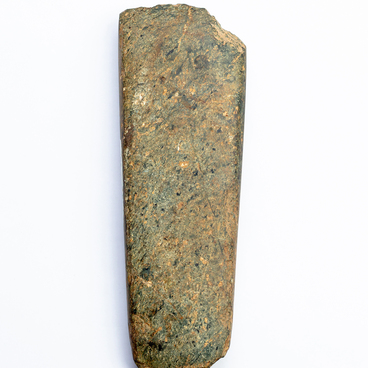
During this period, the techniques of grinding and polishing stone in the production of jewelry and weapons reached reached their peak, evolving into an art form.
The classic forms of this craft were embodied in battle axes, spearheads, and arrowheads. For polishing, pumice, quartz and emery powders were used, applied with a piece of leather. Gloss was achieved using crushed chalk.
Thus, grinding and polishing were the last steps in the long process of stoneworking, which began in ancient times with the technology of chipping river pebbles.
Grinding as a new method of material transformation
had a great impact on the economy as a whole. It allowed people to widely use
such rocks of stone as basalt, diorite, diabase, clay and limestone slates,
porphyry, serpentine, jade, slate, and others. These materials had not played a
significant role in previous eras, when the main methods were knapping,
flaking, chipping, and retouching of materials.