Font
Color
Graphics
Изображение точки

To see AR mode in action:

1. Install ARTEFACT app for iOS or Android;

2. Find the exhibition «The Indigenous People: Lifeways and Trades»

3. Push the «Augmented reality» button and point your phone's camera at the exhibit;

Скрыть точки интересаПоказать точки интереса

Distaff, Rollers, Mallet, Spindle, Grain scoop

0
Open in app
#1

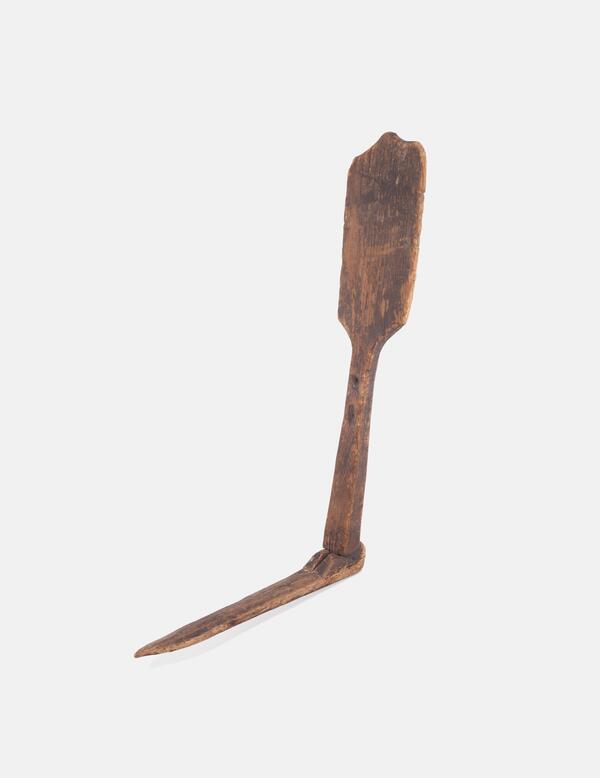
Distaff

#2

Hand spinning, the process of turning fibers, either of plant or animal origin, into yarn, is one of the most ancient crafts.

It was not until the 1830s that the Shors became closely acquainted with the economic culture of the Russians and mastered the process of spinning and knitting sheep wool. Before that time, the main raw materials were nettle and hemp fibers — first wild, later cultivated.

The traditional spinning tool of Shor women was the horizontal loom called “kendyr tybeg”. They wove fabrics and then sewed kendi rrobes, kѳbnek shirts, ştan pants, pѳryk hats, as well as men’s, women’s and children’s casual and festive clothes. The women used kendyr or deer tendon threads.

In his “Essays”, the ethnographer Leonid Pavlovich Potapov gave a detailed description of this device:

#3

[The machine] had two nichenki… One of them was immovable. The machine consisted of two poles ( yrgen ), with the warp ( ocum cibe ) stretched in between. The movable nichenka was fixed on a stick ( kuzuk agazь ), supported by two fork-shaped legs ( tajak ). The warp was divided by theotradevice — two parallel wooden planks… fastened with two pegs at 12–15 cm from one another. There was a cross ( tanmak ), also dividing the base, covered with small transverse notches ( tanmak tiƶi ), into which all the warp threads were inserted one at a time. The stickpaskьşformed the second row of the warp.

#4

In Rus, there were dismountable distaffs with combs and distaffs with a blade. In Siberia, as well as in Altai and the Urals, distaffs of the second type became common. They could be made both dismountable or cut as one whole piece from a pine or spruce with a root. The sliver was tied to the blade (the upper part of the distaff), and the spinner sat on the flat bottom.

With her left hand, the craftswoman pulled a thread from the sliver, twisted it with her fingers, then wound it on a spindle and wrapped it in a loop at its upper end. This prevented the thread from unwinding during work.

Shor women used wooden spindles for spinning. At one tapering end of the “spike” an oblique cut was made to secure the thread; at the other there was a round flat stone that enhanced inertia. The spindle was set in motion with the palm of the right hand, and the thread was held with the finger of the left hand. Stakes were driven into the wall of the house — the basis of the kendyr chugurcha — as a kind of “spool” for the finished yarn.

#5
Name: Distaff
№: 
Date of creation: the mid-19th century
Place of creation: Gornaya Shoria, the Russian Empire
Technique: wood
Dimensions: 46×5×5 cm
#6
Grater rollers
#7

In the pine nut industry, every third year was considered the most productive. The Shors started collecting pine nuts from mid-August, when the cones were so ripe that they fell to the ground. Harvesting lasted until late autumn, usually until the first snow.

Each large family (“seok”, “seyok”) harvested nuts in its own area, which was called “pagla” (literally “place for climbing”).

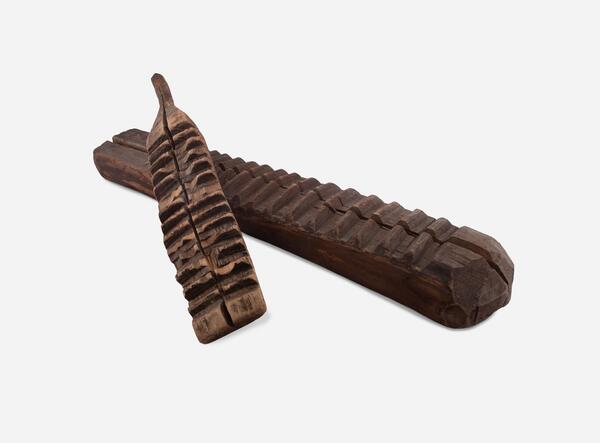
After there was no resin left in the cones, they were peeled on ushpe rollers to extract the nuts. The Siberian researcher Sergey Porfiryevich Shvetsov described this process as follows:

#8

When cleaning a nut, a worker sits on the smooth end of the bottom board, throws nut cones onto the notches, which he rubs with the teeth of another board, holding the latter with both hands.

#9

The exhibition features a pair of wooden grater rollers with transverse, triangular ribs. The longer lower one with 15 ribs was the base; a whole cone was placed on it. The upper roller was used for grinding.

An ushpe should not be confused with another type of grater called paspak.

The textbook of the Shor language, edited by the linguist Elektron Fyodorovich Chispiyakov, offers the following definitions:

#10

An ushpe is a roller with notches for breaking cedar cones, ” “a paspak is a grain grater, a stone grater.

#11

Using a paspak began after the cones had been peeled off. In addition, the paspak was used to grind grain into flour. According to ethnographers, three ancient Shor devices with the same purpose have survived to this day: a paspak (also suitable for grinding salt), a manual stone mill called “terben” with two millstones, and a “sak” — a wooden mortar with a pestle, carved from cedar, less often birch or aspen. Flour-milling work was done by women, while peeling cedar cones was, as a rule, the responsibility of men.

Back in 1859, the missionary Vasily Ivanovich Verbitsky noted:

#12

Their common vice [of the wealthy Mrassu Shors] is extortion: without high interest they will not lend to the poor.

#13

Pine nuts, like furs, were the only way (besides labor) for hunters to pay for purchased goods, and according to historians, local creditors took advantage of it.

#14
Name: Grater rollers
№:
Date of creation: the early 20th century
Place of creation: Gornaya Shoria, the Russian Empire
Technique: wood, carving
Dimensions: big — 87×17×9 cm, small — 69×11×4 cm
#15
Mallet
#16

The key taiga treasures of Gornaya Shoria include valuable species of timber, game animals and pine nuts. Harvesting pine nuts has remained profitable to this day.

Cedar trees can have inaccessible crowns or be comfortable to climb due to having branches. The second type is believed to produce three times more seeds than the first type. Cedar forests are divided into nearby areas, shared by all members of the community, and distant ones, which are used for commercial harvesting. They have long been assigned to specific clans and families, just like hunting grounds. For a long time, those plots were inherited, and visiting a cedar forest without its owner’s consent was strictly prohibited.

Whole teams, including women and children, spent the entire period, from mid-August to late autumn, in the forest.

Preparation started in the middle of summer. A camp was built in the center of the cedar forest, near the spring: “odag” houses made of branches and poles (for one season) or logs (long-term dwellings) and a square log barn (on four pillars) called “anmar” for storing nuts.

Horses were used to bring food, equipment, guns, and ammunition, and the Shors also took their dogs. Like food, tools were kept in a log barn or house, mounted on high “chairs” to make the structures rodent proof.

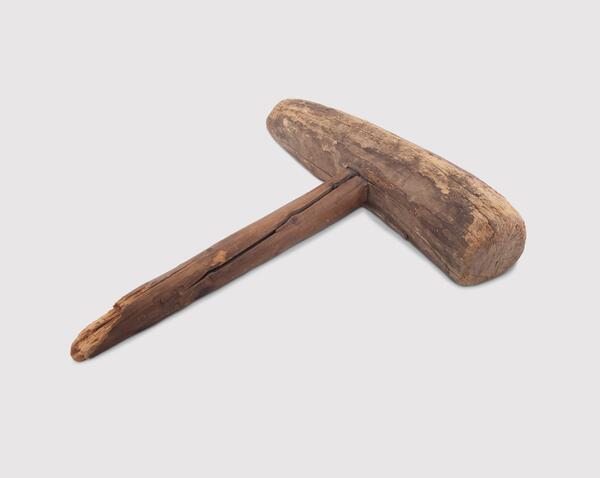
There were several ways to harvest nuts. In the taiga cedar forests, pickers climbed a tree using a “tapty” wooden ladder and pulled the cones with mallets or simply with their feet. They would also collect “tushkin” cones that had been caused to drop by gusty winds or by the pickers who used heavy mallets with a long handle to beat the trunks of inaccessible trees.

Women and children brought the cones to the camp in “annik Kaaba” bags or “tergesh” birch bark baskets. The cones were put into the barns and left there for several days to get rid of the resin. Then the men crushed the cones with “ushpe” rollers and ground them on “paspak” (“pabryk”) wooden graters. Then the nuts were sifted through a coarse-mesh “elek” sieve and winnowed using “sargash” hand tools. Winnowing could also be done by using wooden spatulas: the nuts were thrown onto a stretched canvas and tossed so that the waste was sifted out.

As soon as it began to snow, the nuts were loaded onto horses or sleighs and brought to the village.

Harvesting cedar nuts became especially popular in Gornaya Shoria in the late 19thand early 20thcenturies, with the development of trade. 

#17
Name: Mallet
№: 36728023
Date of creation: the early 20th century
Place of creation: Gornaya Shoria, the Russian Empire
Technique: wood
Dimensions: 46,5×37,5×9 cm
#18
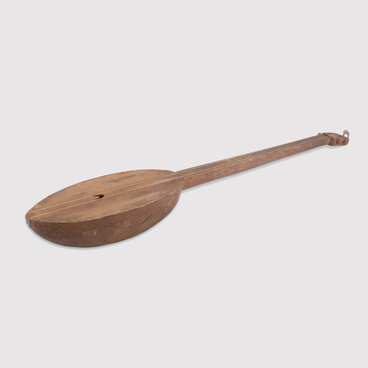
Spindle
#19

Until the first half of the 20thcentury, the Shor people in the Kemerovo region practiced nettle and hemp weaving. In the autumn, hemp was pulled out, collected and dried indoors, threshed with sticks and winnowed to remove the chaff. The dried stems were broken in the middle, the remaining fibers were stripped apart and tied into bundles (this work was called “kendir soyoraga”, that is, “threshing hemp”).

To connect the fibers into a thread, their ends were moistened with saliva, softened with teeth, and slightly twisted with the index finger. The thread was wound into a round tube and placed in a birch bark box. This process was called “kendir ulanna”.

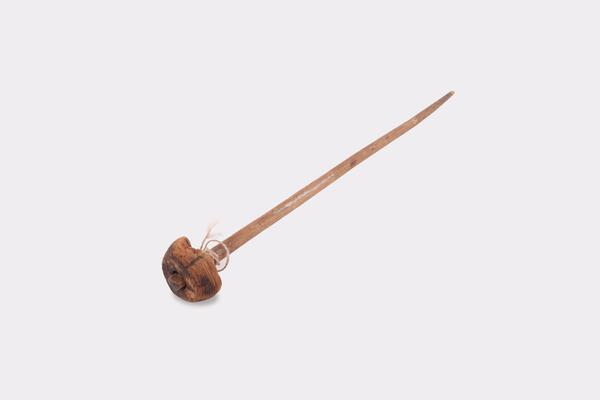
The next stage was spinning, when a spindle (“aik”, or “iik”) was used. This device for twisting fibers into yarn was carved from a single piece of wood, usually bird cherry. The smooth cone-shaped shaft was round in cross-section and had an oblique notch near the bottom to provide a secure anchorage for the thread.

Usually, there was a spindle whorl between the shaft and the notch — it was called “aik-pazhi” or “orchikpazhi”. It was a disk that was flat on one side and convex on the other, with a round hole in the middle. The whorl functioned as a flywheel, maintaining the strong and uniform rotation of the spindle.

The spindle was set in motion with the right hand, while using the left hand to hold the thread that was twisting clockwise. Spinning was laborious and monotonous: spinners had to pull, twist and wind the threads again and again. Their hands quickly got tired, and labor productivity was quite low. During the spinning process, the joined fibers were passed through a hook or ring attached to the ceiling or a wall.

Unlike their Russian counterparts, Shor craftswomen did not wind threads into yarn balls. The yarn was left on the spindles, and then it was rewound directly into a frame onto stakes driven into the wall of the house. The circumference of such a frame could reach 12 arshins (about 8.5 meters).

The yarn was bleached: a cauldron was filled with water and birch or aspen tar, the yarn was boiled for two or three days and washed down by the local river.

Kendyr fabric was used both for sewing clothes and for various household needs.

#20
Name: Spindle
№: 
Date of creation: the early 20th century
Place of creation: Tomsk Governorate, the Russian Empire
Technique: wood, turning on a lathe
Dimensions: 46×3×5 cm
#21
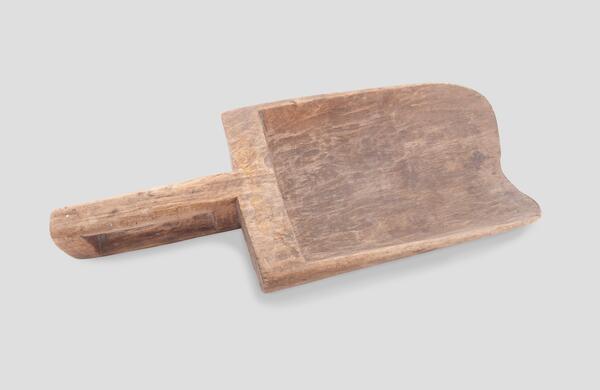
Grain scoop
#22

The Shor agriculture had all the usual stages, but the archaic methods of work made it extremely difficult. The taiga forest was cut down and burned to make room for arable land; each cleared area was highly valued and was in the private use of the person who cultivated it. Fertilizers were necessary — without them, the soil became depleted after three or four years, and farmers had to move to a new place.

For a long time, crops were harvested by hand; the threshing method of roasting produced no more than 0.1 hectares of crop per person per day. Only then one could start winnowing, that is, separating grain from chaff while simultaneously removing dirt and insects.

In its simplest form, the winnowing process consists of throwing grain into the air in such a way that the grain falls back, and light rubbish and chaff are blown away by the wind. Before the advent of special winnowing machines with fans, people used their own hands, wooden shovels, or scoops.

The Shors used “sargash” hand-held boxes that looked like half of a round shaman’s tambourine or a wide scoop. The sides of such winnowing tools were made from birch bark or thin cedar shingles and attached to the wooden bottom with wooden nails or leather straps.

Shor farmers put the threshed grain into cylinder birch bark vessels and left it on wooden “tastak” platforms in the field. Once winnowed, the grain was taken to barns placed on four posts to make them rodent proof. If there were no barns, grain was stored under a shed built on arable land, in huge birch bark boxes that were covered with a board and pressed down with stones. There were no locks on the grain barns since there was no theft in Shor villages.

In the 20thcentury, ethnographers, who observed the life of the Shors for a long time, noted that they had aѳdyşkelaw (literally meaning “loan”): in the autumn, families with a good harvest would certainly share it with less fortunate neighbors, meaning that next year it would be vice versa, should the situation change. People would also share a big meal to celebrate the first harvest. 

#23
Name: Grain scoop
№: 
Date of creation: the early 20th century
Place of creation: Kemerovo Oblast, the Russian Empire
Technique: wood
Dimensions: 55×22,5×7 cm
#24
read morehide

Distaff, Rollers, Mallet, Spindle, Grain scoop

0
Point your smartphone camera to open in the app
Share
VkontakteOdnoklassnikiTelegram
Share on my website
Copy linkCopied
Copy
Open in app
To see AR mode in action:
  1. Install ARTEFACT app for 
  2. iOS or Android;
  3. Find and download the «Paintings in Details» exhibition
  4. Push the «Augmented reality» button and point your phone's camera at the painting;
  5. Watch what happens on your phone screen whilst you flip through the pictures.
 
We use Cookies
Cookies on the Artefact Website. We use cookies to ensure that we give you the best experience on our website. If you continue without changing your settings, we'll assume that you are happy to receive all cookies on the Artefact website. However, if you would like to, you can change your cookie settings at any time.
Learn more about useHide
Content is available only in Russian

X

Нашли опечатку?...

%title%%type%