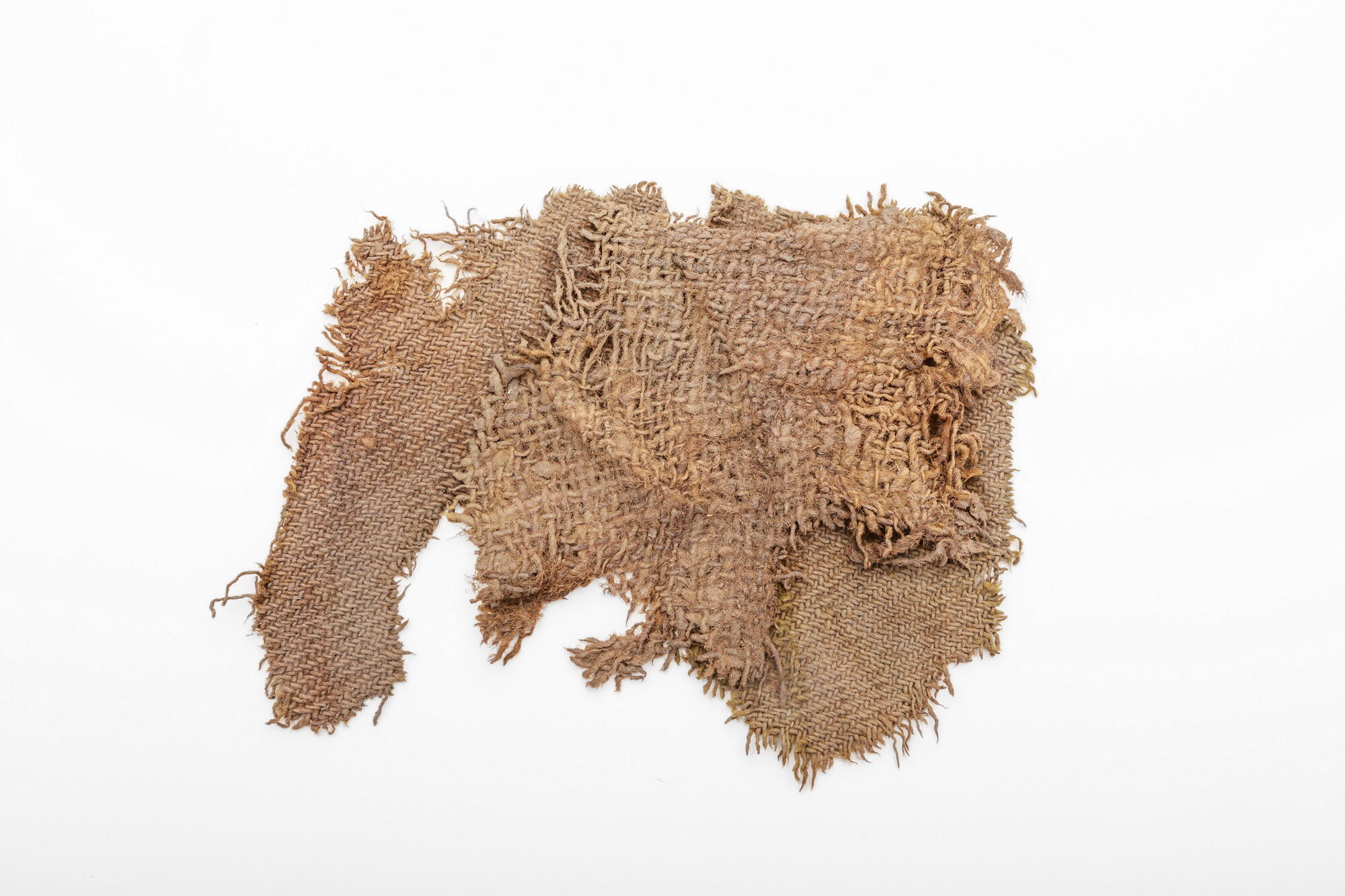


Textiles are made of organic materials, so they are rarely preserved in cultural deposits. Only a few fragments of fabric woven by hand about a thousand years ago were found on the archaeological sites of the Cheptsa River basin.
Idnakar women spun fabrics at home — this is evidenced by a large number of spindle whorls found on the territory of the hillfort. These are clay or bone devices used to weigh down the spindle. Women in Idnakar also sewed, which is evidenced by bone and metal needles, as well as bone boxes for storing them. Often, needle cases were decorated with patterns.
Parts of weaving looms are also found at the site of medieval Prikamye settlements — the wooden looms themselves have not been preserved. It is still impossible to reconstruct in detail the design of an Udmurt loom, but certain finds, such as blocks and rings for holding heddles, indicate that it was a horizontal loom. This is an older type of machine than the vertical loom.
Most of the surviving fragments of medieval fabric are woolen. Sheep were combed, wool was collected during molting, and fleece was cut off with a sharp knife or special scissors. Most likely, the wool was prepared for spinning by beating.
Fabrics found in Chepetsk cultural deposits were made using the simplest type of weave — a plain one. Woven products are represented by belts made on planks, fragments of woven trimmings and round cords. One of the most outstanding finds is a fragment of a woolen blue-red belt from a male grave at the Kuzminsky burial ground.
Udmurt fabrics have traces of dyes, in particular some precious ones — madder and imported indigo. Indigo dye was extracted from plants that had been grown in India and Persia since the olden times. Later, the Arabs brought this culture to Africa, Sicily and Spain.
Some fabric fragments have traces of dyes ranging from brown to olive green, but their origin is unknown.
An Idnakar man’s costume could consist of a linen shirt, pants and outerwear such as a homespun or fur coat, which was secured with a woven or leather belt. The shoes had soft soles and short bootlegs, gathered at the ankle with a strap.
Women and girls wore tunic-like shirts that were almost knee-long or even reached the feet. Sometimes the hem was embroidered with beads. Married women had a bigger number of ornaments on their clothes compared to unmarried ones. Magical powers were attributed to each of the decorations.



