Font
Color
Graphics
Изображение точки

To see AR mode in action:

1. Install ARTEFACT app for iOS or Android;

2. Find the exhibition «Orthodox Icons from across the Don Region»

3. Push the «Augmented reality» button and point your phone's camera at the exhibit;

Скрыть точки интересаПоказать точки интереса
Показать в высоком качестве

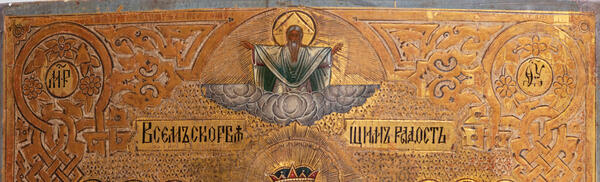
Icon “Joy of All Who Sorrow”

Creation period
the 19th century
Place of сreation
the Russian Empire
Dimensions
35,5x31 cm
Technique
wood (linden), levkas, tempera, gilding
1
Open in app
#6

The type “Joy of All Who Sorrow” developed in Russian iconography in the 17th century under Western European (Roman Catholic) influence. The icons of “Joy of All Who Sorrow” are often strikingly different from each other, and it is sometimes difficult to understand what they all have in common. Throughout the course of its formation, the iconography of “Joy of All Who Sorrow” never had a single stable composition, so the canon of the icon is not strict, and it exists in a variety of versions.

In the icon displayed, the Virgin Mary is depicted full height in the center of a multi-figure composition. She is dressed in royal attire against a background of golden gloriole, on a brown stepped elevated platform — the ambo. On Her left arm, She holds the Baby Jesus, and in Her right hand is a scepter crowned with a cross, a symbol of Her heavenly power. Above the Virgin Mary, against a background of golden gloriole is God the Father in white robes.
#4
Icon “Joy of All Who Sorrow”
#2

Legend has it that the icon “Joy of All Who Sorrow” helped Euphemia Papina, a sister of Moscow Patriarch Joachim, to heal a chronic wound in her side. This happened in Moscow in 1688. The newly glorified image of the Virgin Mary was in the Church of the Transfiguration of the Savior on Ordynka, where Euphemia was a parishioner. As for when and under what circumstances the icon came to the church, there is no exact information. Rumors of the miraculous healing spread quickly throughout Moscow, as they concerned the patriarch’s close relative. Soon a formal legend was written, and prayers dedicated to the icon appeared. The workers of the Tsar’s icon painting workshop at the Armory began to make copies of the icon.


Around 1710–1711, due to the move of the royal court from Moscow to St. Petersburg, Tsarevna Natalia Alekseyevna, Peter the Great’s sister, took the icon “Joy of All Who Sorrow” out of the Church of the Transfiguration on Ordynka. It remains unknown whether she took out a copy or the original. Uncertainty in this matter has persisted in many popular reference books on miracle-working icons of the Virgin Mary since the 19th century: some authors adhere to the version of the original, others — to that of the copy. Nevertheless, both icons of “Joy of All Who Sorrow” — the one that remained in Moscow and the one that was taken to St. Petersburg — were venerated as miracle-working icons.

#3
View in the State Catalogue
read morehide
00:00
00:00
1x

Icon “Joy of All Who Sorrow”

Creation period
the 19th century
Place of сreation
the Russian Empire
Dimensions
35,5x31 cm
Technique
wood (linden), levkas, tempera, gilding
1
Point your smartphone camera to open in the app
Share
VkontakteOdnoklassnikiTelegram
Share on my website
Copy linkCopied
Copy
Open in app
To see AR mode in action:
  1. Install ARTEFACT app for 
  2. iOS or Android;
  3. Find and download the «Paintings in Details» exhibition
  4. Push the «Augmented reality» button and point your phone's camera at the painting;
  5. Watch what happens on your phone screen whilst you flip through the pictures.
 
We use Cookies
Cookies on the Artefact Website. We use cookies to ensure that we give you the best experience on our website. If you continue without changing your settings, we'll assume that you are happy to receive all cookies on the Artefact website. However, if you would like to, you can change your cookie settings at any time.
Learn more about useHide
Content is available only in Russian

X

Нашли опечатку?...

%title%%type%