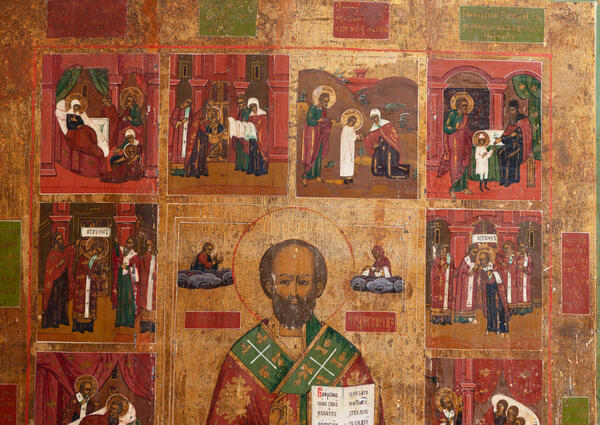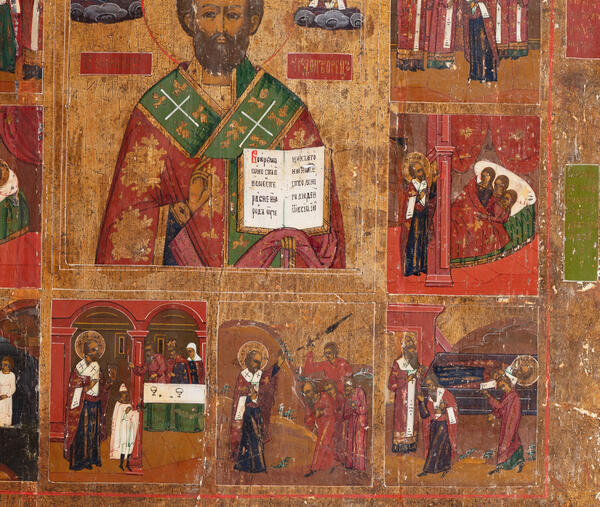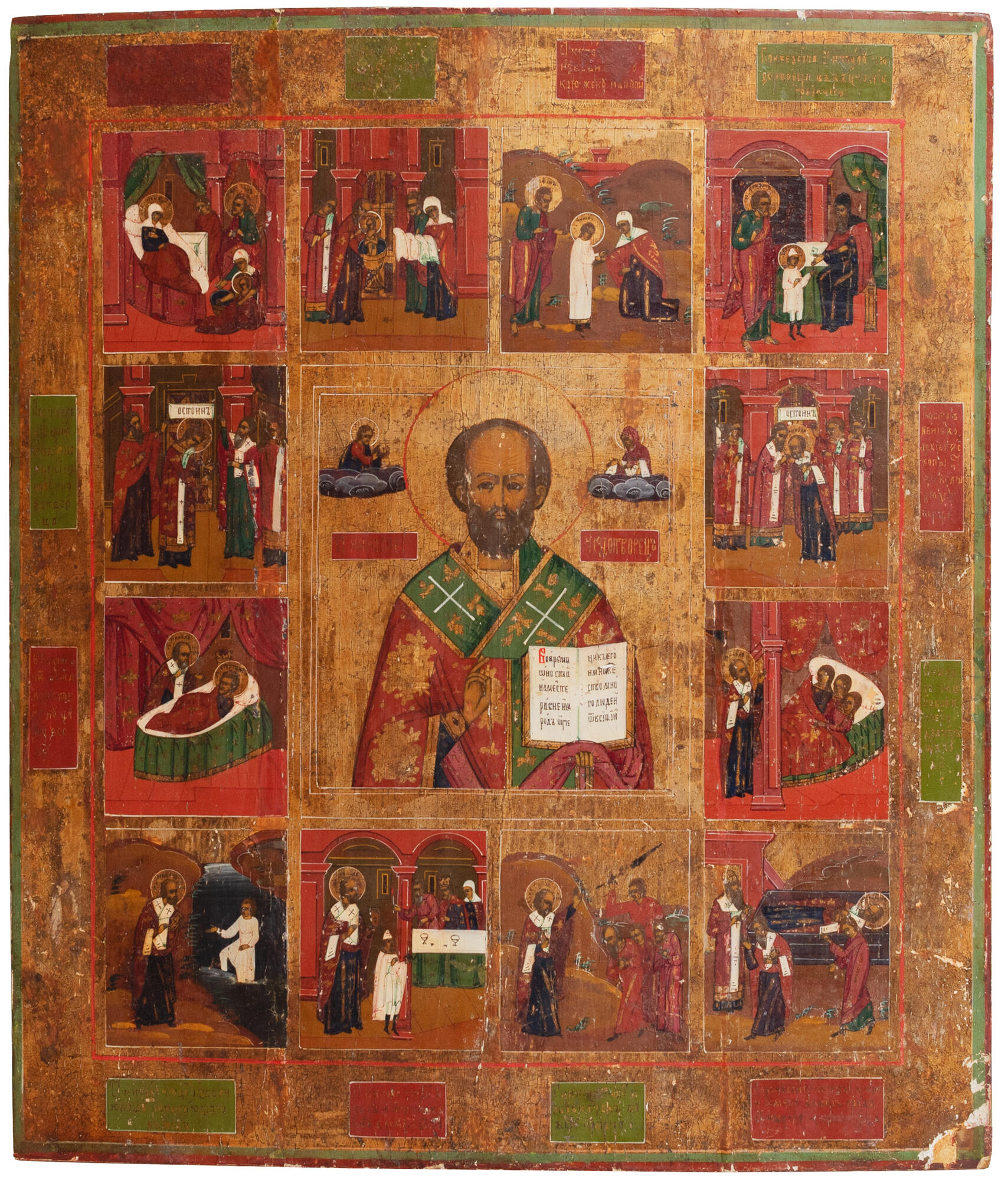


The icon depicts St. Nicholas the Wonderworker, one of the most revered saints in Russia since the Christianization of Rus in 988. The centerpiece depicts a bust-length image of St. Nicholas dressed in a red phelonion with a vegetal pattern, a blue cassock with golden cuffs, and a green omophorion with white four-pointed crosses and vegetal patterns. With his right hand, the saint makes a blessing gesture, and with his left hand he holds an open Book of the Gospels.
To the left and right of St. Nicholas are Jesus Christ and the Virgin Mary. The centerpiece is flanked by rectangular images of the same small size with scenes from the life of St. Nicholas. The subjects in the border scenes are characterized by landscapes and architectural elements. They represent the key events of the saint’s life: his birth, baptism, education, ordination, and the miracles that glorified his name.
Hagiographic icons of Saint Nicholas the Wonderworker, known from the 13th–14th centuries, make up a vast group of the entire iconographic heritage of Russia. When creating the saint’s image, icon painters relied on his hagiography, akathistos hymns, liturgical texts, the 11th century Russian Lection on the Translation of St. Nicholas’ Relics, the Tale of Moving the Image of Saint Nicholas the Wonderworker from Korsun to Ryazan, and other sources. Hagiographic icons have the most complete and best-developed iconography. Miracles are known, which, according to legend, occurred in Russia — for example, the miracle of the Kievan child.
The legend tells of a couple from Kiev who were returning home along the Dnieper River after a pilgrimage to the relics of Saint Martyrs Boris and Gleb in Vyshgorod. On the way, a tired woman fell asleep and dropped her baby into the water. The parents in despair turned to St. Nicholas, “having great faith in him, ” praying to the wonderworker for help. The next morning the child was found unharmed in the galleries of St. Nicholas Cathedral in Kiev, locked from the outside, “The child lay wet before the image of St. Nicholas”. After that, the Sophia icon of the saint became known as St. Nicholas the Wet.
The subjects of the hagiographic icons of St. Nicholas
the Wonderworker could differ from region to region. Each had its own favorite
subjects, to which special attention was paid.