Pectoral crosses consisting of two parts came to Old Rus from the monasteries of Asia Minor and the Balkans with the Christianization. Such crosses that could be opened, as well as rectangular and round reliquaries, were called encolpions. Inside, relics or prosphora, liturgy bread, incense, and other small objects were kept. Encolpions with relics were worn on the chest — people used them to protect themselves from temptations and misfortunes, especially during pilgrimage and travel.
The excavations were initiated by Bishop Jacob of Saratov and Tsaritsyno and were led by Archpriest Iosif Shilov.
Bishop Jacob was one of the brightest spiritual leaders of the diocese. In addition to his direct duties in the church, he was fond of archaeology and ethnography, collected ancient books and manuscripts. He initiated the first excavations in ancient Volga Tatar-Mongolian settlements, for example, Old Sarai in the Astrakhan governorate or Uvek in the Saratov governorate. Also, under the bishop’s leadership, a museum was created at the Saratov Theological Seminary, in which, perhaps, this encolpion stayed after its acquisition.
Byzantine double-part encolpions in the form of a four-pointed cross with round medallions and tear-shaped protrusions at the ends became widespread in Russia in the 11th–13th centuries. They were mass-produced and made from cheap materials. However, few intact encolpions have survived to this day. Usually, the finds include separate parts.
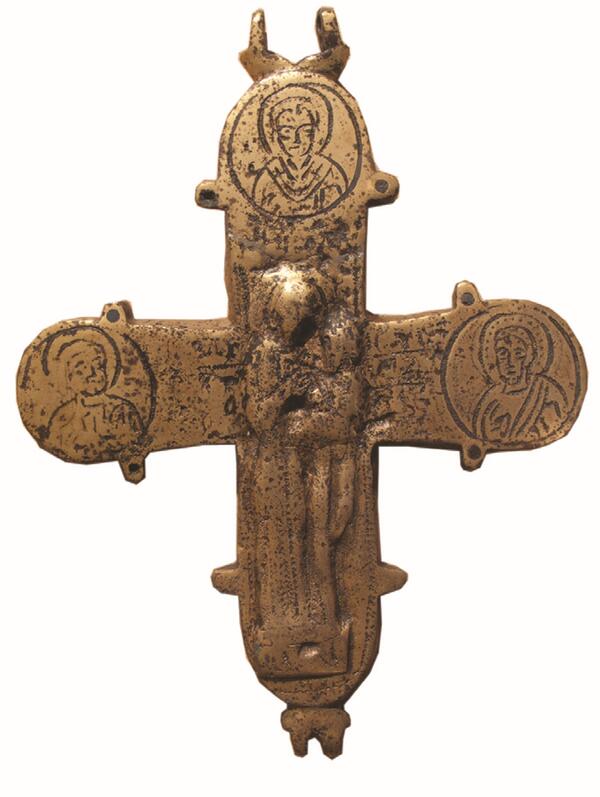
The exhibit from the museum’s collection is decorated with embossing, engraving and niello techniques. Our Lady of Kupyatitskaya is depicted in the middle of the cross and the medallions feature the selected saints — the apostles Peter and Paul and St. Nicholas. The figures are clearly outlined by a silhouette line. The iconographic features of the saints are conveyed with great accuracy, and each image is individualized. The style and the techniques indicate that the artisan was aware of the main artistic trends of his time. The object can be dated to the early 13th century.
The museum houses the reverse part of such a hollow cross. It was found in 1839 during archaeological excavations near Sarai, also known as Sarai-Berke, or New Sarai. The city was built on the territory of the modern Volgograd region around 1260 and was the capital of the Golden Horde until the very end of the 14th century.
The excavations were initiated by Bishop Jacob of Saratov and Tsaritsyno and were led by Archpriest Iosif Shilov.
Bishop Jacob was one of the brightest spiritual leaders of the diocese. In addition to his direct duties in the church, he was fond of archaeology and ethnography, collected ancient books and manuscripts. He initiated the first excavations in ancient Volga Tatar-Mongolian settlements, for example, Old Sarai in the Astrakhan governorate or Uvek in the Saratov governorate. Also, under the bishop’s leadership, a museum was created at the Saratov Theological Seminary, in which, perhaps, this encolpion stayed after its acquisition.
Byzantine double-part encolpions in the form of a four-pointed cross with round medallions and tear-shaped protrusions at the ends became widespread in Russia in the 11th–13th centuries. They were mass-produced and made from cheap materials. However, few intact encolpions have survived to this day. Usually, the finds include separate parts.
The exhibit from the museum’s collection is decorated with embossing, engraving and niello techniques. Our Lady of Kupyatitskaya is depicted in the middle of the cross and the medallions feature the selected saints — the apostles Peter and Paul and St. Nicholas. The figures are clearly outlined by a silhouette line. The iconographic features of the saints are conveyed with great accuracy, and each image is individualized. The style and the techniques indicate that the artisan was aware of the main artistic trends of his time. The object can be dated to the early 13th century.