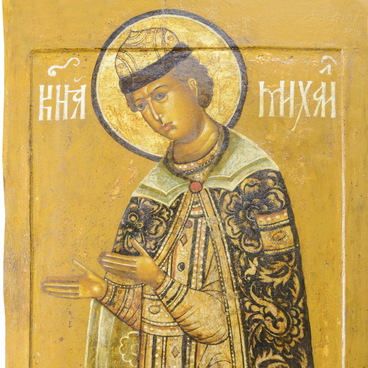
The icon of St. Simeon the Stylite entered the Radishchev Art Museum in Saratov as a result of a ten-year work that included researching and collecting objects of artistic and ecclesiastical art. The work began in 1967 and made it possible to add a significant number of interesting objects that used to belong to large Orthodox churches and small Old Believer prayer houses in the Volga region near Saratov.
The adherence to the “old faith” was a characteristic feature of the spiritual life of the Saratov governorate from the very beginning. Over the following centuries, secluded communities and settlements of zealots of old faith appeared in the region. By the 18th century, they became centers that were important for the entire Russia. Such were the richest Irgiz Old Believer monasteries on the left bank of the Volga or the Cheremshan hermitage — a complex of monasteries, convents and secluded communities.
The Old Believers collected and held old artworks in high esteem, their churches and prayer houses contained collections of old-style icons and ancient religious manuscripts. And Simeon the Stylite was an especially revered saint.
This Syrian Christian monk, who discovered a new form of asceticism — living on a pillar, was born in the middle of the 4th century on the border with Cilicia. Once, as a child, he went to the church and was impressed by a reading of the Beatitudes. Then Simeon left his job as a shepherd and went to one of the nearest monasteries. There he gave himself up to the practice of an austerity. For example, once he wrapped a coarse rope around his body. As a result, his wounds began to fester so badly that other monks complained about the stench and worms falling from Simeon.
In the end, the saint found his own way of obedience and service — he went to the Syrian Desert, where he built a pillar several meters high, on which he spent the next 37 years fasting and praying. As a result, God gave him the gift to heal mental and physical diseases.
The inscription on the back of the work indicates that the icon used to belong to the Old Believers. However, it is unknown in which particular Saratov prayer house this image was kept; it is also difficult to say where exactly in the church it was used. Traditionally, the figures of stylites were placed on the pillars, but in the 17th century, similar icons were quite often found in the main tiers of the iconostasis, retaining the elongated shape of the saint on a high pillar.
The adherence to the “old faith” was a characteristic feature of the spiritual life of the Saratov governorate from the very beginning. Over the following centuries, secluded communities and settlements of zealots of old faith appeared in the region. By the 18th century, they became centers that were important for the entire Russia. Such were the richest Irgiz Old Believer monasteries on the left bank of the Volga or the Cheremshan hermitage — a complex of monasteries, convents and secluded communities.
The Old Believers collected and held old artworks in high esteem, their churches and prayer houses contained collections of old-style icons and ancient religious manuscripts. And Simeon the Stylite was an especially revered saint.
This Syrian Christian monk, who discovered a new form of asceticism — living on a pillar, was born in the middle of the 4th century on the border with Cilicia. Once, as a child, he went to the church and was impressed by a reading of the Beatitudes. Then Simeon left his job as a shepherd and went to one of the nearest monasteries. There he gave himself up to the practice of an austerity. For example, once he wrapped a coarse rope around his body. As a result, his wounds began to fester so badly that other monks complained about the stench and worms falling from Simeon.
In the end, the saint found his own way of obedience and service — he went to the Syrian Desert, where he built a pillar several meters high, on which he spent the next 37 years fasting and praying. As a result, God gave him the gift to heal mental and physical diseases.
The inscription on the back of the work indicates that the icon used to belong to the Old Believers. However, it is unknown in which particular Saratov prayer house this image was kept; it is also difficult to say where exactly in the church it was used. Traditionally, the figures of stylites were placed on the pillars, but in the 17th century, similar icons were quite often found in the main tiers of the iconostasis, retaining the elongated shape of the saint on a high pillar.