When tobacco was brought to Russia from America in the 17th century, the demand for containers to store it arose. For example, snuff tobacco was put in elaborately decorated snuffboxes.
In the 1670s, people began to roll the leaves of the tobacco plant into cigars. To prevent any damage during transportation, cigars were stored in solid boxes — cigar cases, which were made of silver, decorated with enamel, and inlaid with precious stones. But soon humidors — tight boxes for cigars — appeared. After that, there was no need for cigar cases anymore.
The case came back into fashion with the advent of cigarettes. During the 1853–1856 Crimean War, Russian and Turkish soldiers wrapped tobacco in paper cartridges or newspaper scraps and smoked the improvised rolls at the halt. This idea was adopted by the British and French. England launched mass production of cigarettes. In the late 1880s, the United States introduced a cigarette rolling machine, which accelerated the spread of cigarettes.
The design of the cigarette case has not changed, but different materials were used for its production. Wealthy smokers could afford gold and silver models. For those less wealthy, cigarette cases were made of brass, bronze, or steel. The accessory was bought and used not only because of its convenience but also because it was fashionable.
During the First World War, cigarette cases decorated in the propaganda theme appeared: they were produced in the workshops of Prokofiev and the Krutikovs, at the Sikachev factory, as well as other places. After 1917, the propaganda cigarette cases were made based on pre-revolutionary models while using Soviet slogans.
In the 1920s, the era of Soviet cigarette cases began. They were made of cupronickel, brass, and tin. The imagery became more varied. The cases were decorated using the techniques of engraving, stamping, and casting, as well as niello and baked enamel. They were mostly inexpensive and widely available.
In 1927, this accessory became one of the official awards. Simpler cigarette cases were granted for victories in competitions and professional achievements. Niello ones were awarded to the Red Army commanders. Models decorated in the baked enamel technique were given to most prominent party activists.
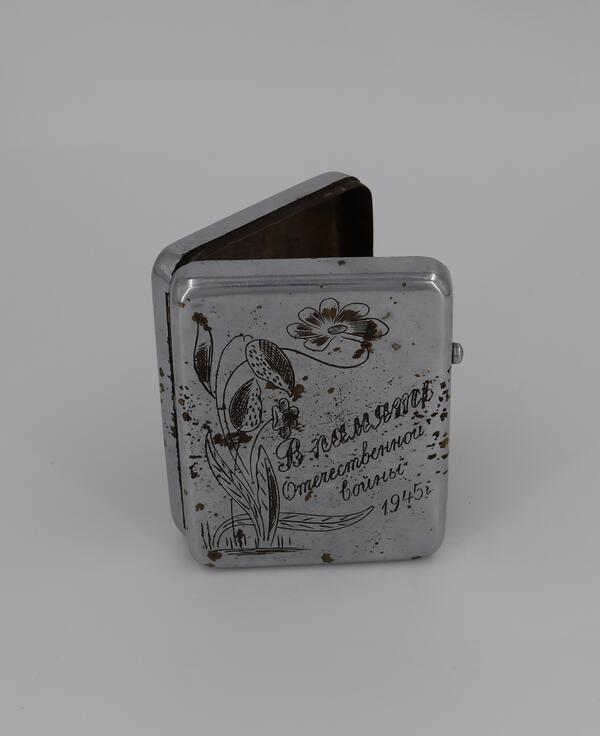
During the Great Patriotic War, cigarette cases were made in frontline conditions, using aluminum from destroyed enemy aircraft. Such cases, made with a dedicatory inscription, were awarded as keepsakes to those who distinguished themselves in battle. Cigarette cases that had a portrait of Stalin on the lid were awarded to top commanders.
In the 1670s, people began to roll the leaves of the tobacco plant into cigars. To prevent any damage during transportation, cigars were stored in solid boxes — cigar cases, which were made of silver, decorated with enamel, and inlaid with precious stones. But soon humidors — tight boxes for cigars — appeared. After that, there was no need for cigar cases anymore.
The case came back into fashion with the advent of cigarettes. During the 1853–1856 Crimean War, Russian and Turkish soldiers wrapped tobacco in paper cartridges or newspaper scraps and smoked the improvised rolls at the halt. This idea was adopted by the British and French. England launched mass production of cigarettes. In the late 1880s, the United States introduced a cigarette rolling machine, which accelerated the spread of cigarettes.
The design of the cigarette case has not changed, but different materials were used for its production. Wealthy smokers could afford gold and silver models. For those less wealthy, cigarette cases were made of brass, bronze, or steel. The accessory was bought and used not only because of its convenience but also because it was fashionable.
During the First World War, cigarette cases decorated in the propaganda theme appeared: they were produced in the workshops of Prokofiev and the Krutikovs, at the Sikachev factory, as well as other places. After 1917, the propaganda cigarette cases were made based on pre-revolutionary models while using Soviet slogans.
In the 1920s, the era of Soviet cigarette cases began. They were made of cupronickel, brass, and tin. The imagery became more varied. The cases were decorated using the techniques of engraving, stamping, and casting, as well as niello and baked enamel. They were mostly inexpensive and widely available.
In 1927, this accessory became one of the official awards. Simpler cigarette cases were granted for victories in competitions and professional achievements. Niello ones were awarded to the Red Army commanders. Models decorated in the baked enamel technique were given to most prominent party activists.
During the Great Patriotic War, cigarette cases were made in frontline conditions, using aluminum from destroyed enemy aircraft. Such cases, made with a dedicatory inscription, were awarded as keepsakes to those who distinguished themselves in battle. Cigarette cases that had a portrait of Stalin on the lid were awarded to top commanders.