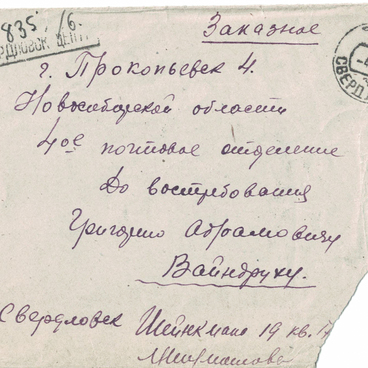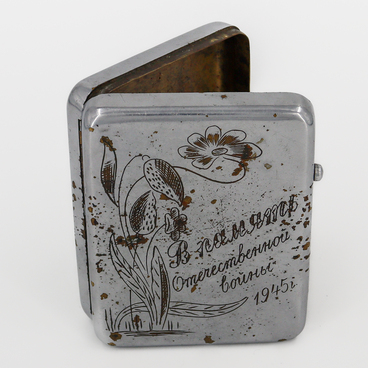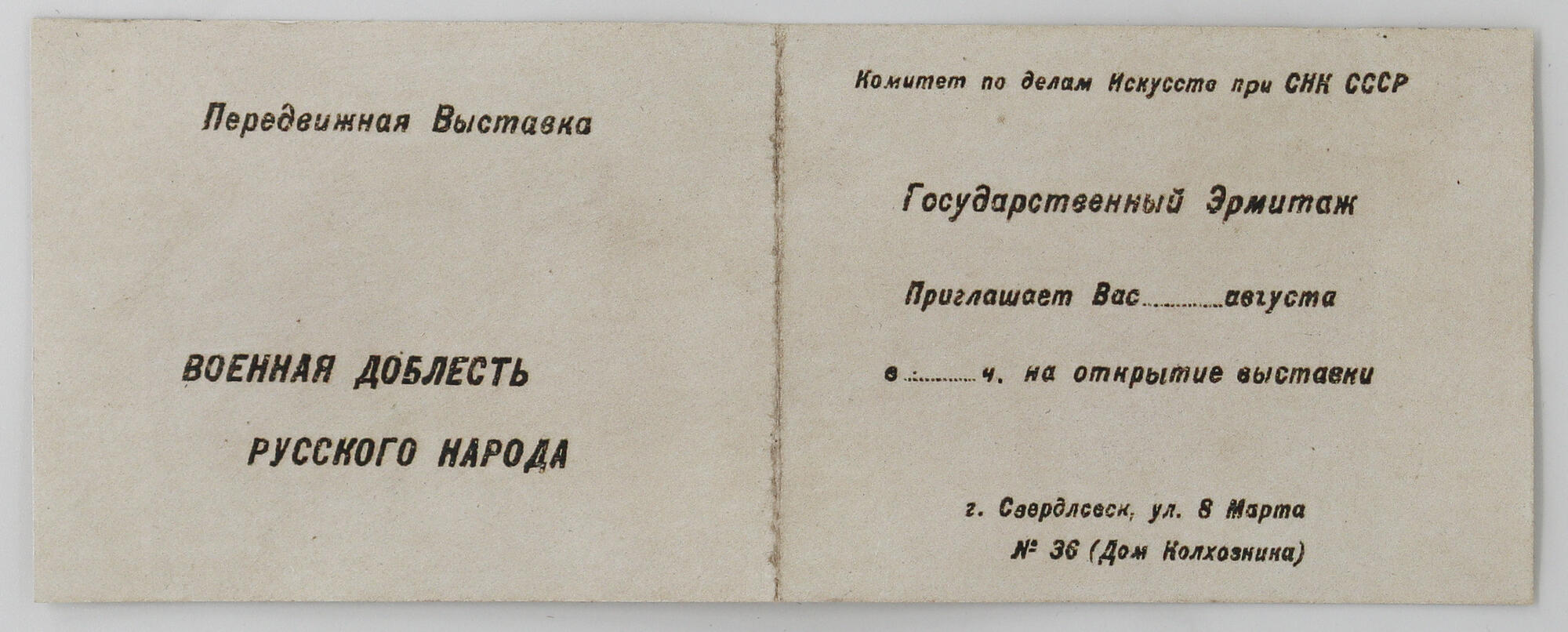


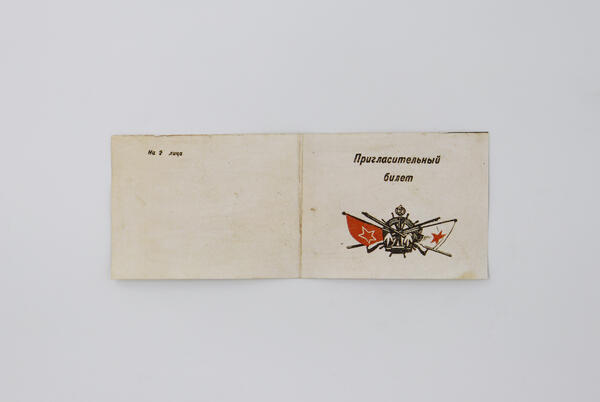
An invitation card for two persons enabled the owner to attend the opening of the temporary exhibition “Military Prowess of the Russian People”. The exposition was organized by the branch of the State Hermitage in Sverdlovsk and the city department of arts. It became possible due to the fact that, with the outbreak of the war, numerous Hermitage collections were evacuated to the capital of the Urals.
The first train with exhibits was sent to the rear on July 1, 1941. Vladimir Frantsevich Levinson-Lessing, the head of the museum’s department of West-European art, was appointed the train master and then the director of the Hermitage branch. Until the end of the war, the collections were kept in Sverdlovsk.
Upon the evacuation, the museum staff resumed their activities: they continued to work on scientific papers, gave lectures on the history of Russia’s military past in educational institutions, hospitals, factory clubs and workshops.
On August 14, 1943, the exhibition “Military Prowess of the Russian People” opened at the local Collective Farmer’s House. It was dedicated to the milestones of the country’s military history, from the 13th century till the Great Patriotic War.
The exposition presented works of painting, graphics and sculpture. For example, portraits of Kutuzov and Barclay de Tolly by George Doe, a bust of Peter I by Carlo Bartolomeo Rastrelli, a bust of Suvorov by Ilya Ginzburg. Besides, such unique items were displayed there as the personal arms of Prince Pozharsky and Napoleon, the uniform and hat of Peter I, the marshal’s baton of Louis-Nicolas Davout, who did not lose a single battle, etc.
The exhibition ended with the theme of the Great Patriotic War. It consisted of several plots: the fighting of the Red Army, the Soviet rear, the allies of the USSR in the fight against the enemy, and cultural monuments destroyed during the battles. The theme of the war was revealed through the works of Moscow artists. They were supplemented by photographs and documents dedicated to the defense of Leningrad, Sevastopol and Stalingrad.
The “Uralsky Rabochiy” newspaper published a review left by one of the first visitors to the exhibition, an engineer from Kamensk-Uralsky:
“This exhibition is a remarkable phenomenon of these days. You walk through the halls, and seem to turn the pages of the history of our invincible, mighty people. Instances of courage and heroism of the defenders of our great Motherland are engraved on memory in such a vivid, spectacular, and palpable way.”
The first train with exhibits was sent to the rear on July 1, 1941. Vladimir Frantsevich Levinson-Lessing, the head of the museum’s department of West-European art, was appointed the train master and then the director of the Hermitage branch. Until the end of the war, the collections were kept in Sverdlovsk.
Upon the evacuation, the museum staff resumed their activities: they continued to work on scientific papers, gave lectures on the history of Russia’s military past in educational institutions, hospitals, factory clubs and workshops.
On August 14, 1943, the exhibition “Military Prowess of the Russian People” opened at the local Collective Farmer’s House. It was dedicated to the milestones of the country’s military history, from the 13th century till the Great Patriotic War.
The exposition presented works of painting, graphics and sculpture. For example, portraits of Kutuzov and Barclay de Tolly by George Doe, a bust of Peter I by Carlo Bartolomeo Rastrelli, a bust of Suvorov by Ilya Ginzburg. Besides, such unique items were displayed there as the personal arms of Prince Pozharsky and Napoleon, the uniform and hat of Peter I, the marshal’s baton of Louis-Nicolas Davout, who did not lose a single battle, etc.
The exhibition ended with the theme of the Great Patriotic War. It consisted of several plots: the fighting of the Red Army, the Soviet rear, the allies of the USSR in the fight against the enemy, and cultural monuments destroyed during the battles. The theme of the war was revealed through the works of Moscow artists. They were supplemented by photographs and documents dedicated to the defense of Leningrad, Sevastopol and Stalingrad.
The “Uralsky Rabochiy” newspaper published a review left by one of the first visitors to the exhibition, an engineer from Kamensk-Uralsky:
“This exhibition is a remarkable phenomenon of these days. You walk through the halls, and seem to turn the pages of the history of our invincible, mighty people. Instances of courage and heroism of the defenders of our great Motherland are engraved on memory in such a vivid, spectacular, and palpable way.”