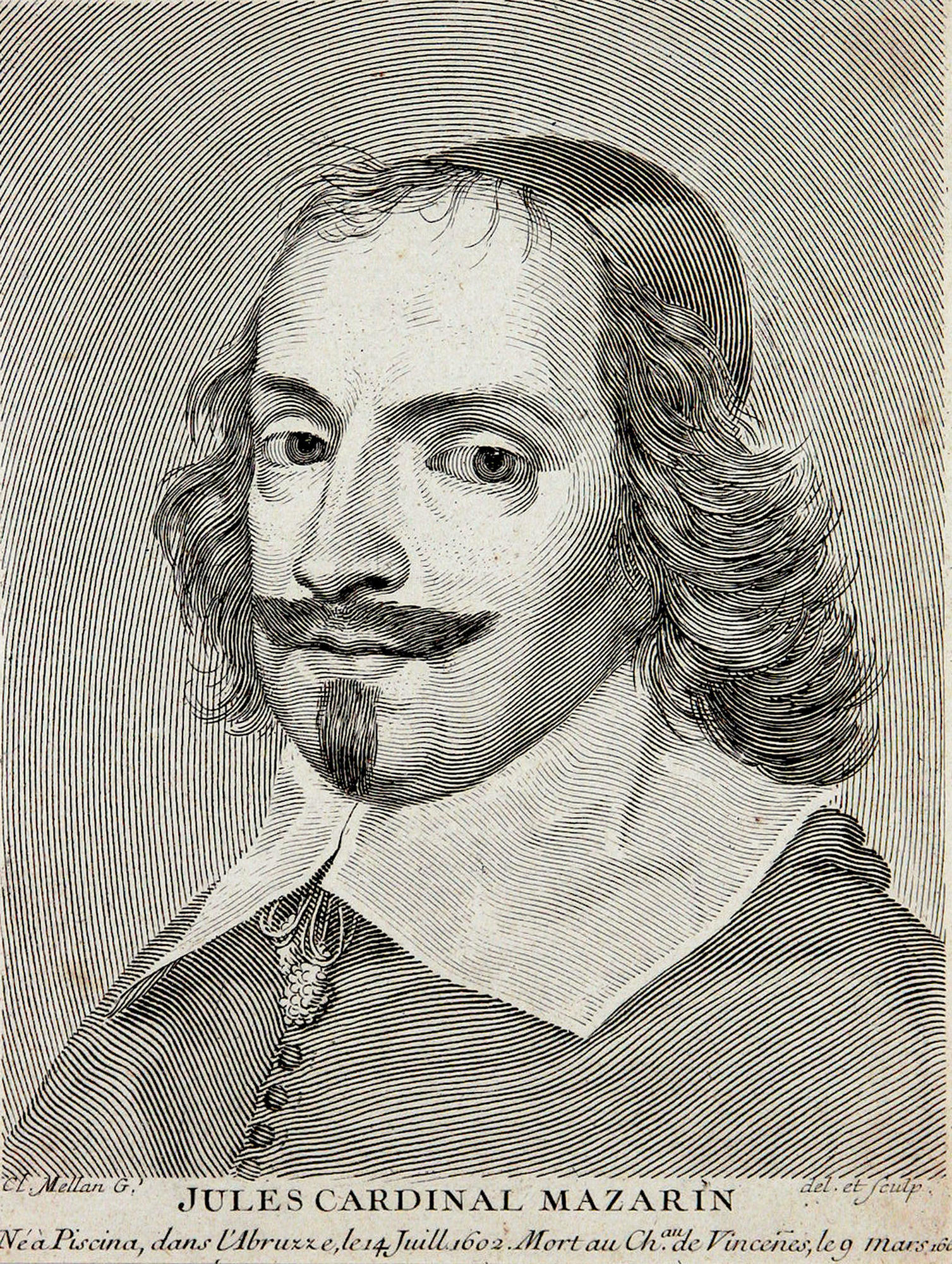


The Irbit Museum of Fine Arts presents a portrait of Cardinal Jules Mazarin by the outstanding French engraver Claude Mellan (1598–1688).
Mellan became famous for his portraits, in which he conveyed not only physical likeness but also the most subtle emotions with remarkable precision. His work is distinguished by lively expressiveness, intimacy, and poetic sensitivity — creating a sense of personal connection with the sitter. Among his distinguished patrons were members of the Bourbon royal family and prominent churchmen, including Cardinals Richelieu, Bentivoglio d’Aragona, and Mazarin.
Cardinal Jules Mazarin (born Giulio Raimondo Mazzarino; July 14, 1602 — March 9, 1661) was born into the family of Pietro Mazzarino, a member of the Sicilian branch of a noble Italian family. He spent his childhood in Rome, where he received his early education, and later studied in Spain. Upon returning to Rome, Mazarin began his ecclesiastical and diplomatic career, becoming a novice at the papal court in 1624 and soon rising to prominence as a skilled negotiator.
In 1630, Mazarin participated in negotiations with Cardinal Richelieu, helping to broker a truce between France and Spain in 1631. A close professional — and eventually personal — relationship developed between the two cardinals. Mazarin first visited France in 1634 and his diplomatic talents impressed King Louis XIII. In 1638, the king recommended him for the cardinalate, and Mazarin was granted French citizenship. On December 16, 1641, at the urging of the ailing Richelieu, Pope Urban VIII elevated him to the rank of cardinal.
Following the deaths of Richelieu (1642) and Louis XIII (1643), Mazarin was appointed chief minister by the regent, Anne of Austria, who ruled on behalf of her young son, Louis XIV. In foreign policy, Mazarin achieved remarkable successes: he concluded the Peace of Westphalia (1648), ending the Thirty Years’ War; forged an alliance with Oliver Cromwell’s England (1655); and secured the Peace of the Pyrenees with Spain (1659), which affirmed French dominance in Europe.
Domestically, however, his rule faced fierce opposition. Heavy taxation and centralizing reforms provoked the Fronde — a series of civil uprisings (1648–1653). In 1651, the Parliament of Paris declared Mazarin an “enemy of the state”, forcing him into temporary exile. After the Fronde was suppressed, he returned to power and remained first minister until his death.
Mazarin died on March 9, 1661, at the Château de Vincennes. His passing marked the end of the era of cardinal-ministers: Louis XIV, then 22 years old, immediately announced the beginning of his personal rule, famously declaring that he would be his own chief minister.
In literature, Mazarin is often depicted as a shrewd, calculating, yet highly capable statesman — most notably in Alexandre Dumas’s novel “Twenty Years After”, the sequel to “The Three Musketeers”. While the novel dramatizes many events and relationships, it reflects the enduring perception of Mazarin as a master of political intrigue.