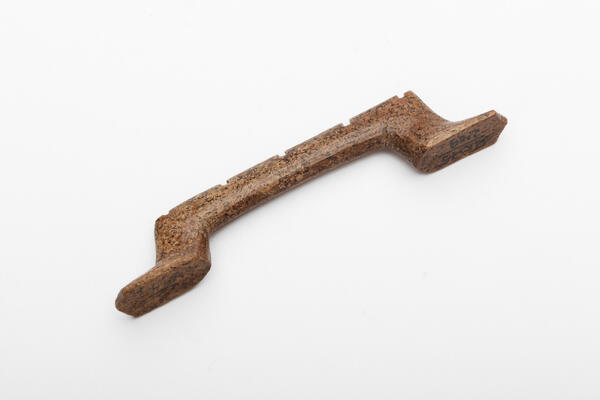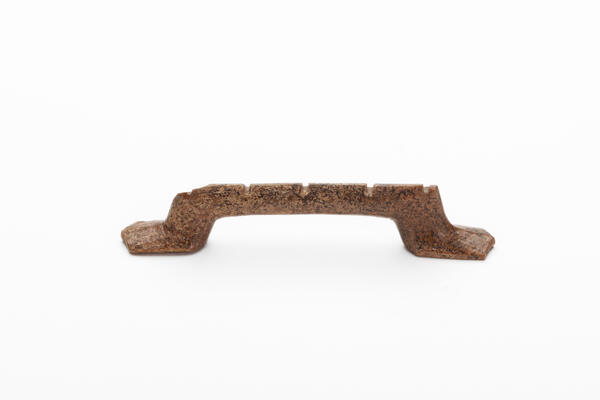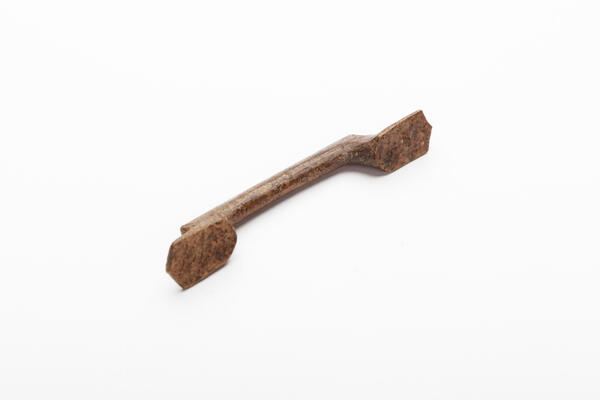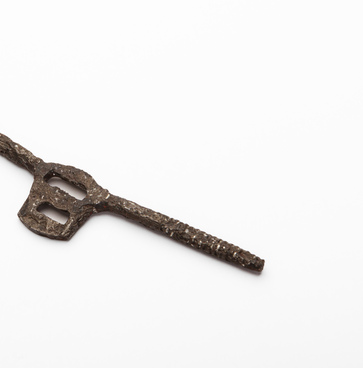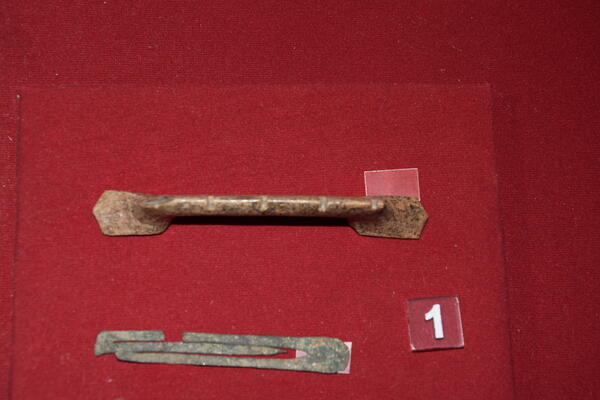
In the Middle Ages, people in Idnakar played stringed musical instruments during prayers and on holidays. During excavations in the middle section of the site, a five-string bridge was found in a layer that was formed in the 10th century. A similar device was found once before — in 1993, during the studies of the site. A hole in one of the legs makes the presented bridge resemble the head of a pike — a predatory fish.
It is still impossible to establish exactly what a stringed musical instrument was like in Udmurtia a thousand years ago. Some scientists claim that it was a boat-shaped plucked string instrument called krez pyzh. It has been reconstructed and can nowadays be heard at concerts given by national musical groups of Udmurtia.
Experts in musical antiquities from Veliky Novgorod believe that the bridge found at the Idnakar site is identical to the element of the Mansi musical instrument called sankvyltap. The Khanty call this same stringed instrument nars-yukh (also known as Siberian lyre). The Chepetsk population and the Ob-Ugric tribes have a common ancestral origin, so such coincidences are quite possible.
Traditionally, sankvyltap and nars-yukh were made by hollowing. Men made instruments for themselves or their family members. Wood was hollowed out from a solid piece of spruce or cedar until the future instrument took the shape of a boat with a protruding bow or, less commonly, the shape of a fish.
The strings of the instruments of the Ob-Ugric tribes were made from deer tendons soaked in glue, as well as elk or deer intestines. They were tied into a knot on the “bow” part at one end and then secured to the “stern” crossbar using wooden pegs or bird bones.
The instruments could be large and reach 130 centimeters in length and 30 in width, but at the same time had a depth of only 5–7 centimeters. The “Ob gusli” was played only by men: they sat on the floor with their legs crossed, with one side of the instrument resting on the hips and the other — on the body. In general, the restored Udmurt musical instrument bears a resemblance to that of the peoples of the North, but their playing styles are fundamentally different.