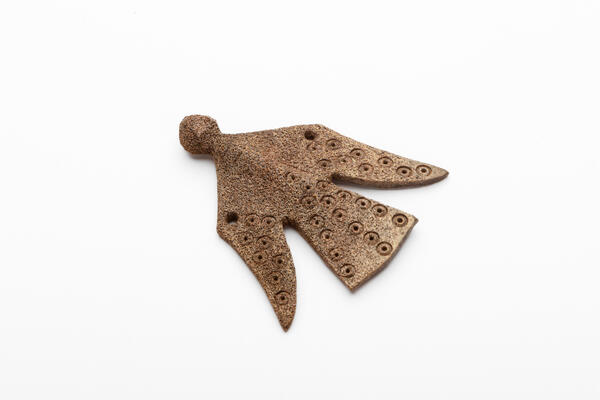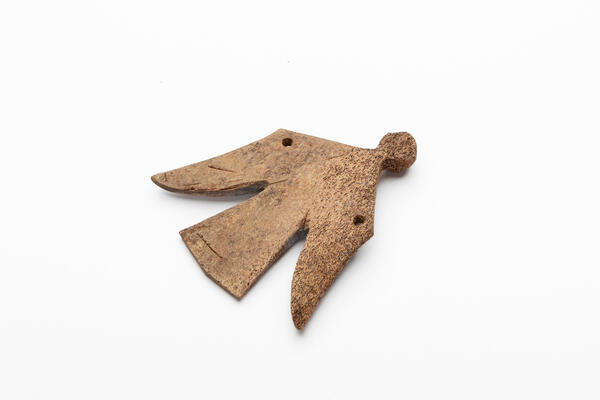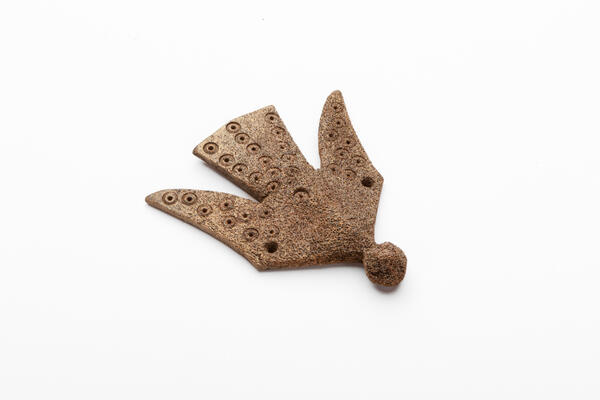
A bird-shaped pendant carved from bone was found in 2012 during a study of the Kushman hillfort (Uchkakar) in Udmurtia. The figurine’s wings are lowered, the tail is widened, the front side is decorated with a circular pattern, and the shoulders have holes for a cord.
The image of a bird is typical of the iconic bronze casting in the Perm zoomorphic style; however, this pendant is made of bone, not metal. This product is one of a kind and goes to show that the populations of the Cheptsa basin and the Perm region had close trade relations and similar cultures.
The image of a waterbird is central to the Perm zoomorphic style. For many peoples, the duck is the main character in their creation myths: its eggs produced two supreme deities, who picked the light or the dark side. According to legend, the land was formed from a pinch of earth that a duck picked up in its beak from the bottom of the first ocean.
The image of a bird has been traditionally viewed as a female amulet and a symbol of fertility and household prosperity. The indigenous peoples of Siberia, the Trans-Urals, the Prikamye region and the North of Russia used the sacral pattern of duck feet in women’s clothing; jewelry and noise-making pendants were shaped like duck feet and believed to be amulets for protection against evil spirits.
The bird is also a basic symbol of the other world; it was often compared to the transition of the human soul to another dimension after death since heaven has long been considered the abode of the gods. The Perm zoomorphic style is based on a synthesis of images of humans and animals, such as bears, elks, lizards and birds. It symbolizes the unity of the three worlds and the way people connect with the world around them.
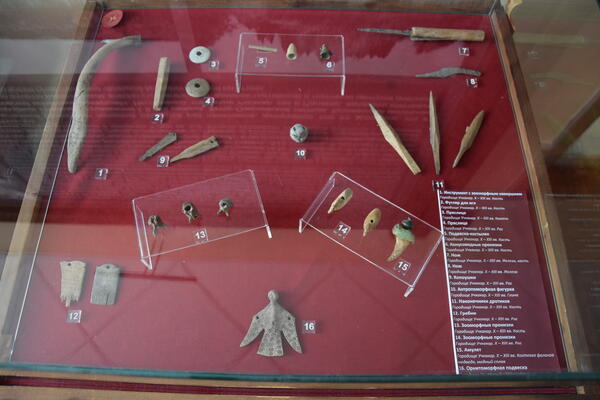
In 2019, future restorers — students at Kazan Federal University — did their internship at the Idnakar Museum-Reserve of History and Culture. A pendant from the Kushman settlement, which is displayed in the permanent exhibition of the museum, was also examined. It was concluded that the item is at risk of crumbling completely because of the porous structure of the bone. The valuable exhibit is now being prepared for restoration.